The football card market is showing a sharper competitive edge heading into Week 11, and Joe Burrow has become one of the clearest focal points. In a season-long card portfolio contest built around waiver claims and percentage gains, recent moves suggest collectors and competitors alike are zeroing in on players with momentum, favorable late-season narratives, and room to climb before the playoff push.
That shift has been especially noticeable in Burrow’s market. As his on-field case strengthens, his cards have drawn increased attention from participants looking for upside at a critical point in the competition. With the standings tightening and waiver activity ramping up after a quieter stretch, each move now carries more weight, both in weekly positioning and in the broader read on where the hobby sees value.
How the contest works
The format is straightforward but revealing from a market perspective. Ten participants each manage a portfolio of five football cards. Like fantasy football, they can use waiver opportunities throughout the season and into the playoffs to swap out cards and chase better performance. The winner is determined by the highest overall percentage gain across the season.
That setup turns every pickup into a real-time market statement. Participants are not just betting on players. They are betting on timing, liquidity, recent sales data, and how quickly sentiment can change when a player catches momentum. As the NFL calendar moves deeper into the season, those variables become even more important because there is less time for a slow-developing hold to recover.
For more collector background, read Joe Morgan Collection Draws Strong Prices at Louisville Slugger Museum Auction.
Week 11 standings show how important timing has become
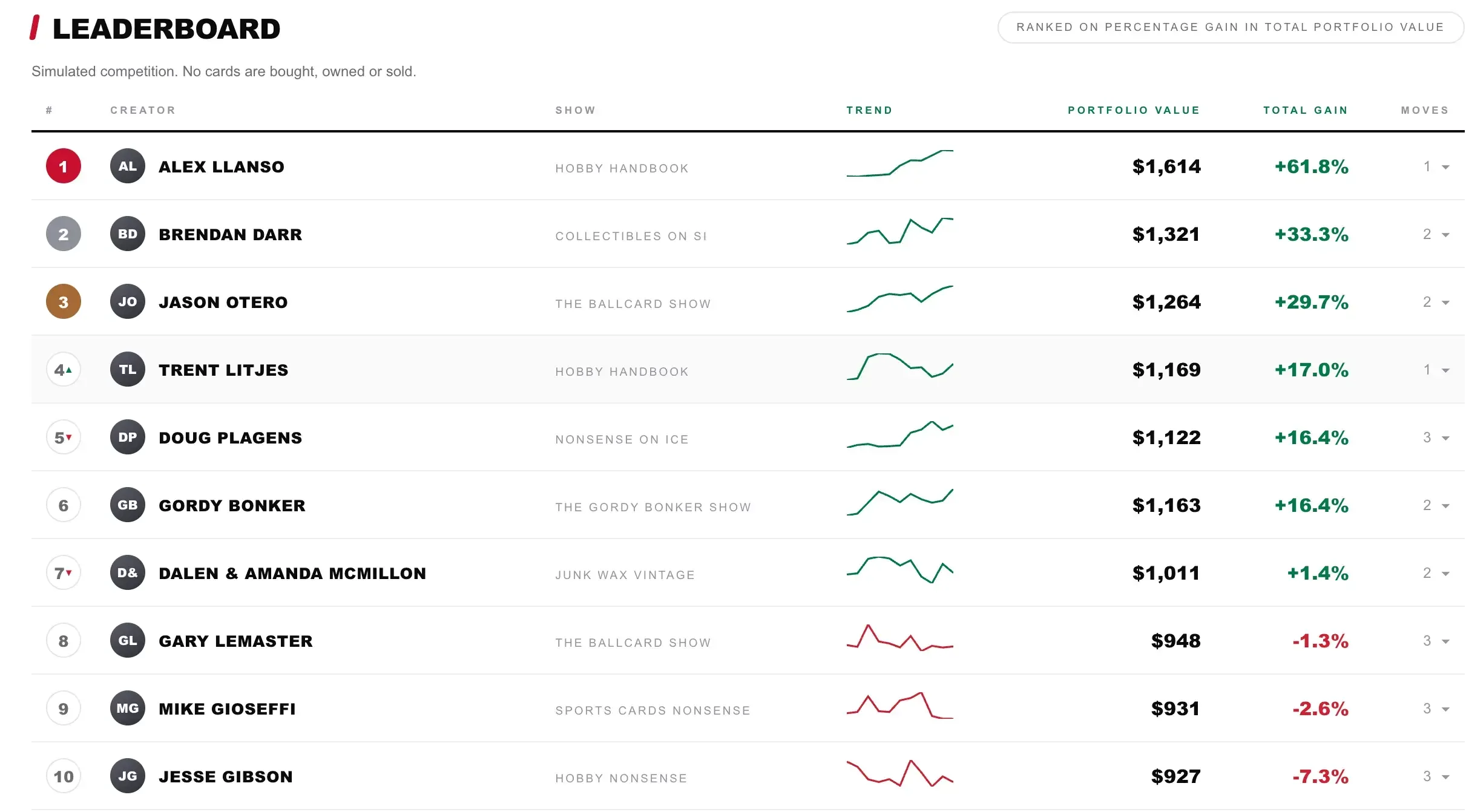
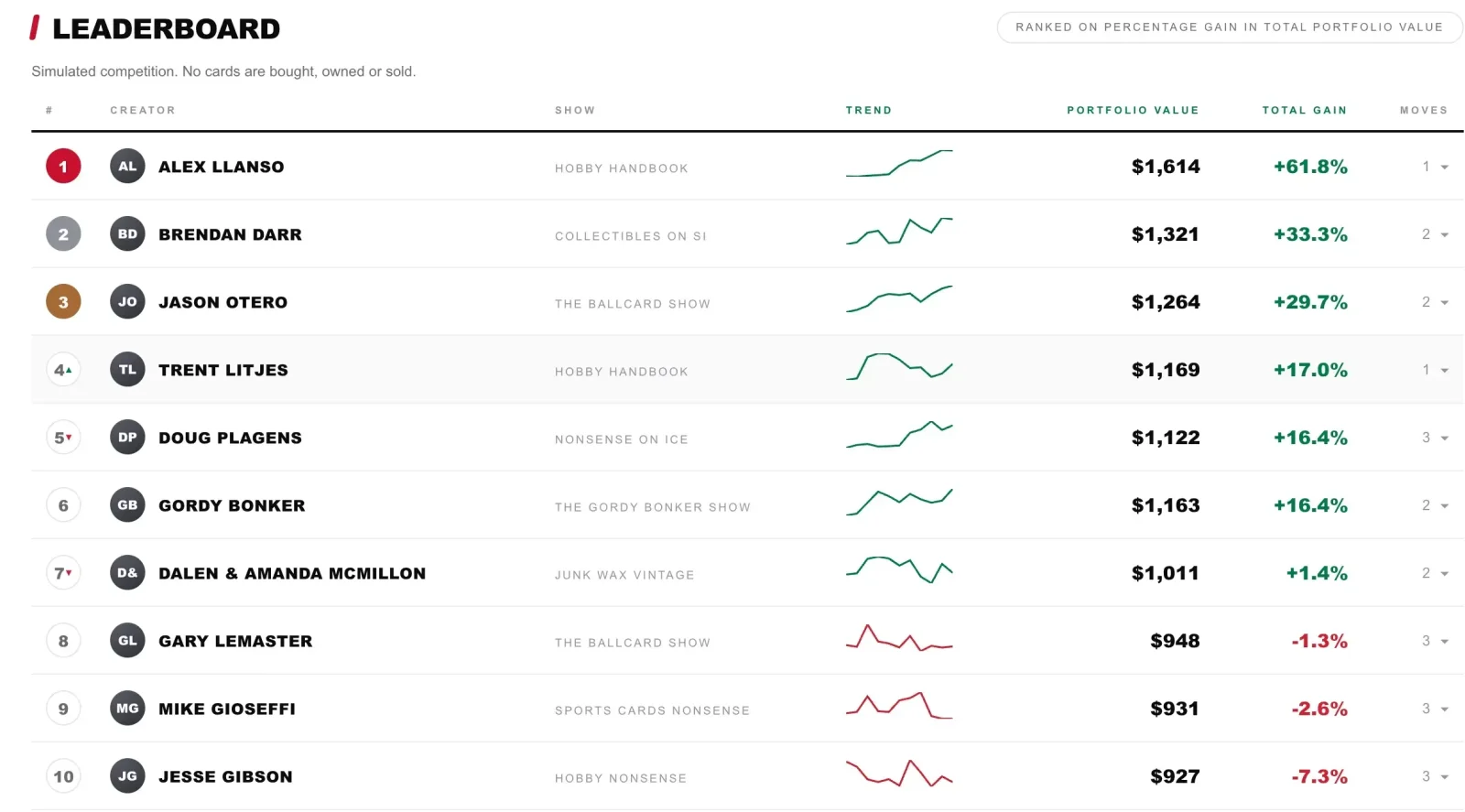
The latest standings entering Week 11 show a contest that is still very much in motion. Alex Llanso remains in first place after a sustained run at the top, helped by strong timing on several key moves. A major part of that success has come from navigating in and out of hot names at the right moment rather than sitting still while the market shifts.
Joe Burrow has been one of the most important names in that equation. Alongside other major quarterback targets such as Caleb Williams and Josh Allen, Burrow has been part of the strategy mix for participants who have managed to stay ahead of market swings. In a format based on percentage growth, being early matters just as much as being right.
The standings also featured movement behind the leader. Trent Litjes climbed from seventh to fourth, signaling how quickly the board can change with one or two successful calls. Gordy and Doug also turned in solid weeks, even if the gains were not enough to leapfrog every rival. Jason Otero made one of the more notable jumps as well, holding onto a podium spot while narrowing the gap near the top.
For another perspective on this story, read SCN Challenge Week 11: Joe Burrow Gains Steam as Waiver Debate Intensifies.
Those shifts underline a bigger hobby truth. In-season football card markets can move fast when buyers start to concentrate around MVP candidates, playoff quarterbacks, or players tied to nationally visible matchups. A portfolio that looks quiet one week can become highly active the next if the right player gets hot.
Joe Burrow is becoming a clear late-season target
Burrow’s appeal at this stage is easy to understand. He has built serious momentum in the MVP conversation, and the combination of individual production, narrative strength, and prime-time visibility makes him one of the most attractive football card names on the board right now.
That matters because hobby demand is rarely driven by stat lines alone. Collectors react to moments, headlines, and spotlight games. A quarterback with MVP buzz heading into a high-profile matchup is the kind of player who can generate a short-term surge in attention, especially if buyers believe more upside is still available.
Participants in the challenge appear to be reading the market that way. Multiple managers have invested in Burrow over the last few weeks, a sign that his card market is not being treated as a one-off spike but as a broader trend with room to run. When several experienced competitors start leaning toward the same player at the same time, it often reflects growing confidence in both the player and the market around him.
The biggest Week 10 waiver move centered on Burrow
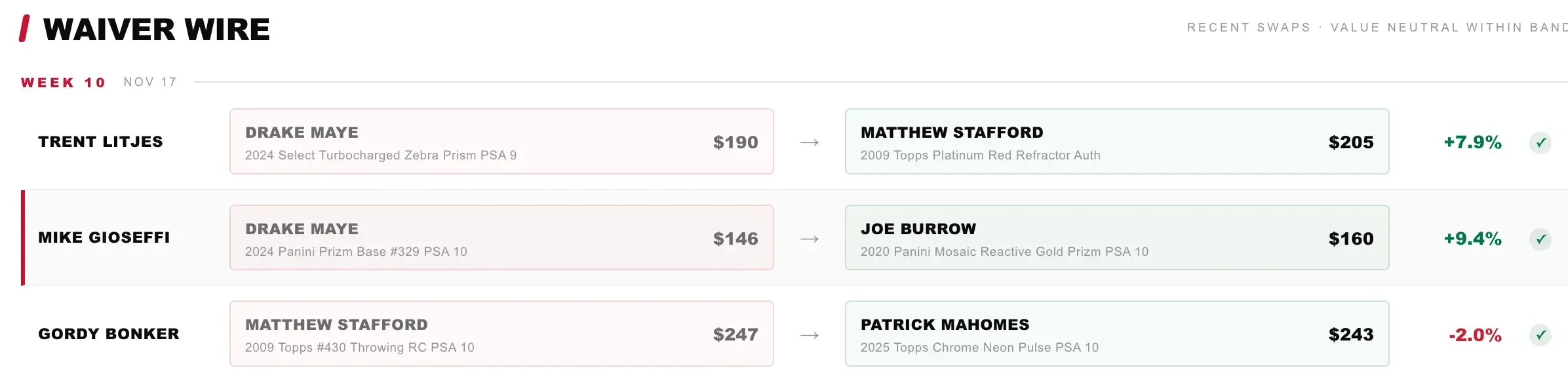
The headline transaction from the latest waiver period was a direct move into Joe Burrow. Mike Gioseffi, after waiting much of the season to make a change, swapped out Drake Maye for Burrow. In a contest where inactivity can be costly, that was a meaningful pivot.
The move says a lot about current sentiment. Maye represents developmental upside and future intrigue, but Burrow offers immediate relevance. At this point in the season, that distinction matters. Managers chasing gains before the playoffs are under more pressure to find cards tied to players who can move now, not just eventually.
From a market standpoint, Burrow checks nearly every box that matters late in the NFL season. He has name recognition, a strong collector base, high-end card ecosystem support, and enough current buzz to trigger new buying interest. That combination makes him a natural target in any performance-based hobby contest.
Controversy over old sales data highlights a key card market problem
The most debated waiver move of the week did not involve Burrow, but it did spotlight a major issue that impacts any card-based competition: how to handle stale or limited sales data.
Trent Litjes was allowed to exchange Drake Maye for a Matt Stafford card whose last recorded sale dated back to 2022. The move drew criticism because the card was reportedly active at auction with bidding already well above that older comp level. In other words, the replacement value being used for the transaction may not have reflected the true current market.
That dispute cuts to the heart of modern card pricing. Last sales are useful, but they are not always enough. Thinly traded cards, especially niche parallels or low-pop graded copies, can sit dormant for long stretches. When they finally reappear, the old comp may have little relevance to the actual price buyers are willing to pay.
For collectors outside the contest, this is a familiar challenge. A stale sale can make a card look cheaper than it really is. It can also distort performance if a market-tracking format leans too heavily on outdated numbers. In a fast-moving sport like football, where player value can swing sharply in a matter of weeks, price discovery becomes one of the hardest parts of evaluating true market position.
Tyler Shough’s market shows the risk of low-pop cards without liquidity
Another useful lesson from the challenge comes from Tyler Shough, whose market has become a case study in how scarcity does not automatically produce healthy value movement.
One of the more closely watched cards in the contest is a Tyler Shough Teal Refractor /199 PSA 10. Despite the card’s scarcity, the problem has been a lack of meaningful sales data. Only eight copies have reportedly been graded, including just two PSA 10s and two PSA 9s. With so few public transactions, establishing a stable market value becomes difficult.
That has left the card effectively stuck. Even if comparable versions of the card family are showing stronger prices, the absence of direct sales can drag down the visible value in a competition setting. A standard refractor example reportedly last sold for $200, suggesting the Teal Refractor could look less severe on paper if more recent or better-aligned comps existed. Instead, the limited data environment has magnified the downside.
This is an important reminder for collectors chasing ultra-low population cards. Scarcity can be powerful, but liquidity matters too. A card with almost no sales history may be genuinely desirable and still underperform in practical pricing because there are not enough transactions to support quick value recognition.
Why late-season football card strategy often shifts toward quarterbacks
The current waiver activity also reflects a broader seasonal tendency in the hobby. As the NFL playoff race takes shape, quarterback cards usually become the center of attention. They are easier for the market to rally around, and they carry the clearest path to hobby-defining moments through nationally televised games, MVP races, and postseason wins.
That pattern helps explain the renewed interest in Burrow and the willingness to make aggressive swaps now instead of waiting. The window for major in-season football card gains can be narrow. Once the playoffs begin, market reactions often become even sharper, rewarding participants who positioned themselves before the rush rather than during it.
In that context, Burrow looks like a textbook buy for anyone prioritizing immediate relevance. He has star power, hobby familiarity, and a late-season narrative that can accelerate quickly if the on-field results keep coming.
Another roster decision may be coming soon
One more storyline to watch involves Puka Nacua. After an unusual week that included suspension-related discussion while he was already on injured reserve, he was ultimately ruled out for the season following MCL surgery. That development leaves his lone holder in the contest facing another likely roster adjustment.
For the challenge, that means at least one more meaningful decision may be on the way. For collectors, it is another example of how fragile football card momentum can be. Injury news can halt a promising market almost instantly, especially in a season-long format where managers cannot afford to wait out long recoveries.
With Week 11 arriving and the playoff picture coming into sharper focus, the card market signals from this contest are getting easier to read. Managers are showing a growing preference for proven quarterbacks, actionable market data, and players with immediate upside. Right now, Joe Burrow sits near the center of all three trends, and that is why his card market is drawing so much attention at this stage of the season.
Photo Gallery