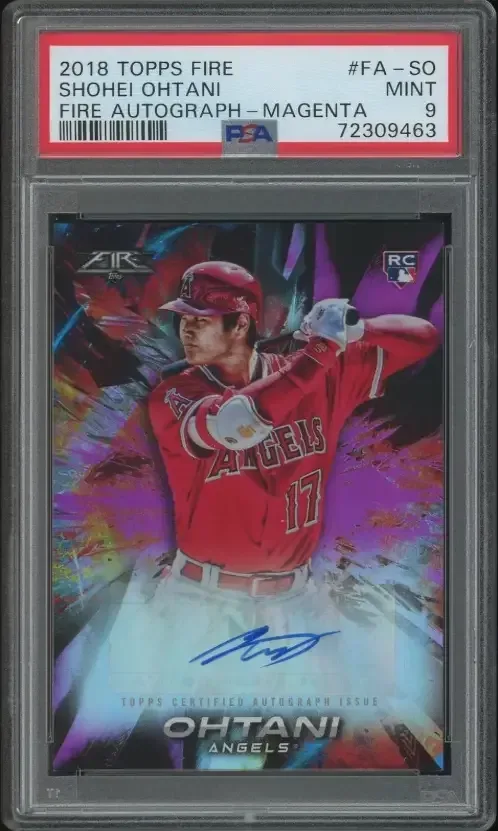
Topps Fire never carried the same hobby status as flagship Topps releases, Chrome, or the most premium autograph-driven products. Even so, the brand built a loyal following thanks to its aggressive artwork, bright color treatments, and accessible box format. For many collectors, it was the flashy outlier on the shelf, a product that looked different from nearly everything else in the baseball card market.
That identity has helped the set age well. After Topps Fire ended with its 2022 release, interest in the brand began to shift. What was once seen as a lower-cost rip with bold design has turned into a retired product line with a cult following, especially when star rookies and scarce autograph content are involved.
The biggest proof is on the high-end sales side. The strongest Topps Fire results are not just respectable for a mid-tier brand. They are major numbers, driven by iconic rookies, low serial numbering, one-of-one scarcity, and condition-sensitive graded copies. Here are the Top 3 Topps Fire baseball sales ever recorded from the supplied sales data.
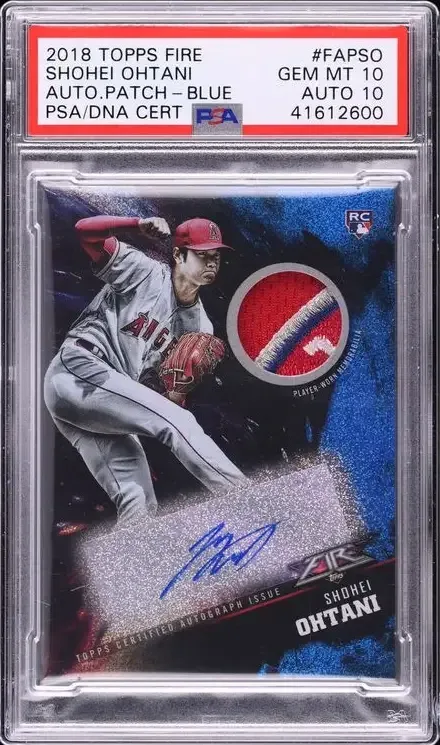
No. 3: 2018 Topps Fire Shohei Ohtani Blue Autograph Patch /15 PSA 10 sold for $20,400
The third-highest sale in Topps Fire baseball history belongs to one of the most desirable player and product combinations of the modern era: a Shohei Ohtani rookie patch autograph from 2018. This particular copy is the Blue parallel, serial-numbered to 15, and graded PSA 10 with a Gem Mint 10 autograph.
For more collector background, read Top 3 Sports Card Sales of the Week: Lionel Messi, Stephen Curry, and Babe Ruth Lead the Market.
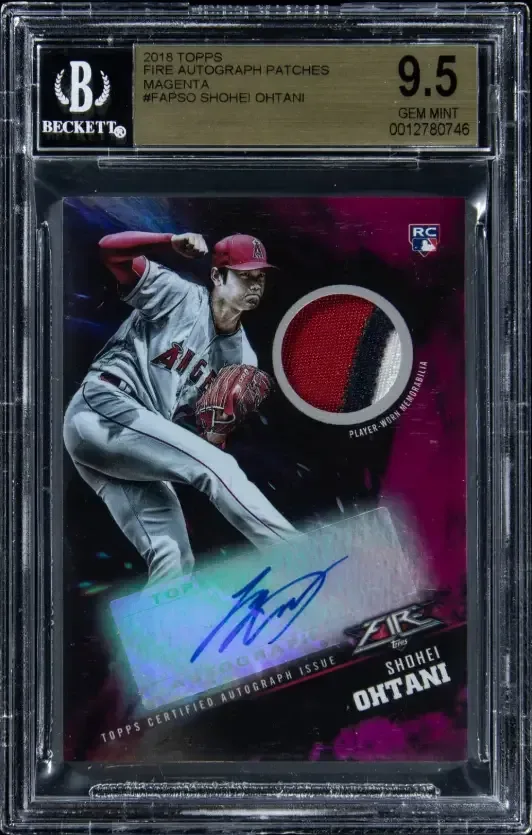
Ohtani rookie cards already sit in a category of their own, but Topps Fire gives this one a different visual identity than the cleaner, more traditional rookie releases from the same season. The card uses Fire's stylized design language while still delivering the content collectors chase most aggressively: a rookie autograph, a patch window, and low numbering.
The patch itself adds another layer of appeal. The reported example features a multicolor swatch with red, white, blue, and silver, giving it stronger eye appeal than a standard single-color relic. For collectors in the modern market, that matters. When a card already has the right player, rookie-year status, and autograph, a premium patch can separate a good card from a centerpiece card.
This PSA 10 example sold on March 15, 2026, via auction for $20,400. The sale reportedly drew 57 bids, a sign that demand was broad rather than limited to a single buyer stepping up early. Competitive bidding often says as much about a card's market strength as the hammer price itself, and this was one of the clearest examples in the Topps Fire sales record.
The card's tracked value later moved significantly higher, with a listed figure of $35,450 in the supplied sales data. That jump reinforces an important point about Topps Fire's best cards: collectors are no longer treating them as novelty pieces from a discontinued product. The top Ohtani cards from the set are being evaluated more like legitimate modern rookie grails within a niche brand.
There is also a scarcity advantage here that should not be overlooked. A rookie patch autograph numbered to 15 is already a very tight supply for one of the hobby's biggest stars. Add in a PSA 10 holder and a clean autograph grade, and the pool narrows even more. That combination of star power, grade, and scarcity is exactly what pushes a retired product into serious collector territory.
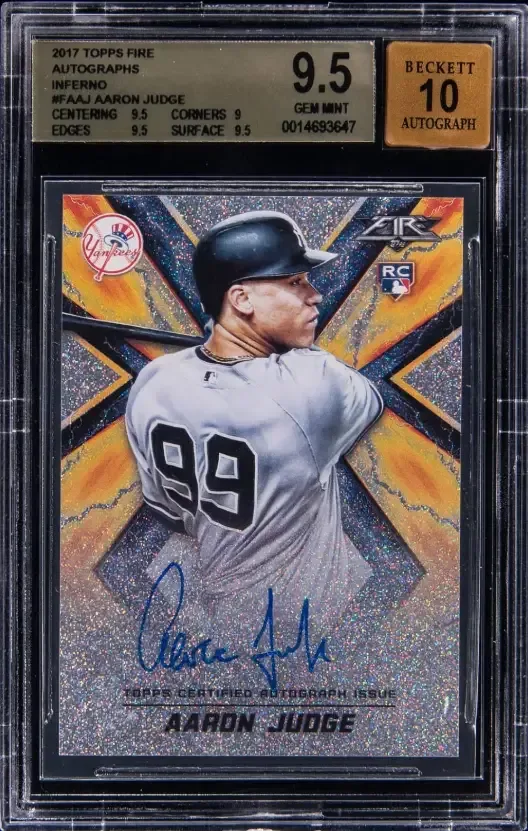
No. 2: 2017 Topps Fire Aaron Judge Inferno Autograph 1/1 BGS 9.5 sold for $47,580
Second on the all-time Topps Fire list is a monster Aaron Judge rookie: the 2017 Topps Fire Inferno Autograph 1/1, graded BGS 9.5 with a 10 autograph. It sold for $47,580 on May 9, 2026, making it one of the most important cards ever produced in the brand's run.
Judge's 2017 rookie cards continue to carry weight across the hobby, and the one-of-one status here immediately puts this card in elite company within the Fire product line. The Inferno designation represents the top scarcity tier, and in this case it delivered the kind of true hobby trophy that can elevate an entire brand's reputation.
Visually, Inferno cards stand apart from the standard release. The finish has been described as a speckled or mini-diamond style surface, giving the card a distinctive premium look that fits the Fire name well. On a product known for dramatic aesthetics, this parallel pushes the concept even further. That matters because when collectors chase one-of-ones, they often want the card to look unmistakably special at first glance. This one checks that box.
The grade is another major part of the story. A BGS 9.5 on a one-of-one modern autograph rookie is a substantial result, especially in a product with design elements and surfaces that can be less forgiving than plainer releases. The autograph 10 adds another confidence point for buyers who want a complete premium presentation.
The sale reportedly took place through a major auction format and drew 22 bids. For a one-of-one Judge rookie autograph from a retired product, that level of activity supports the final number. Buyers were not just paying for rarity. They were paying for the exact intersection of player importance, rookie-year timing, serial uniqueness, and a high grade from Beckett Grading Services.
The supplied market data later pegged the card's value at $37,960, which sits below the sale price. That difference does not diminish the significance of the result. One-of-one cards are notoriously difficult to price with precision because there are no true direct comps. A singular card can bring a premium simply because two determined buyers decide that the opportunity may not return anytime soon. With a player like Judge, that dynamic becomes even stronger.
This sale also says something broader about the Fire brand. A discontinued mid-level set producing a nearly $50,000 result for an Aaron Judge rookie auto shows that collectors are willing to separate flagship prestige from individual-card appeal. When a card is rare enough and tied to the right player, the logo on the box matters less than many people assume.
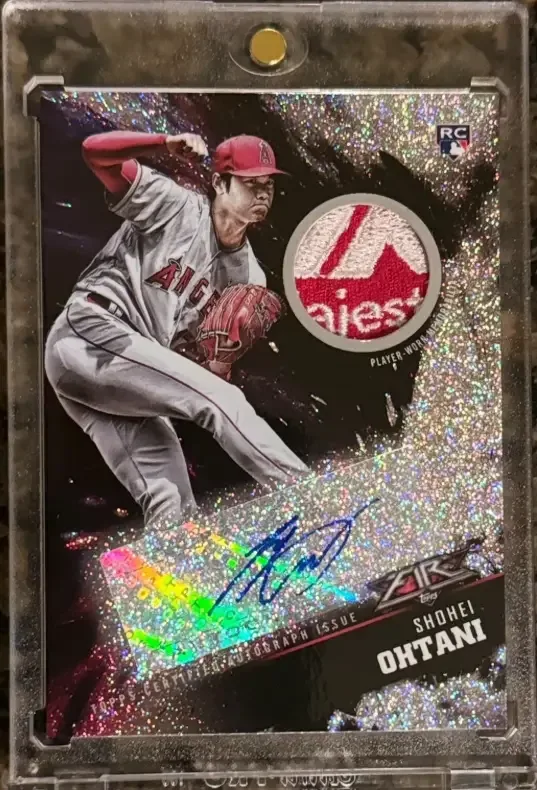
No. 1: 2018 Topps Fire Shohei Ohtani Inferno Autograph Patch 1/1 sold for $60,000
The top spot belongs to Shohei Ohtani, whose 2018 Topps Fire Inferno rookie autograph patch 1/1 reached $60,000 on April 27, 2026. Among all reported Topps Fire baseball sales in the provided data set, nothing has sold for more.
It is easy to see why this card stands above the rest. It combines nearly every modern hobby driver in one package: a transcendent rookie, a one-of-one print run, an autograph, and a patch. When those elements appear together on a single card from a memorable rookie season, collectors are not just buying a Fire card. They are buying one of the most concentrated forms of Ohtani scarcity from a licensed 2018 release.
Unlike the other two cards in this Top 3, this example was reported as ungraded at the time of sale. That makes the result even more notable. High-end modern cards often realize their strongest prices in PSA or BGS holders because the grade reduces uncertainty. For this card to hit $60,000 raw indicates just how powerful the underlying content was. Buyers did not need a slab to understand the significance of a one-of-one Ohtani rookie autograph patch from a retired Topps brand.
The sales data also notes that the transaction was completed via best offer rather than a traditional auction. That stands out because six-figure and near-six-figure caliber modern cards often move publicly through competitive bidding. A best-offer structure suggests a direct negotiation where the buyer and seller met at a level both considered fair for a unique asset.
What happened after the sale may be just as important. The tracked value later moved above $80,000, showing that the market continued to view the card favorably after the transaction closed. That kind of post-sale strength is not guaranteed, especially for niche-brand cards. In this case, it points to the durability of premium Ohtani demand and to a growing respect for the strongest Fire pieces.
There is also a symbolic angle to this result. Ohtani has become the defining player for many modern-era collectors, and 2018 remains one of the most important rookie seasons in the current card market. A one-of-one autograph patch from that year has built-in demand regardless of brand, but the Fire label gives it an added degree of individuality. It is not the standard Ohtani chase card that every collector expects to see. It is rarer, louder, and more product-specific, which can make it even more attractive to advanced collectors hunting cards that stand apart.
For the Fire brand itself, this $60,000 sale functions like a benchmark. It establishes that the very best cards from the product are capable of competing in a far more serious market tier than many hobby watchers once would have projected.
Why Topps Fire's best cards keep gaining attention
The three biggest Topps Fire sales share a clear pattern. Every card is tied to a foundational modern star. Every card is either a one-of-one or a very low-numbered autograph patch rookie. Every card also offers a strong visual identity that feels distinct from more conventional releases.
That combination is important because discontinued products often become more collectible when they fill a design niche that no other brand fully replaces. Topps Fire was never trying to look traditional. Its style was bold, abstract, and immediately recognizable. For some collectors that limited mass appeal during its active run, but in the secondary market it can become an asset. Cards that are instantly identifiable tend to carve out loyal followings, especially when paired with stars like Ohtani and Judge.
The retirement of the brand after 2022 has likely added to that effect. Once a product line ends, the total supply becomes fixed forever, and interest can shift from box-breaking value to legacy value. Collectors start asking different questions: Which rookies mattered most in this brand? Which parallels defined the set? Which one-of-ones became hobby landmarks? The three sales here provide strong answers.
Another key detail is that all three cards sit at the intersection of player collecting and set collecting. An Ohtani supercollector can chase these because they are elite Ohtani rookies. A Fire specialist can chase them because they are among the best cards the product ever made. That dual appeal helps support prices at the top end.
As the market keeps sorting modern brands into long-term winners and short-lived experiments, Topps Fire's headline sales suggest that its best cards have already secured a place in the conversation. The biggest cards from the run are not just surviving on nostalgia. They are attracting real money, competitive bidding, and rising valuations, especially when the checklist lines up with generational talent and true scarcity.
Photo Gallery