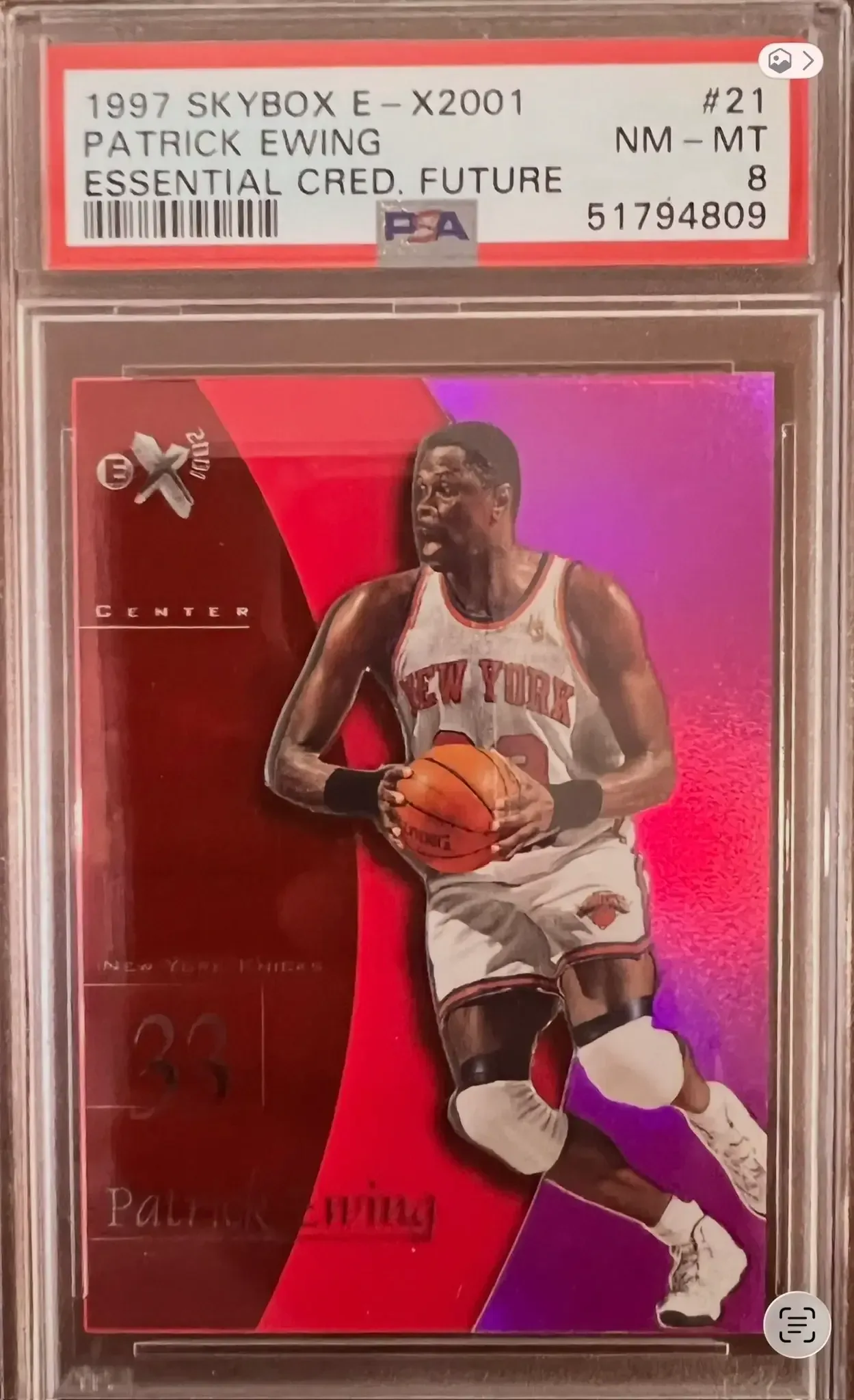
Patrick Ewing has one of the deepest hobby catalogs of any Hall of Fame big man from the modern era, and the cards that tend to rise above the rest usually combine three things: recognizable design, genuine scarcity and proven market strength. While Ewing has more than enough key issues to fill a long want list, a few cards consistently separate themselves when collectors talk about centerpiece-level examples.
These are the top 3 Patrick Ewing cards from the supplied group, chosen for their mix of hobby reputation, population profile and public sales performance. Each one reflects a different lane of Ewing collecting, from ultra-tough late-1990s parallels to a modern insert that still commands serious respect.
Top 3 Patrick Ewing Cards at a Glance
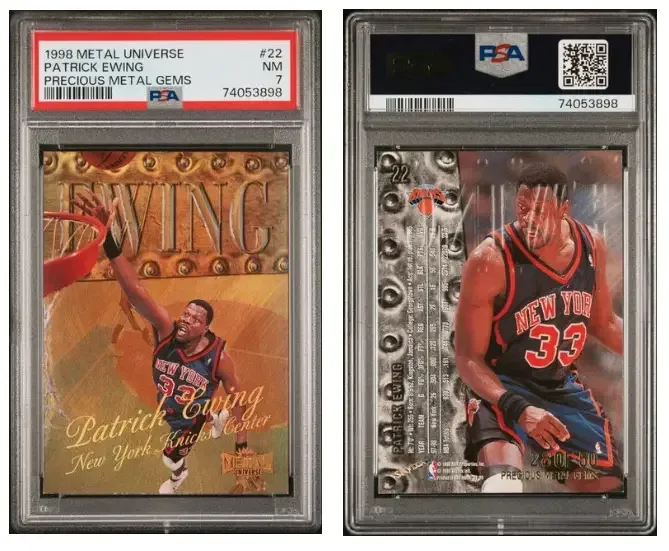
- 1998 Skybox Metal Universe Precious Metal Gems /50
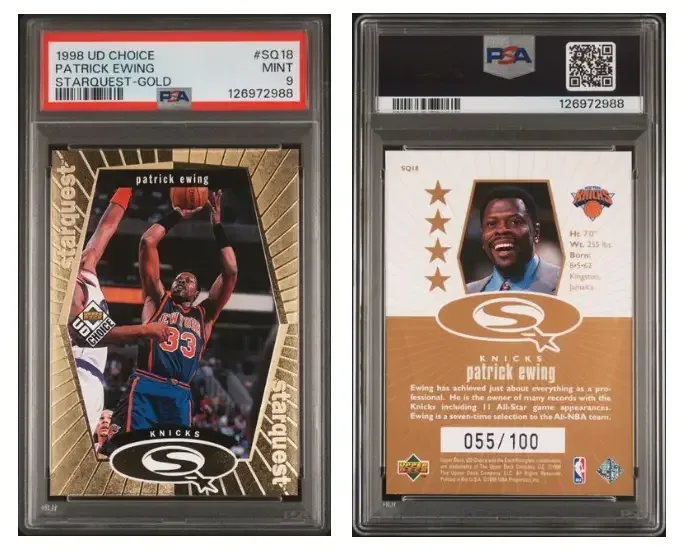
- 1998 Upper Deck Collector's Choice Starquest Gold /100
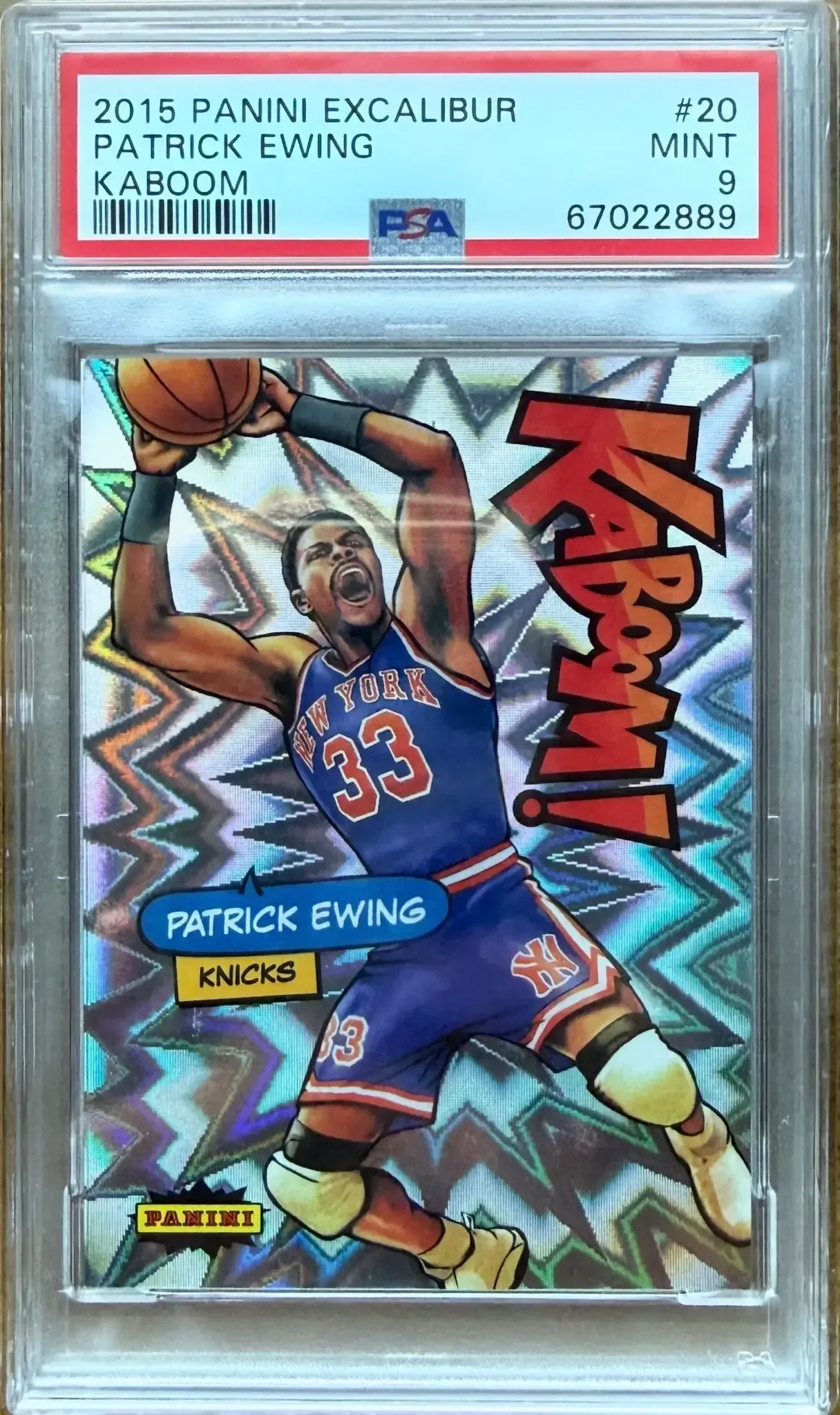
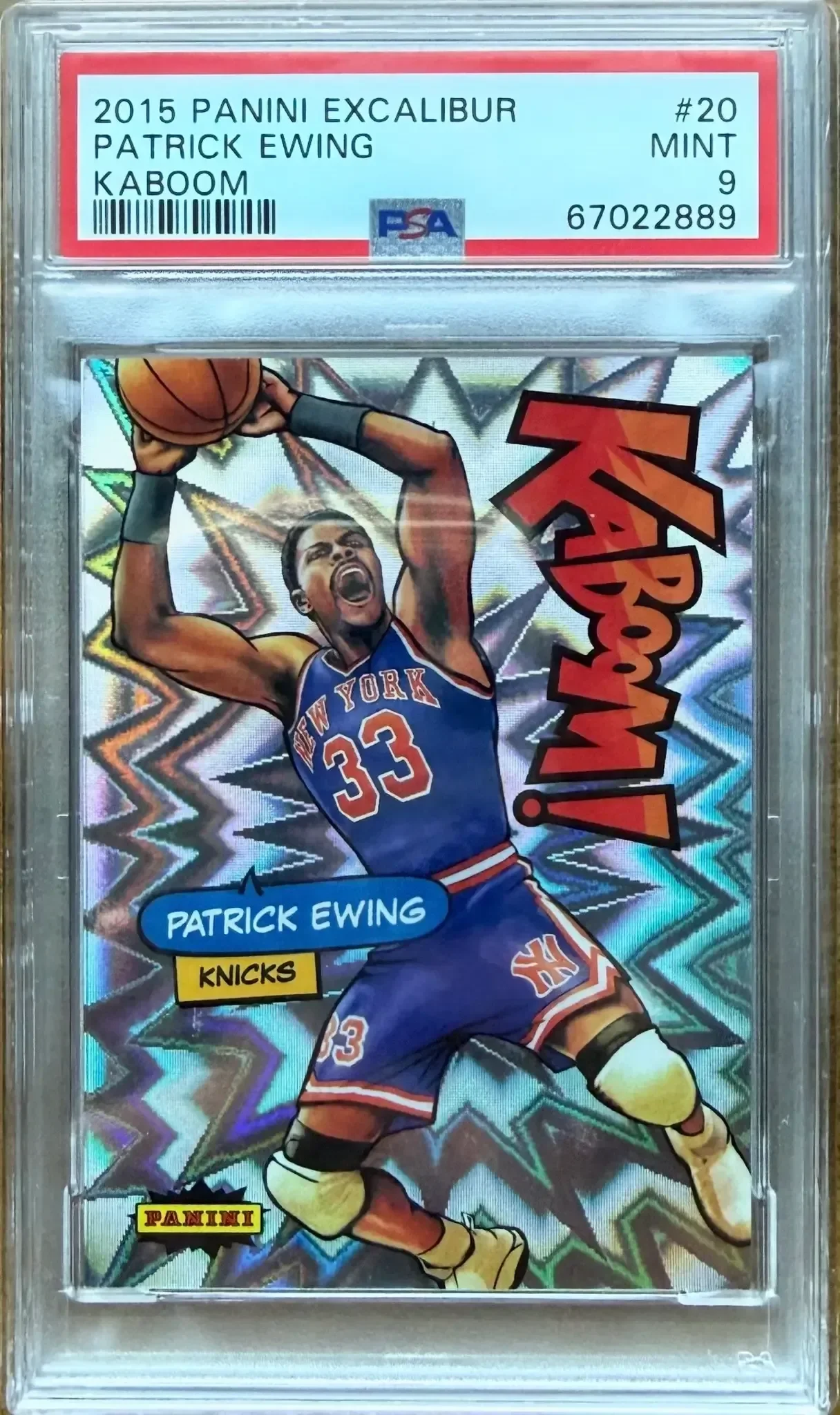
- 2015 Panini Excalibur Kaboom
1. 1998 Skybox Metal Universe Precious Metal Gems /50
If the goal is to identify the most iconic card in this group, the 1998 Skybox Metal Universe Precious Metal Gems /50 has the clearest claim. PMGs sit near the top of the hobby's hierarchy when it comes to late-1990s basketball parallels, and that status carries over to Patrick Ewing even in a market that often gives more attention to guards and wing stars.
The appeal starts with the set itself. Precious Metal Gems are one of the defining premium parallel concepts of the era, and the Metal Universe brand remains one of the most celebrated names from 1990s basketball collecting. For Ewing collectors, that combination creates a card that is not just rare, but culturally important within the hobby.
For more collector background, read 4 Iconic PSA 10 Rookie Cards From 1983 Topps Baseball Still Driving Collector Demand.
The population details help explain why this one stays so difficult. Among examples graded by PSA, there are no recorded grades above PSA 7. The available breakdown lists seven PSA 7s, four PSA 6s and one PSA 5. That means only 12 of the 50 copies have been graded by PSA based on the supplied data, a reminder of how infrequently these cards surface and how condition-sensitive they can be.
That condition story matters. A card can be scarce, but when even the best graded copies top out at PSA 7, collectors tend to treat high-end examples as trophy pieces rather than incremental upgrades. In practical terms, the grade ceiling increases the prestige of strong mid-grade holders because they effectively function as top-pop caliber cards in the marketplace.
Public sale history backs up the card's place at the top. The highest reported public sale for a PSA 7 was $13,000 on May 19, 2024. That price point is a strong indicator that Ewing's best PMG remains one of his true blue-chip cards. Even within a category loaded with famous names, a five-figure result for a PSA 7 shows just how much demand there is when one becomes available.
For another perspective on this story, read Vinny Di Meglio’s Five Standout Patrick Ewing Cards.
For collectors who specialize in Hall of Fame centers, Knicks legends or landmark 1990s inserts and parallels, this is the kind of card that can define an entire player run. It checks every box: visually memorable, serial-numbered, notoriously tough and supported by a sale level that confirms its importance.
Why it stands out
- Set prestige: Precious Metal Gems remains one of the hobby's signature parallel lines.
- Serial number: Limited to 50 copies.
- Population strength: No PSA examples higher than PSA 7 were noted.
- Market proof: A PSA 7 reached $13,000 in a public sale.
2. 1998 Upper Deck Collector's Choice Starquest Gold /100
The second spot goes to the 1998 Upper Deck Collector's Choice Starquest Gold /100, a card that blends extreme graded scarcity with a market profile that can surprise collectors who only know Ewing through his mainstream base and rookie cards.
Starquest Gold has a different personality than PMG. It does not carry the same universal hobby mythology, but for player collectors and 1990s parallel chasers, it offers a strong mix of scarcity and eye appeal. The issue is limited to 100 copies, and the certified population supplied here is remarkably thin. PSA has just one PSA 10, two PSA 9s and one PSA 8 recorded.
That kind of distribution makes every high-grade copy meaningful. With only two PSA 9s listed and no public sale of the lone PSA 10 noted in the supplied data, the PSA 9 effectively becomes the grade level most collectors can actually track in the open market. When supply is this tight, a single sale can reset expectations quickly.
That is exactly what happened with the reported top PSA 9 sale. On November 30, 2025, a PSA 9 sold publicly for $7,200. For a card whose raw copies generally trade in a much lower range, that number highlights how dramatic the premium can become once scarcity and condition combine in the right holder.
There is an important hobby lesson in that gap between raw and graded pricing. The supplied data places raw versions around $60 to $100, yet the PSA 9 sale reached several thousand dollars. That spread underscores a reality many advanced collectors already know: not all rare cards are easy to grade, and not all population reports are replaceable with raw submissions. A collector holding a clean raw copy may appear to have upside, but the population data also suggests how difficult it is to convert that raw card into a top-tier graded result.
For Ewing collectors, Starquest Gold works as a bridge between niche and mainstream appeal. It is scarce enough for serious parallel hunters, but recognizable enough that even broader basketball collectors can understand why it matters. Add a public sale above $7,000 for a PSA 9, and it clearly earns a place near the top of the list.
Why it stands out
- Low serial number: Limited to 100 copies.
- Tight PSA population: One PSA 10, two PSA 9s and one PSA 8 in the supplied figures.
- Strong graded premium: Raw sales are modest, but high-grade copies can command major money.
- Market proof: A PSA 9 sold for $7,200 in a public sale.
3. 2015 Panini Excalibur Kaboom
The third card is the 2015 Panini Excalibur Kaboom, which gives this top 3 list a modern counterweight to the late-1990s heavy hitters. Kaboom has grown into one of the most recognized insert brands of the modern era, and that popularity has extended well beyond active superstars and rookies. For established legends like Ewing, a strong Kaboom can become one of the most desirable non-rookie modern cards in the catalog.
Part of the appeal is simple visual identity. Kaboom cards have a distinct style that stands out instantly, and collectors across multiple sports tend to treat them as display pieces as much as investment-grade inserts. That broad appeal matters for a player like Ewing because it opens demand from both Knicks collectors and the larger insert market.
The supplied pricing and population data show why the card belongs here. Raw copies generally sell in the $225 to $300 range, already a healthy level for a modern-era insert of a retired star. In PSA holders, the population is still relatively controlled, with seven PSA 10s, 11 PSA 9s and one PSA 8 noted.
Compared with the two 1998 entries above, Kaboom is not the rarest card on this list. What pushes it into the top 3 is its strong combination of accessibility, recognizability and proven ceiling. The highest reported public sale for a PSA 9 was $3,000 on January 29, 2026, while the highest public sale for a PSA 10 reached $6,300 on July 5, 2026.
Those numbers matter because they show Kaboom is not just a popular insert in theory. Collectors are willing to pay real premium prices for top examples of all-time greats, and Ewing's market fits that trend. While some rare 1990s parallels appeal mostly to deep specialists, Kaboom carries a wider collector base. That broader audience can make it one of the more liquid premium Ewing cards when demand heats up.
It also serves a different role in a collection. A PMG or Starquest Gold may feel like a hard-to-replace rarity tied to a very specific moment in 1990s card design. Kaboom, by contrast, is a modern status insert that still presents Ewing as a hobby-relevant name decades after his playing peak. For collectors building across eras, that matters.
Why it stands out
- Modern insert status: Kaboom is one of the most recognizable insert brands in the hobby.
- Cross-era appeal: It attracts both player collectors and modern insert collectors.
- Solid PSA demand: PSA 9 and PSA 10 examples have posted notable public sales.
- Market proof: A PSA 10 reached $6,300 in a public sale.
What These Three Cards Say About the Patrick Ewing Market
Taken together, these three cards show that Patrick Ewing's strongest hobby material is not limited to one era or one style of collecting. The PMG represents peak late-1990s prestige and extreme scarcity. Starquest Gold shows how a lower-profile parallel can become a major chase when top-grade supply is nearly nonexistent. Kaboom proves that Ewing still has meaningful traction in the modern insert market.
They also highlight how much of Ewing's premium market depends on condition rarity, not just print scarcity. The PMG's lack of examples above PSA 7, the Starquest Gold's tiny upper-end population and the Kaboom's separation between raw and top-grade pricing all point to the same theme: elite Patrick Ewing cards become much more significant when they survive in strong holders.
For collectors evaluating Ewing's cardboard legacy, these are the kinds of cards that help define the upper tier. Each one has a distinct identity, each one carries real hobby recognition, and each one has public sales data that supports its standing among the most desirable Patrick Ewing cards on the market today.
Photo Gallery