The 1983 Topps Baseball set remains one of the hobby’s most recognizable releases from the era, and part of its staying power comes from how strongly key rookie cards perform in top grade. For collectors chasing sharp corners, clean centering and crisp surfaces from a notoriously condition-sensitive set, PSA 10 examples continue to stand out as headline cards.
Among the most notable rookie cards in the set are Tony Gwynn, Ryne Sandberg, Wade Boggs and, in a very different way, John Stuper. Three are Hall of Fame names whose rookie cards have long anchored the release. The fourth is a reminder that scarcity in gem mint condition can create its own lane of collector interest, even when the player does not carry the same career résumé.
Here is a closer look at how these four 1983 Topps rookies stack up in raw value, PSA population and peak public sale history.
Why 1983 Topps Baseball Still Matters
For vintage-adjacent collectors and investors, 1983 Topps sits in an appealing spot. It is old enough to carry strong nostalgia, familiar design elements and real condition challenges, yet modern enough that large numbers of cards still circulate in the market. That combination creates a clear separation between ordinary examples and elite copies.
For more collector background, read Aaron Judge’s Most Iconic Inscribed Baseball Cards and Why Collectors Chase Them.
Gem mint cards from this set are not simply about star power. They are also about how difficult it can be to locate examples with strong centering and clean presentation. That helps explain why PSA 10s from 1983 Topps continue to attract attention across both major rookies and much less celebrated names.
The four cards below illustrate different collecting angles inside the same set: blue-chip Hall of Fame rookies, established market favorites and a low-population surprise that shows how grading scarcity can influence pricing.
Tony Gwynn Rookie Card Leads the Group
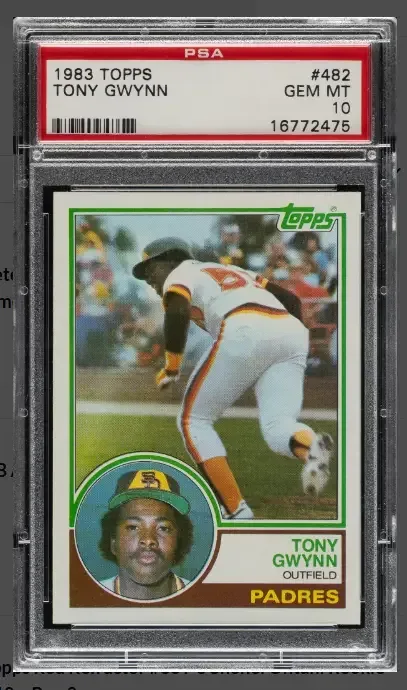
Tony Gwynn’s 1983 Topps rookie card, card No. 482, remains one of the signature pieces in the set. As one of the most respected hitters of his generation and a foundational San Diego Padres card, Gwynn’s rookie has maintained broad appeal for years.
Raw copies typically trade in the roughly $15 to $25 range, making the card approachable in ungraded form. That accessibility changes quickly once collectors move into top-condition territory. PSA’s population data shows 753 PSA 10s, along with 6,657 PSA 9s and 17,963 PSA 8s. Those numbers reflect a heavily submitted card, but they also show just how much of the market sits below gem mint grade.
The card’s highest recorded public PSA 10 sale reached $9,225 on April 19, 2016. That result remains a powerful benchmark for one of the release’s most recognizable rookies. Even with a larger PSA 10 population than some collectors might expect, Gwynn’s stature, visual appeal and long-term hobby respect keep the card near the top of any 1983 Topps conversation.
Collectors tend to view the Gwynn rookie as a cornerstone rather than a novelty. It checks nearly every box: Hall of Fame player, beloved franchise icon, strong name recognition across generations and proven demand in top grade. For many set-focused buyers, it is one of the first cards that defines the release.
Ryne Sandberg Offers Star Power and Broad Collector Appeal
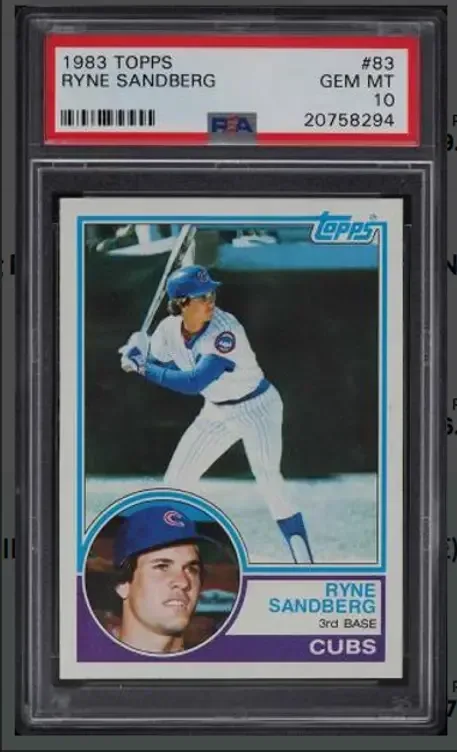
Ryne Sandberg’s 1983 Topps rookie card, No. 83, is another essential entry from the set. Sandberg’s popularity with Chicago Cubs collectors, combined with his Hall of Fame career, gives this card a durable market base that extends beyond pure rookie-card specialists.
In raw condition, the card generally sells for about $10 to $20. Like Gwynn, the real separation appears once the grade climbs. PSA population numbers list 826 PSA 10s, 7,845 PSA 9s and 10,596 PSA 8s. That makes Sandberg’s gem mint count slightly higher than Gwynn’s, but the premium for top-end examples remains meaningful.
The highest public PSA 10 sale for the Sandberg rookie reached $3,807 on February 15, 2021. That figure sits well below Gwynn’s peak, but it still underscores the strength of top-grade demand for one of the set’s headline rookies.
Sandberg’s card also represents a useful case study in collector behavior. Not every Hall of Fame rookie from the same set performs identically, even when both have strong populations and broad recognition. Player legacy, team following, timing of peak sales and market cycles all shape outcomes. In Sandberg’s case, the card remains firmly established as a key piece from 1983 Topps, even if it does not always command the same price ceiling as the very biggest names.
For Cubs fans and Hall of Fame rookie collectors, it remains one of the most important cards from the early 1980s Topps run.
Wade Boggs Combines Scarcity and Strong Sales
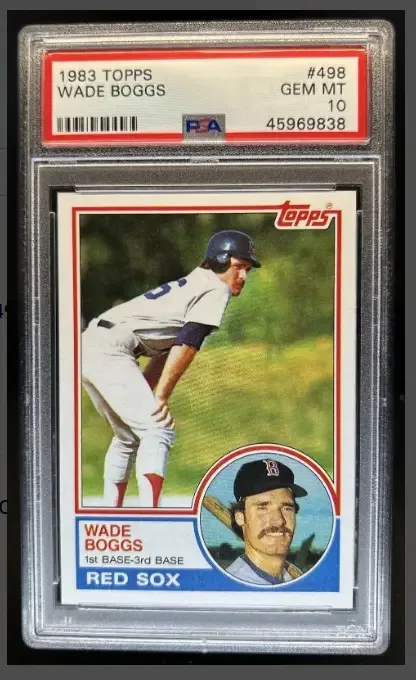
Wade Boggs’ 1983 Topps rookie card, No. 498, brings another Hall of Fame name into the mix and stands out for having the lowest PSA 10 population among the three major stars discussed here. That lower gem mint count helps make it one of the more intriguing cards in the set.
Raw copies generally sell for around $20 to $35, putting it at the high end of this group in ungraded form. PSA population data shows 417 PSA 10s, 4,210 PSA 9s and 9,260 PSA 8s. Compared with the Gwynn and Sandberg rookies, the PSA 10 supply is notably tighter.
That smaller gem mint population has helped support impressive pricing. The card’s highest recorded public PSA 10 sale reached $5,822 on September 27, 2026. That result places the Boggs rookie above Sandberg’s peak public sale and reinforces how population pressure can support premium values when paired with a Hall of Fame player.
Boggs has long carried a strong following among Boston Red Sox collectors and batting-title era enthusiasts, and his rookie card benefits from both. In many ways, this card occupies a sweet spot inside the set. It offers a legendary player, a classic rookie-card designation and a materially lower PSA 10 count than some of the other marquee names from the same release.
For collectors comparing top-grade star rookies from 1983 Topps, the Boggs card may be one of the more compelling population-driven targets.
John Stuper Shows How Low Population Can Create Interest
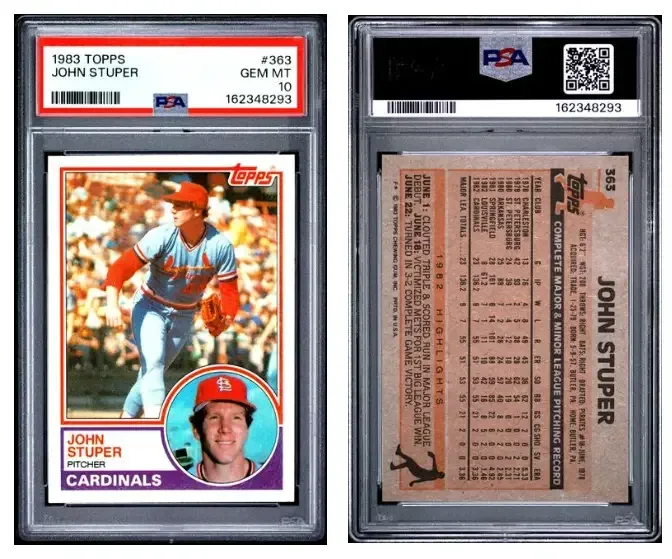
John Stuper’s 1983 Topps rookie card, No. 363, is the outlier in this group. He does not bring the Hall of Fame credentials or broad mainstream popularity of Gwynn, Sandberg or Boggs. Yet in PSA 10, his card tells a different kind of hobby story.
Raw versions generally sell for about $3 to $7, making it one of the least expensive cards in the release in ungraded form. The graded picture is dramatically different because of how few high-end examples exist. PSA population counts show only 22 PSA 10s, along with 13 PSA 9s and 6 PSA 8s.
That tiny supply has helped create legitimate demand in gem mint condition. The highest recorded public sale for a PSA 10 example reached $330 on March 1, 2026. While that figure is far below the set’s star rookie benchmarks, it is still a notable result for a player card that many casual collectors would otherwise overlook.
Stuper’s card is a strong example of a niche market inside graded collecting. Not every sought-after PSA 10 is driven by player greatness alone. Some are powered by registry competition, population rarity, set-building pressure and the challenge of finding clean copies from a difficult issue. In a set as widely collected as 1983 Topps, even lesser-known names can become important when the highest grade is scarce enough.
That does not put the Stuper rookie in the same category as the marquee Hall of Fame cards, but it does help explain why collectors continue to watch low-population PSA 10s from this set.
Quick Checklist of the Four Key Rookie Cards
- Tony Gwynn, San Diego Padres, Card No. 482, Rookie Card
- Ryne Sandberg, Chicago Cubs, Card No. 83, Rookie Card
- Wade Boggs, Boston Red Sox, Card No. 498, Rookie Card
- John Stuper, St. Louis Cardinals, Card No. 363, Rookie Card
Population and Peak Sale Snapshot
Here is how the four featured cards compare based on the supplied PSA population figures and highest recorded public PSA 10 sales:
- Tony Gwynn #482: 753 PSA 10s, 6,657 PSA 9s, 17,963 PSA 8s, peak public PSA 10 sale of $9,225
- Ryne Sandberg #83: 826 PSA 10s, 7,845 PSA 9s, 10,596 PSA 8s, peak public PSA 10 sale of $3,807
- Wade Boggs #498: 417 PSA 10s, 4,210 PSA 9s, 9,260 PSA 8s, peak public PSA 10 sale of $5,822
- John Stuper #363: 22 PSA 10s, 13 PSA 9s, 6 PSA 8s, peak public PSA 10 sale of $330
What These Four Cards Say About the 1983 Topps Market
Taken together, these cards highlight why 1983 Topps remains such a durable set in the graded-card market. Collector demand is not tied to a single formula. Hall of Fame status matters. Team collecting matters. Population scarcity matters. Registry competition matters. The set offers examples of all of those forces working at once.
Gwynn shows the power of all-time player appeal and a massive long-term hobby following. Sandberg reflects the stability of a major rookie tied to a beloved franchise and a Hall of Fame résumé. Boggs demonstrates how a lower PSA 10 population can boost an already important rookie card. Stuper proves that in a widely collected set, extreme gem mint scarcity can produce attention even for a far less celebrated player.
That range is part of what keeps collectors engaged with 1983 Topps. It is not just a set with a few famous rookies. It is a release where grade sensitivity creates meaningful differences across the checklist, making PSA 10 copies especially important for anyone chasing the best examples available.
For collectors browsing the market today, raw copies of these rookies still offer affordable entry points, while PSA 10s remain the true premium targets. Whether the focus is Hall of Fame star power or ultra-low population scarcity, these four cards continue to show why 1983 Topps Baseball holds its place as one of the hobby’s defining sets of the decade.
Photo Gallery