If you collect long enough, you eventually run into a box full of late-1980s and early-1990s baseball cards that someone dismisses with two words: junk wax. The label is easy to use and easy to misuse.
For collectors, the better question is not whether those cards are “junk,” but what the term actually describes. In hobby usage, it points mainly to overproduction. Many cards from that period were printed in huge quantities, which means plenty survived and many remain easy to find today. That scarcity problem affected value, but it did not erase the appeal of the cards themselves.
That distinction matters because the same era also produced some of the hobby’s most familiar designs, formative childhood collecting memories, and a few surprisingly tricky identification problems. If you inherited a stack, bought a binder, or want to revisit the cards you grew up with, the skill that helps most is simple: learn how to identify the exact card, not just the player on the front.
What “junk wax” really means
The phrase “junk wax” is hobby slang rather than a formal category with one official start and end date. A practical working definition is more useful than a rigid one. In hobby coverage, the era is generally associated with the late 1980s into the early 1990s, and Beckett specifically describes the classic overproduced stretch as cards from the late 1980s through 1993.
That definition is important because it centers production volume, not artistic quality. A card can have a beloved design, a memorable player, and real sentimental importance while still belonging to an overproduced period. Calling something junk wax does not prove it is ugly, fake, or historically unimportant. It usually means too many copies were made for scarcity to do much of the heavy lifting.
That also explains why arguments about exact boundaries often go nowhere. One collector may use the term for everything from 1987 through 1992. Another may stretch it differently. The more practical move is to treat “junk wax” as a shorthand for an era shaped by mass production and broad availability, then judge each set on its own design, checklist, print characteristics, and variation details.
For buyers, that framing helps avoid two common mistakes. The first is writing off entire boxes of cards without checking what is actually there. The second is assuming any card from that period must be valuable just because it is old. Age alone is not the point. Supply is.
- Think of “junk wax” as a production-era label, not a verdict on design.
- Use the term as a clue to expect high surviving supply.
- Avoid hard year-by-year dogma unless a checklist or set reference requires it.
Why overproduction changed how these cards are valued
When a set is printed in very large quantities, collectors do not just get more chances to buy it at release. They also get decades of leftover supply. That is the core economic story behind junk-wax-era cards. Plenty were opened, plenty were stored, and plenty remained in circulation. As a result, ownership never narrowed the way it can with genuinely scarcer releases.
Topps’ discussion of 1987 Topps is a useful model here. The set is widely remembered and visually recognizable, but it is also a classic lesson in supply and demand. A large print run means nostalgia alone does not automatically create scarcity-driven prices for ordinary examples. A card can be famous without being rare.
For collectors, this has a practical upside. It means many of the era’s iconic base cards, team sets, and commons are still approachable. You can build a representative run of favorite players or finish a full set without needing elite-budget capital. The tradeoff is that condition, unusual versions, and exact identification often matter more than the casual eye expects.
This is why broad statements such as “all junk-wax cards are worthless” miss the point. The real lesson is narrower and more useful: many standard copies are common, so you must know what you are buying. A clean, properly identified card from a distinctive subset or recognized variation is a different conversation from a random stack of mass-produced base cards.
- Large supply suppresses scarcity for many standard copies.
- Condition and exact version matter more when many examples survive.
- Set completion can be affordable, but standout exceptions still require research.
Why collectors still love the era anyway
If overproduction were the whole story, these cards would have vanished from collector conversation. They did not. Nostalgia keeps the era alive because these were the cards many collectors first handled in volume. Packs were available, team sets felt achievable, and the designs became part of everyday baseball memory.
Topps has explicitly framed 1987 Topps in sentimental terms, especially for collectors who grew up opening packs and assembling teams. That perspective matters because it separates financial scarcity from emotional significance. A card does not need to be rare to be meaningful. Familiar borders, logo placement, bright backs, and childhood sorting rituals all contribute to why these sets still get opened, traded, and discussed.
For a modern collector, that creates several healthy ways to engage the era. You might build a favorite franchise binder from the years you first learned lineups. You might collect one representative card from each flagship release. You might focus on design history, comparing how brands presented players before premium foil and serial-numbered parallels dominated the hobby.
The tradeoff is that nostalgia can blur judgment. A card that feels important because you remember it vividly is not automatically scarce, hard to replace, or costly to upgrade. Treat nostalgia as a collecting reason, not a pricing rule. That mindset lets you enjoy the era honestly without expecting every childhood card to fund a retirement plan.
- Nostalgia is a valid collecting reason even when scarcity is low.
- Team sets and design-focused collecting work especially well for this era.
- Sentimental importance and market rarity are not the same thing.
A simple checklist for identifying the exact card
The most useful identification framework is straightforward: year printed, manufacturer, set, player, card number, and parallel if applicable. That sequence keeps you from jumping too quickly to a conclusion based on the front image alone. It also scales well, whether you are looking at a common 1987 Topps single or a confusing variation from a more error-prone set.
Start with the year and manufacturer. If a card says Topps, Donruss, or Upper Deck, that narrows the universe quickly. Then identify the set. In the junk-wax years, this step matters because several major baseball releases can feature the same player with very different design language. After that, confirm the player name and card number. The card number is often the fastest route to distinguishing a regular base card from a subset card or a variation-listed entry.
Only then should you ask whether there is another layer. Is it from series one or series two? Is there an error and a corrected version? Is the back printed differently from the regular release? Is there a test issue that looks nearly identical at first glance? Those questions are how collectors move from “I know the player” to “I know the exact card.”
A practical habit is to inspect both front and back before you enter anything into an inventory or send it for grading. Front design gets you close. Back details often finish the job.
- Use this order: year, manufacturer, set, player, card number, parallel.
- Check front and back before logging a card.
- Do not stop at player name if the set is known for variations or corrections.
Case study: how to identify 1987 Topps correctly
If you want one junk-wax-era set that teaches the basics clearly, 1987 Topps is hard to beat. PSA describes the set as a 792-card release with instantly recognizable visual cues: a faux wood-grain border, the Topps logo in black lettering, the player’s name in white lettering inside a color box, and a team logo in the corner. Those front traits alone often let you identify the set in seconds.
The back matters too. Topps’ 2025 discussion notes blue-and-yellow backs, which gives you a fast confirmation when you flip the card over. PSA also notes that the back carries the player name, position, card number, and statistics. That combination makes 1987 Topps an ideal starter set for learning exact-card habits: identify the year and maker, match the distinctive front design, then confirm the number and player on the back.
Subsets make the exercise a little more interesting. Topps highlights All-Stars, Record Breakers, team leaders, manager cards, and the Turn Back the Clock cards at numbers 311 through 315. That is useful because it teaches an early junk-wax lesson: not every card in a set is just a standard single-player base card. A subset card can share the overall set design while serving a different checklist role.
Here is a practical scenario. Suppose you pull a wood-grain bordered card of a player you recognize but the layout feels slightly different from the stars and commons around it. Before assuming it is a printing quirk or special issue, check the card number and whether it belongs to a named subset. In many cases, the “mystery” is simply that you are holding a checklist-defined insert-like subset within the base release, not a rarer parallel or variation.
- Front clues: faux wood-grain border, black Topps logo, white name text in a color box, team logo in the corner.
- Back clue: blue-and-yellow printing with identifying information and stats.
- Subset check: All-Stars, Record Breakers, team leaders, manager cards, Turn Back the Clock #311-315.
Case study: 1989 Upper Deck proves the era was not all the same
One of the easiest mistakes collectors make is treating junk-wax-era cards as if every set used the same cheap materials and same visual logic. 1989 Upper Deck is the clearest counterexample in this source set. PSA describes it as an 800-card set issued in two series, with cards numbered 1 through 700 and 701 through 800. Just that series split already adds an identification step many casual sorters miss.
The production style was also notably different. PSA points to slick paper stock, full-color backs, and a hologram used for anti-counterfeiting. Upper Deck’s authenticity history adds useful context: the company was founded in 1988 and adopted holograms in response to a market they described as flooded with fake trading cards. Whether you collect Upper Deck heavily or not, that is a reminder that the era included technological and presentation shifts, not just volume.
For identification, the takeaway is simple. If you find a late-1980s baseball card with a more premium feel, a full-color back, and a hologram, do not assume it belongs to the same design world as a standard paper flagship issue from another manufacturer. Confirm the series and stock characteristics as part of the set ID. Two cards from the same general era can require different handling and different expectations.
This matters in practice when you sort mixed lots. A binder page might place 1987 Topps, 1989 Upper Deck, and 1990 Donruss next to each other because they are all baseball cards from roughly the same period. Identification should work in the opposite direction: separate them by maker and physical traits first, then by player and number. The hobby boom was broad, but the sets were not uniform.
- 1989 Upper Deck has 800 cards in two series: #1-700 and #701-800.
- Key traits include slick stock, full-color backs, and a hologram.
- Physical feel and anti-counterfeiting features are part of exact identification.
Where exact identification gets harder: errors, corrections, and look-alikes
The point where many collectors get tripped up is assuming player plus card number settles everything. Sometimes it does not. PSA notes that 1989 Upper Deck includes error and corrected versions for Gary Sheffield #13 and Dale Murphy #357. That means two cards can occupy the same general checklist slot while still requiring a more exact label than the front glance provides.
Beckett’s treatment of 1990 Donruss pushes this lesson even further. The set is described as a 716-card standard-size issue with bright red borders and a large number of errors that were corrected after release. Beckett’s separate coverage even calls the set an error detective’s paradise. In collector terms, that means casual identification can be risky. A card you think is just a basic Donruss copy may have an error-correction distinction that affects how accurately it should be cataloged.
The practical lesson is not that every 1990 Donruss card hides a major discovery. It is that you should slow down whenever a set has a reputation for corrections and anomalies. Search by set and card number, not only by player. Compare the back as carefully as the front. If you are building a master checklist, decide whether you want only standard corrected examples or whether errors matter to your completion goal.
There is a tradeoff here. Variation hunting can be fun, but it can also turn a simple nostalgic project into an endless rabbit hole. If your goal is a representative binder, you may prefer one clean example per checklist number. If your goal is precision, you may need to log the version as carefully as the card itself.
- Do not assume player plus card number always equals full identification.
- 1989 Upper Deck includes named error/corrected examples.
- 1990 Donruss is known for numerous errors and corrections.
A classic pitfall: 1990 Donruss Aqueous Test
If you want a perfect example of why exact-card identification matters, 1990 Donruss Aqueous Test is it. On a quick look, it can resemble regular 1990 Donruss closely enough to fool a rushed sorter. PSA’s Set Registry page says the way to identify it is the phrase “AQUEOUS TEST” printed diagonally on the back. That is the kind of detail you only catch if you make a habit of flipping cards over and reading carefully.
The same PSA-hosted page says the Aqueous Test set contains 264 cards, compared with 716 in the regular 1990 Donruss release, and warns that these cards are frequently faked. It also notes an important authentication clue: the slanted text should appear in a consistent location for each specific player and is printed as part of the card, not added afterward like a stamp. Those are exactly the sort of details that separate true identification from guesswork.
There is also an important honesty clause for collectors here. The PSA Set Registry page itself says not much is known, so this is best treated as a PSA-hosted hobby reference rather than a final manufacturer-level proof of every production detail. That does not make the guidance useless. It just means you should be precise about what you know and what remains less settled.
In practical terms, if a seller presents a supposed Aqueous Test card, your checklist should be strict. Ask for a clear image of the back. Look for the diagonal printed wording. Compare placement. Be skeptical of anything that looks added on top of the surface. And if the seller cannot provide a back scan, assume you do not yet have enough information to identify the exact card confidently.
- Regular 1990 Donruss and Aqueous Test can look very similar from the front.
- The key clue is diagonal “AQUEOUS TEST” text on the back.
- Be especially cautious because PSA warns these are frequently faked.
How to collect the junk-wax era without fooling yourself
The healthiest way to approach junk-wax collecting is to match your goal to what the cards actually are. If you want affordable nostalgia, high-supply sets are often an advantage. If you want exactness, the same era rewards careful set identification, subset awareness, and variation research. What usually goes wrong is when collectors mix those goals without noticing.
A practical approach is to choose one of three lanes. Lane one is the memory lane binder: favorite team, favorite stars, favorite designs, minimal concern about every correction or test issue. Lane two is the set-builder lane: commit to a checklist-defined release and learn its subsets so you know what complete means. Lane three is the variation lane: focus on errors, corrected versions, and unusual test distinctions, understanding that the research burden rises quickly.
Before buying a card from this era, ask a few plain questions. What set is it exactly? Is the seller identifying the card by number? Do front and back images match the claimed version? Is this a regular base card, a subset card, an error, a correction, or a test issue? If a premium is being charged, what exact characteristic is supposed to justify it? Those questions are more protective than any broad rule about whether junk-wax cards are good or bad.
Most of all, resist the lazy extremes. These cards are not automatically treasure, and they are not automatically trash. They are a huge, nostalgic, sometimes confusing part of hobby history. Collect them for the right reasons, identify them carefully, and you will get far more out of the era than the old punchline ever suggests.
- Pick a lane: nostalgia binder, checklist set building, or variation hunting.
- Ask for front and back images when the version matters.
- Use exact identification to decide whether a claimed premium makes sense.
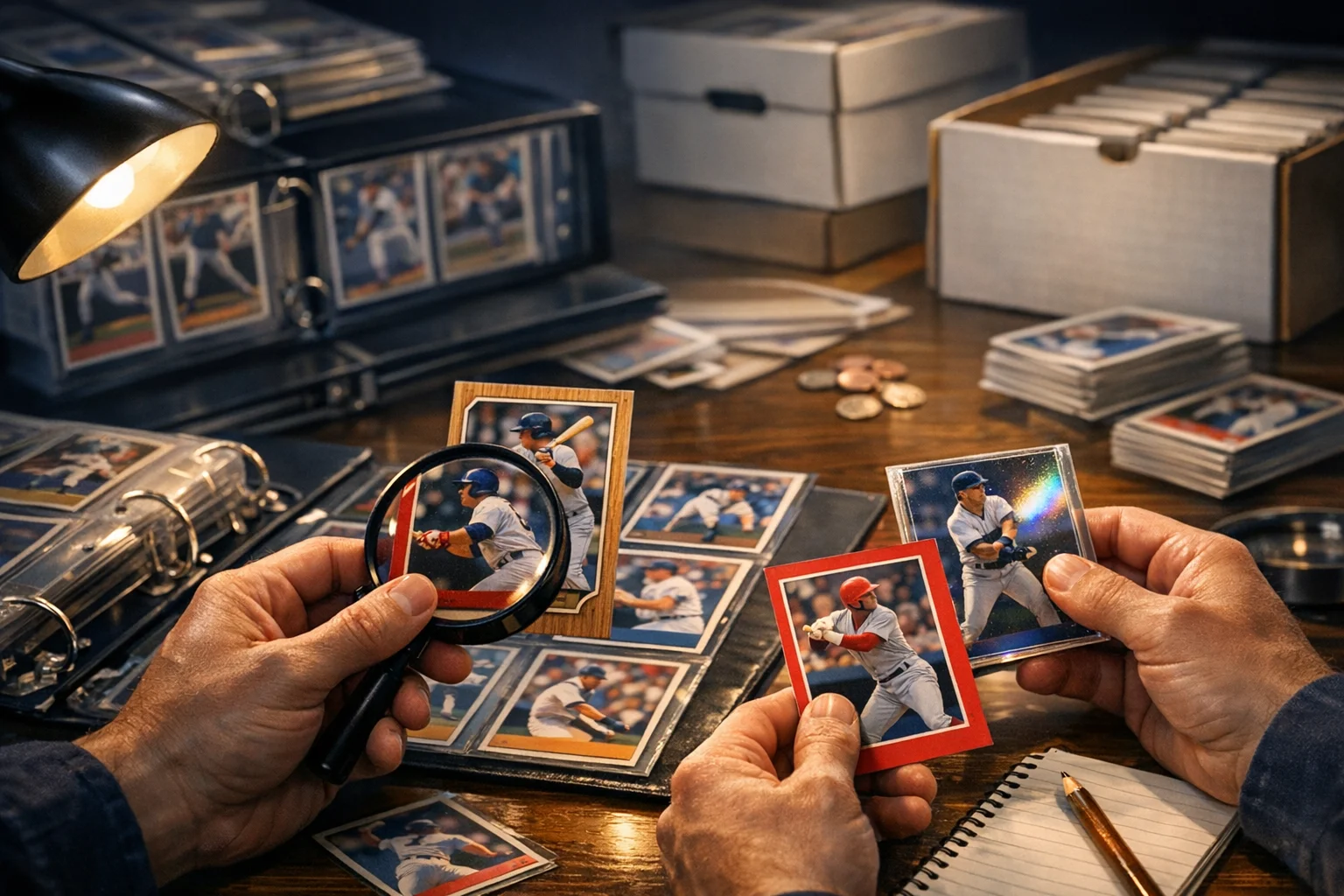
Illustration generated for this guide; not a photograph of an actual card, product or event.
Photo Gallery