Patrick Mahomes enters his age-31 season with a resume that invites direct comparison to Tom Brady at the same stage of his career. Mahomes is beginning his 10th NFL season and his ninth as a starter, already owning five Super Bowl appearances, three championships, three Super Bowl MVPs, and two regular-season MVP awards.
There is another major similarity. Mahomes is coming off a serious knee injury suffered last December against the Chargers, a torn ACL and LCL that ended his season and helped bring Kansas City’s playoff streak to a halt. Brady also suffered a major knee injury at 31, tearing his ACL and MCL in Week 1 of the 2008 season after building a championship-heavy early legacy.
On paper, the overlap is striking. In the card market, the story is much different.
Two all-time resumes, two very different hobby environments
The easiest way to understand the gap between Mahomes and Brady as collectibles is to start with the eras they occupied. When Brady was 31, the sports card market was dramatically smaller and less accelerated than it is now. Breaking had not yet become a defining force, the parallel structure across products was nowhere near as crowded, and grading volume was only a fraction of modern levels.
For more collector background, read Top 3 Football Card Sales of the Week: Tom Brady, Patrick Mahomes, Walter Payton.
That matters because Brady’s card prices at that point were still tied much more closely to what he had already accomplished. The market was not aggressively pricing in years of future dominance. Collectors were rewarding his rings, MVP-level production, and status as a winner, but the hobby had not yet reached the speculative intensity that now surrounds elite quarterbacks.
Mahomes came into the league in the exact opposite setting. His rookie cards were released during the strongest boom period the hobby has ever seen, when production, grading, social media attention, and investor interest all expanded at once. That environment pushed prices higher more quickly and created a market that was often willing to pay in advance for projected greatness.
That does not mean Mahomes is overvalued in a simple sense. It means his cards have always carried an extra layer of expectation that Brady’s cards largely did not at the same age.
For another perspective on this story, read Patrick Mahomes’ Card Market Trails Football’s Rise as Tom Brady Comparison Gets Complicated.
Why Brady’s biggest gains came later
One of the strongest arguments in this comparison is what happened after Brady turned 31. His most important cards appreciated substantially in the years that followed because his legacy continued to expand. He added four more Super Bowl titles after that point, separating himself from the rest of the field and turning the greatest-of-all-time debate into a far less crowded conversation.
As Brady kept winning, collectors paid for those accomplishments in real time. His market had room to climb because the next chapters of his career kept adding new accomplishments that were not yet fully built into pricing.
A notable example is the 2000 Playoff Contenders Rookie Ticket Autograph, one of the most important football cards ever made. Today, high-grade examples can sell for more than $1 million. But when Brady was 31 in 2008, the top recorded sale for that card was just $4,778. The card itself did not change. Brady’s legacy did, and the hobby’s size and spending power changed with it.
That point is central to the Mahomes comparison. Brady’s market still had years of legacy-driven upside ahead of it. Mahomes, by contrast, has spent much of his hobby life being valued not only for what he has done, but for what collectors believe he still might do.
Mahomes cards are being priced with future rings in mind
Mahomes has already built a Hall of Fame-level track record before turning 31, which naturally puts him near the top of the football market. But the modern hobby rarely stops at present value when it comes to franchise quarterbacks. It assigns premiums to possibility.
For Mahomes, that possibility has long centered on one question: can he keep stacking championships and mount a serious challenge to Brady’s place atop the sport?
The market behavior suggests collectors have been willing to pay for that path in advance, at least to a degree. Mahomes has had one of the most watched and most actively traded rookie portfolios in football because buyers see both elite production and historical upside. The result is a market that often behaves less like a reward for completed accomplishments and more like a forecast.
That distinction helps explain why Mahomes and Brady, despite similar age-31 snapshots, have not traveled the same path as collectibles. Brady’s cards rose with each added layer of career certainty. Mahomes’ cards have spent years carrying some of that future expectation already.
The injury added caution, not collapse
Mahomes’ December knee injury introduced a fresh test for the market. It forced collectors to balance long-term faith in one of the game’s greatest quarterbacks against short-term uncertainty tied to health and recovery.
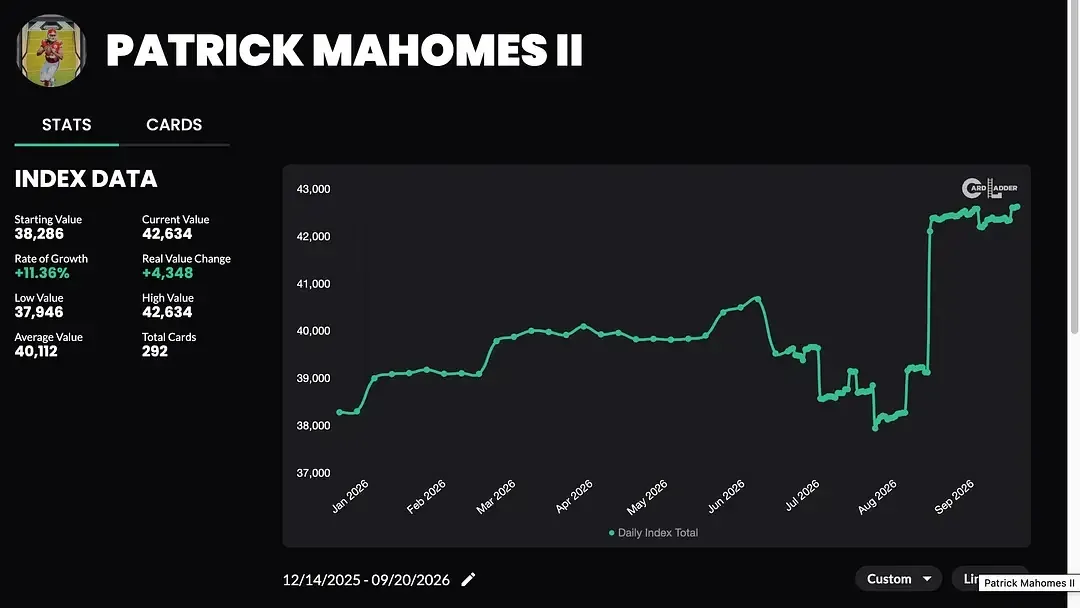
The performance of his Card Ladder index since the injury shows a nuanced reaction. Mahomes is still up 11.36% over that span, which on its own looks healthy. The issue is relative performance. During the same period, the broader football index climbed 38.73%.
That gap says a lot. Collectors have not run from Mahomes cards, but they have not chased them with the same urgency seen elsewhere in the football market. Instead, the market appears to be discounting risk while still respecting the long-term ceiling.
In practical terms, Mahomes has remained a premium name, just not the hottest momentum play in the category during his recovery period. That is an important distinction for anyone reading the market through headline numbers alone.
What the recent sales activity says about demand
Even with the slower relative index growth, Mahomes remains one of the most active names in the hobby. In the last week alone, 764 Mahomes cards were reported sold through Card Ladder’s tracking. That kind of volume reinforces his status as one of the most liquid football players in the market.
Liquidity matters because it gives collectors a more reliable read on pricing behavior. Thinly traded stars can post erratic spikes or drops based on a few isolated sales. Mahomes moves enough cards across enough formats to give a clearer picture of real demand.
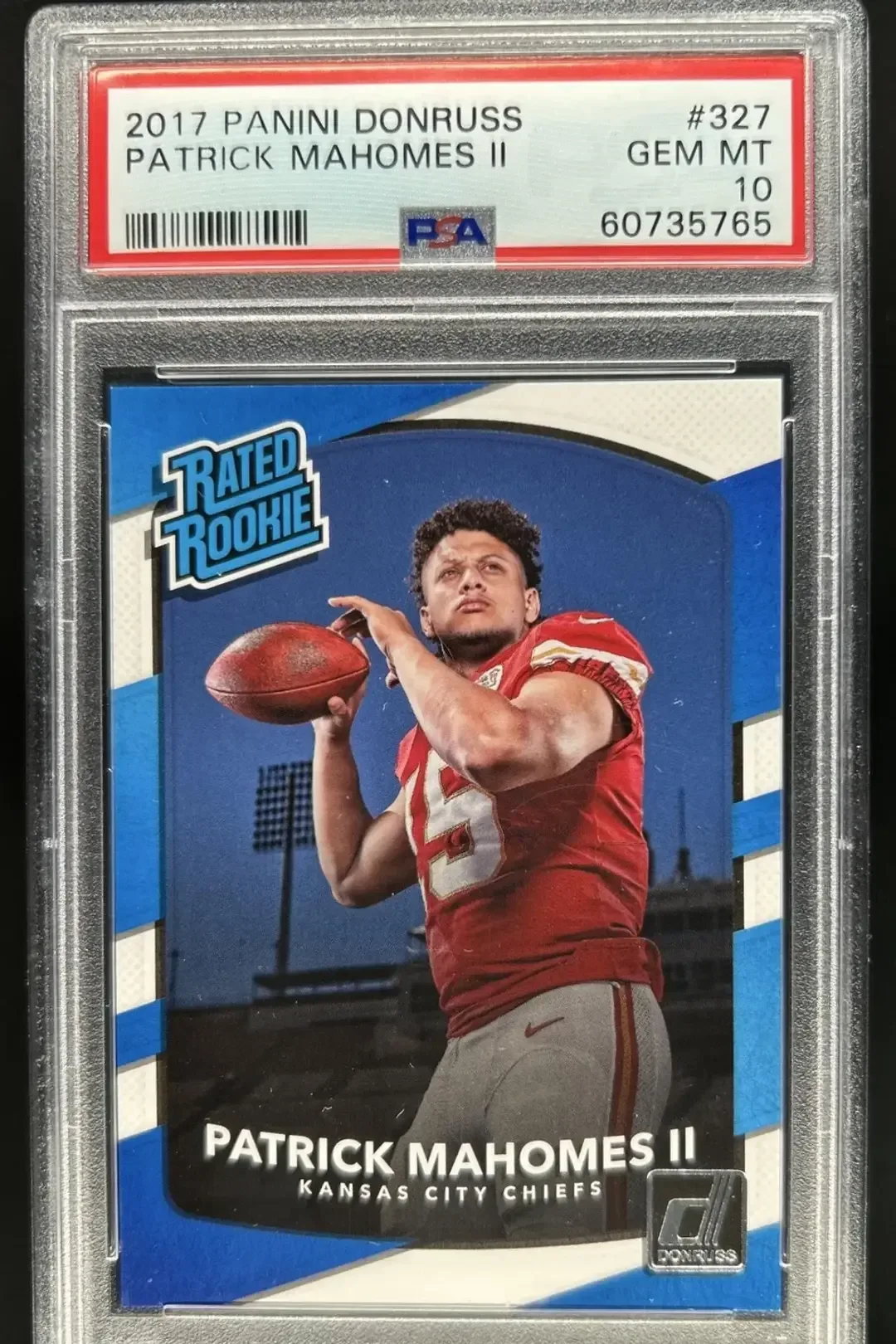
His most popular rookie card over the last week was the 2017 Donruss Rated Rookie #327, which carried an average sale price of $393. That data point is useful for a few reasons. First, it shows demand is not limited to ultra-high-end Mahomes cards. Second, it highlights the lasting popularity of mainstream rookie issues that remain accessible compared with his scarcer autograph and premium chromium options.
The Donruss Rated Rookie has become one of the foundational Mahomes entry points for collectors who want a recognizable rookie card without stepping into the very top tier of his market. Strong recurring activity in that card helps support the broader ecosystem around his brand.
Brady was rewarded after achievement, Mahomes is judged against expectation
The cleanest way to frame the difference between these two markets is this: Brady’s hobby trajectory at 31 was still catching up to his accomplishments, while Mahomes’ market has often tried to get ahead of his next accomplishment.
That difference changes how collectors react to adversity. When Brady was still adding rings, each title created fresh value because so much of his ultimate legacy was still not priced in. With Mahomes, every step forward is measured against expectations that have already been aggressive for years.
If he wins again, the market may respond positively, but some of that possibility has been part of his pricing structure for a long time. If he suffers a setback, the reaction can be sharper because the market is not just adjusting current production. It is re-evaluating a long-term projection.
That dynamic explains why Mahomes can remain one of the strongest names in football cards while still underperforming the broader football index during a recovery window.
Key card and market data points
- Patrick Mahomes age-31 resume: Five Super Bowl appearances, three Super Bowl wins, three Super Bowl MVPs, two NFL MVPs.
- Tom Brady at 31: Three Super Bowl wins, two Super Bowl MVPs, one NFL MVP before his 2008 knee injury.
- Mahomes injury: Torn ACL and LCL suffered in December 2025 against the Chargers.
- Brady injury at 31: Torn ACL and MCL in Week 1 of the 2008 season.
- Mahomes Card Ladder index since injury: Up 11.36%.
- Football index over the same span: Up 38.73%.
- Recent Mahomes sales volume: 764 cards sold in the last week tracked.
- Most active Mahomes rookie card: 2017 Donruss Rated Rookie #327.
- Average recent price for that card: $393.
- Tom Brady 2000 Contenders Rookie Ticket Autograph high sale in 2008: $4,778.
- Current market context for that Brady card: High-grade examples can sell for more than $1 million.
What collectors should watch next
The next phase of Mahomes’ market likely depends on two overlapping variables: health and resumed dominance. If he returns looking fully like himself and the Chiefs move back into the Super Bowl picture, buyers could quickly regain confidence and push key rookie cards higher. The hobby has shown repeatedly that elite quarterbacks can re-accelerate when the narrative turns positive again.
At the same time, Mahomes’ market may continue to move differently than Brady’s did because the hobby is now faster, deeper, and more speculative. A modern superstar does not get the same runway to quietly build value over a decade. Prices react sooner, and expectations arrive earlier.
That makes Mahomes one of the most fascinating football card cases in the market. He has the accomplishments to justify blue-chip status, the liquidity to remain a central hobby figure, and the long-term upside to keep collectors engaged. But unlike Brady at the same age, he is also carrying years of future legacy in his prices already, which means every comeback, every playoff run, and every title chase will continue to be judged against a market that has been betting on history for a long time.
Photo Gallery