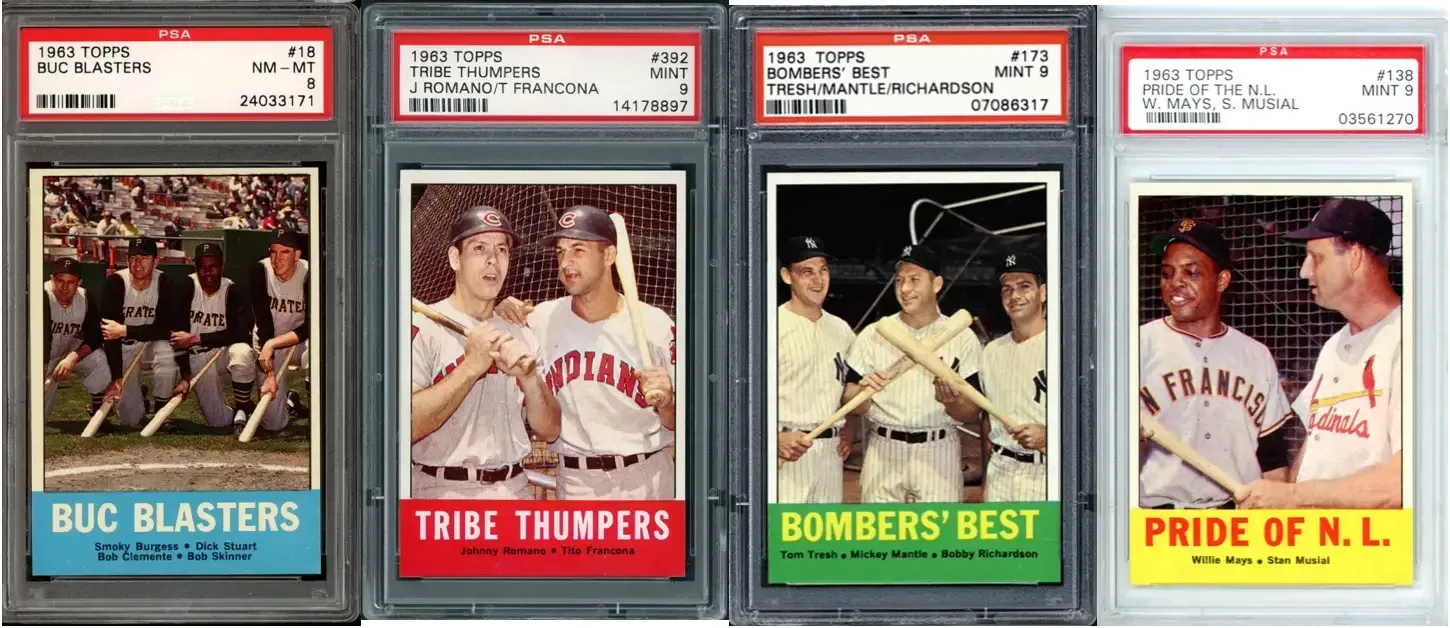
A new record sale for Mickey Mantle’s 1963 Topps card has brought fresh attention back to one of the most admired baseball issues of the decade. The 1963 Topps set has long been a favorite among vintage collectors thanks to its bold photography, colorful nameplate bars, and unusual combination of single-star cards, multiplayer highlights, league leaders, and major rookie content.
Topps also had the baseball card market largely to itself that year. While Fleer made an attempt to push into the category in 1963, Topps stayed in control, and its flagship baseball release became the year’s defining set. By the numbers, that meant a massive 576-card checklist, dwarfing Fleer’s 67-card effort.
What makes 1963 Topps stand out even now is how much it offers in one release. Collectors can chase Hall of Fame stars, scarce high-number cards, legendary rookie cards, and a deep run of multiplayer cards that remain some of the hobby’s most visually memorable pieces from the era. The design helps too. Large color player images are paired with smaller black-and-white portraits, creating a look that is instantly recognizable. At the same time, the colored bottom borders are prone to chipping, which has made high-grade copies especially difficult to locate.
Here is a closer look at six of the most iconic cards from the 1963 Topps baseball set and why they continue to matter to collectors.
For more collector background, read The 7 Most Iconic Baseball Cards of the 1970s and Why Collectors Still Chase Them.
Why 1963 Topps remains a vintage favorite
The 1963 Topps set sits in a sweet spot for vintage baseball collectors. It arrived when many all-time greats were still active, yet it also captured important emerging stars. That mix gives the set strong depth from start to finish.
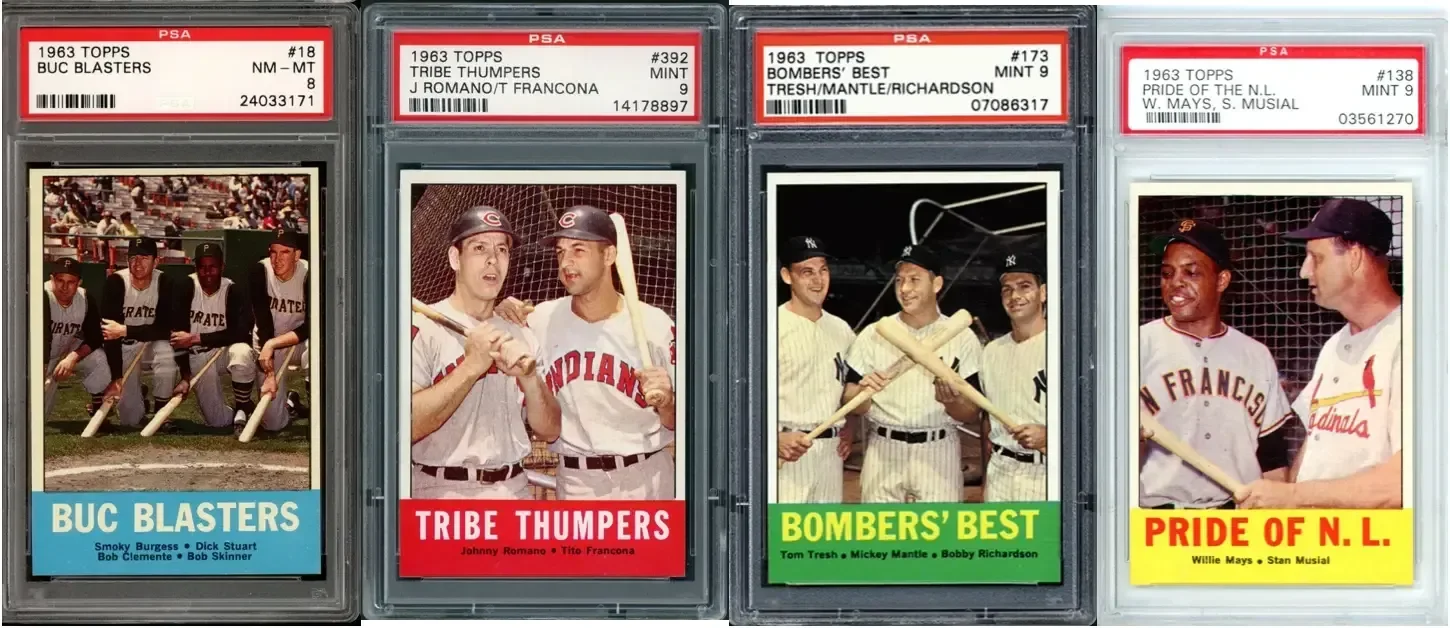
It is also a set known for more than just its base singles. Multiplayer cards such as Buc Blasters, Bombers' Best, Pride of the N.L., Veteran Masters, Friendly Foes, Power Plus, and Dodgers' Big Three give collectors a very different kind of chase. These cards often contain multiple Hall of Famers on one card, even if the hobby has historically assigned higher values to single-player cards.
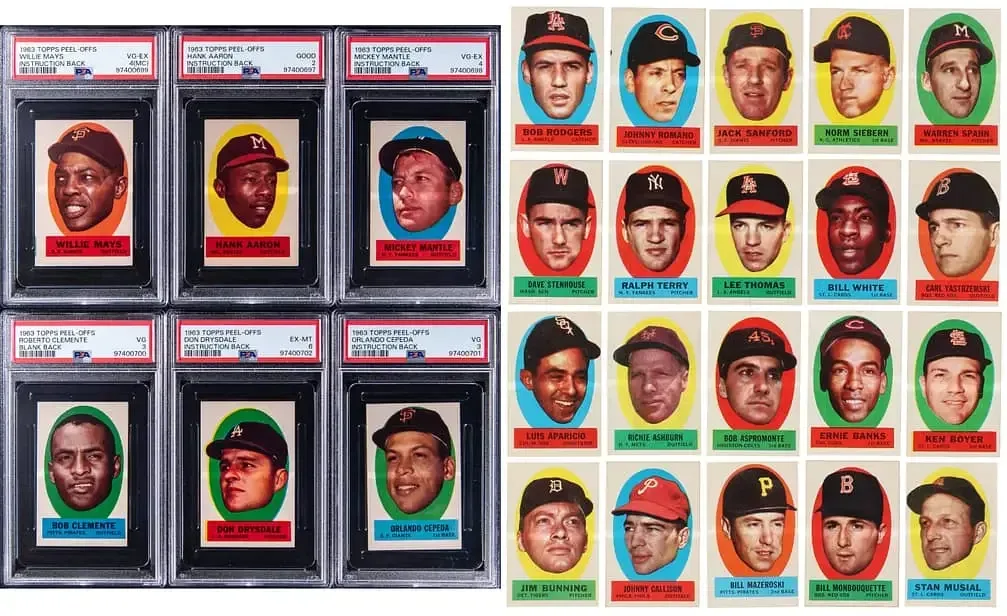
Another appealing layer is the 1963 Topps Peel-Offs insert set, a 46-player run distributed in five-cent packs. Those inserts featured peel-away stickers and included stars such as Mickey Mantle, Willie Mays, Hank Aaron, Roberto Clemente, and Stan Musial. For collectors who enjoy building around a flagship issue, 1963 Topps offers much more than a standard base checklist.
For another perspective on this story, read The 6 Most Iconic Cards in the 1963 Topps Baseball Set.
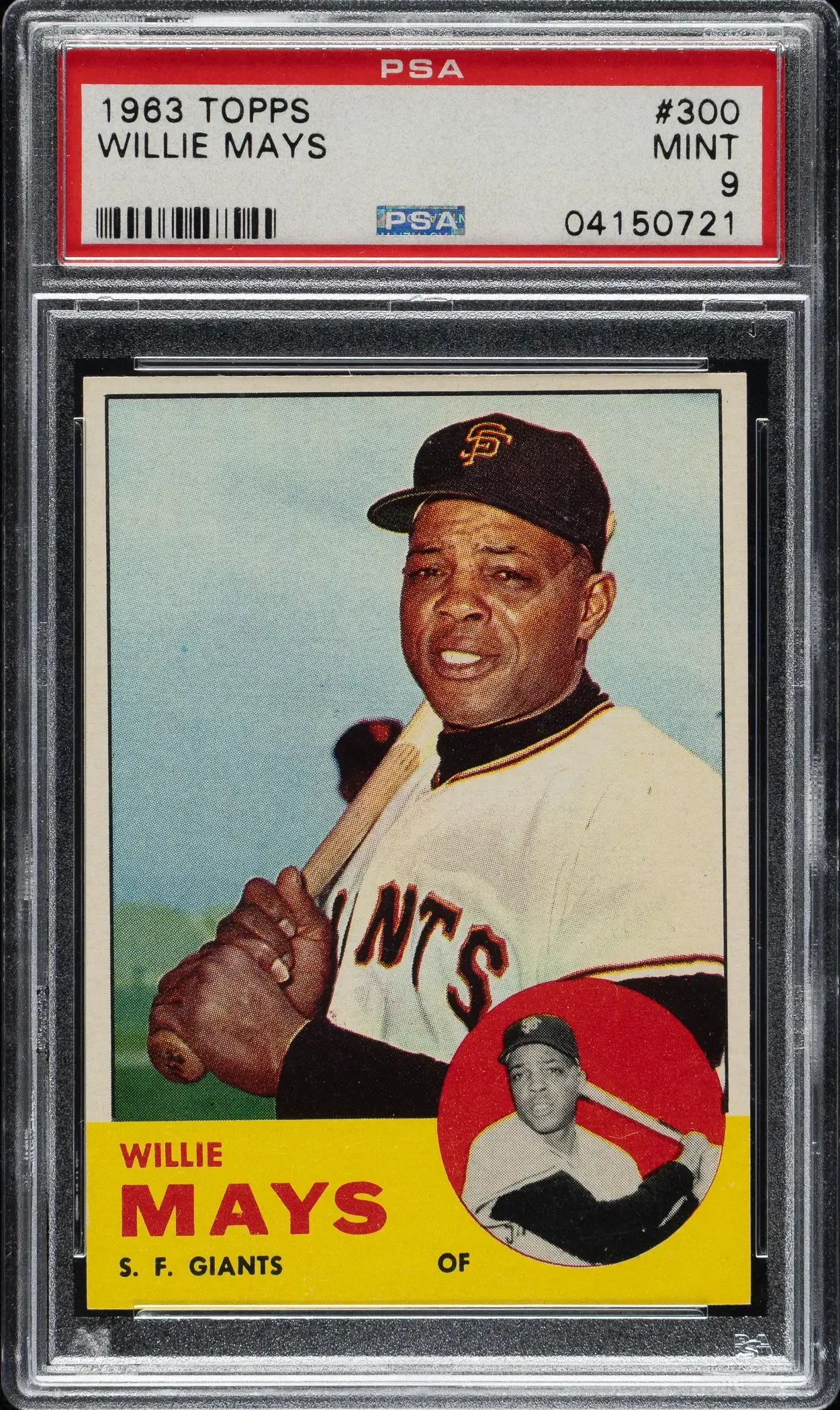
6. Willie Mays 1963 Topps #300
Willie Mays cards are cornerstones in almost any vintage baseball collection, and his 1963 Topps issue remains one of the key star cards from the set. The card carries the same appealing design language that defines the release, but what really drives attention is the point in Mays’ career that it captures.
Mays was coming off a remarkable 1962 season in which he hit a career-high 49 home runs and helped lead the Giants to the World Series. He followed that with another elite campaign in 1963, producing 10.6 WAR, one of the strongest marks of his career. For collectors, that puts this card right in the heart of Mays’ prime.
The card’s market profile shows how condition-sensitive the set can be. The all-time high for a PSA 9 reached $24,500 in a February 19, 2026 sale. Lower grades remain far more accessible, with PSA 6 examples around $420 and PSA 3 copies around $160. PSA’s population report lists 4,225 graded copies, including one PSA 10 and 38 PSA 9s.
Even with Mays’ stature, this card still trades at levels far below some other stars from the same issue, making it an interesting value play for vintage collectors. Mays also appears elsewhere in the set, including Pride of N.L. #138 with Stan Musial, plus a 1963 Topps Peel-Offs insert.
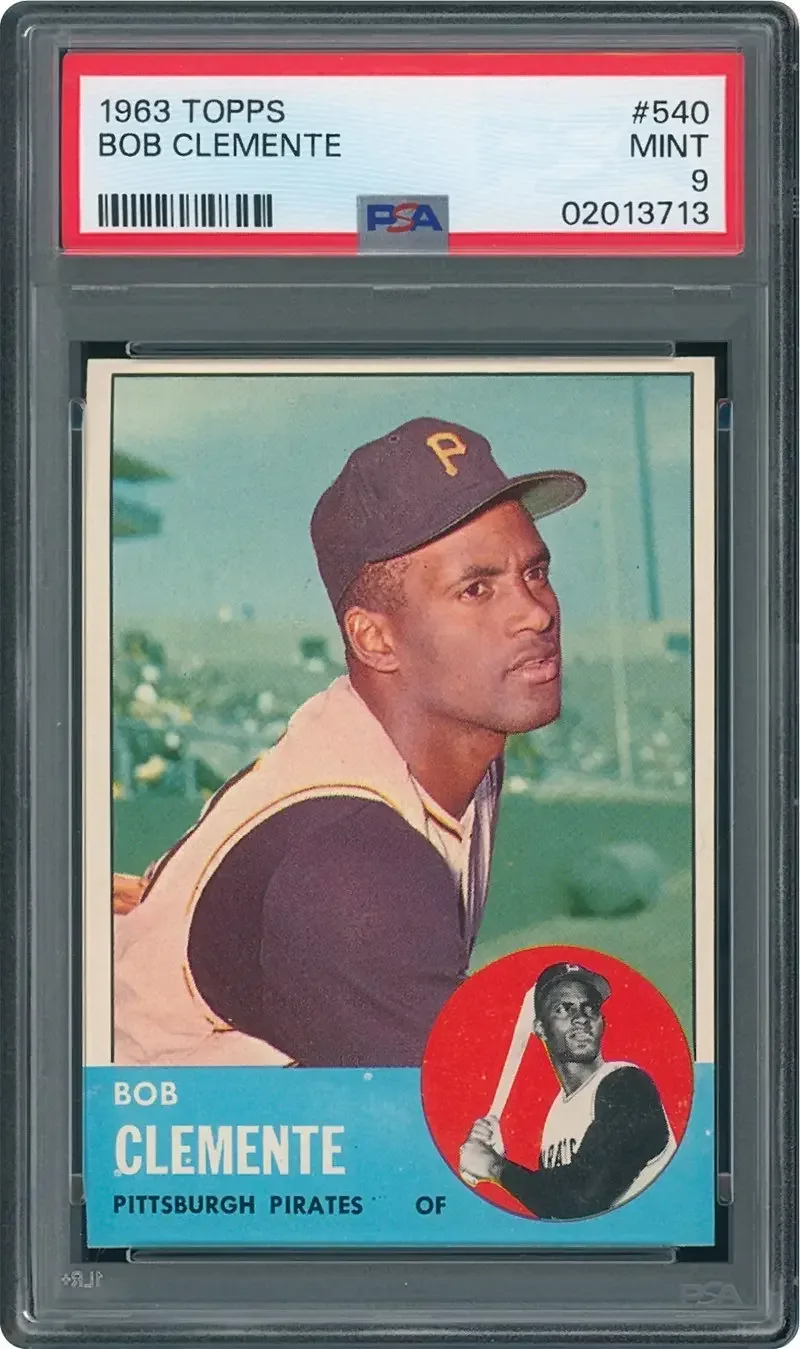
5. Roberto Clemente 1963 Topps #540
Roberto Clemente’s 1963 Topps #540 is one of the toughest mainstream star cards in the entire set because of where it falls on the checklist. Issued in the seventh and final series, it carries the extra scarcity that vintage collectors often associate with high numbers.
That final-series status helps explain why the card has become so desirable in stronger grades. The all-time high sits at $56,047 for a PSA 9 sold on January 7, 2023. More collector-friendly examples still command healthy prices, with PSA 6 copies around $569 and PSA 3s around $250. PSA has graded 3,725 copies, including two PSA 10s and 35 PSA 9s.
Clemente’s on-field resume adds to the appeal. In 1963, he finished second in the National League batting race, further reinforcing the card’s place during one of the best stretches of his career. His popularity with both vintage baseball collectors and Clemente player collectors gives the card broad demand.
There is also evidence of meaningful long-term growth. A PSA 7 example that could be found for less than $250 in 2019 has since seen recent sales around $920. Clemente also appears in the 1963 set on Buc Blasters #18 and in the Peel-Offs insert lineup.
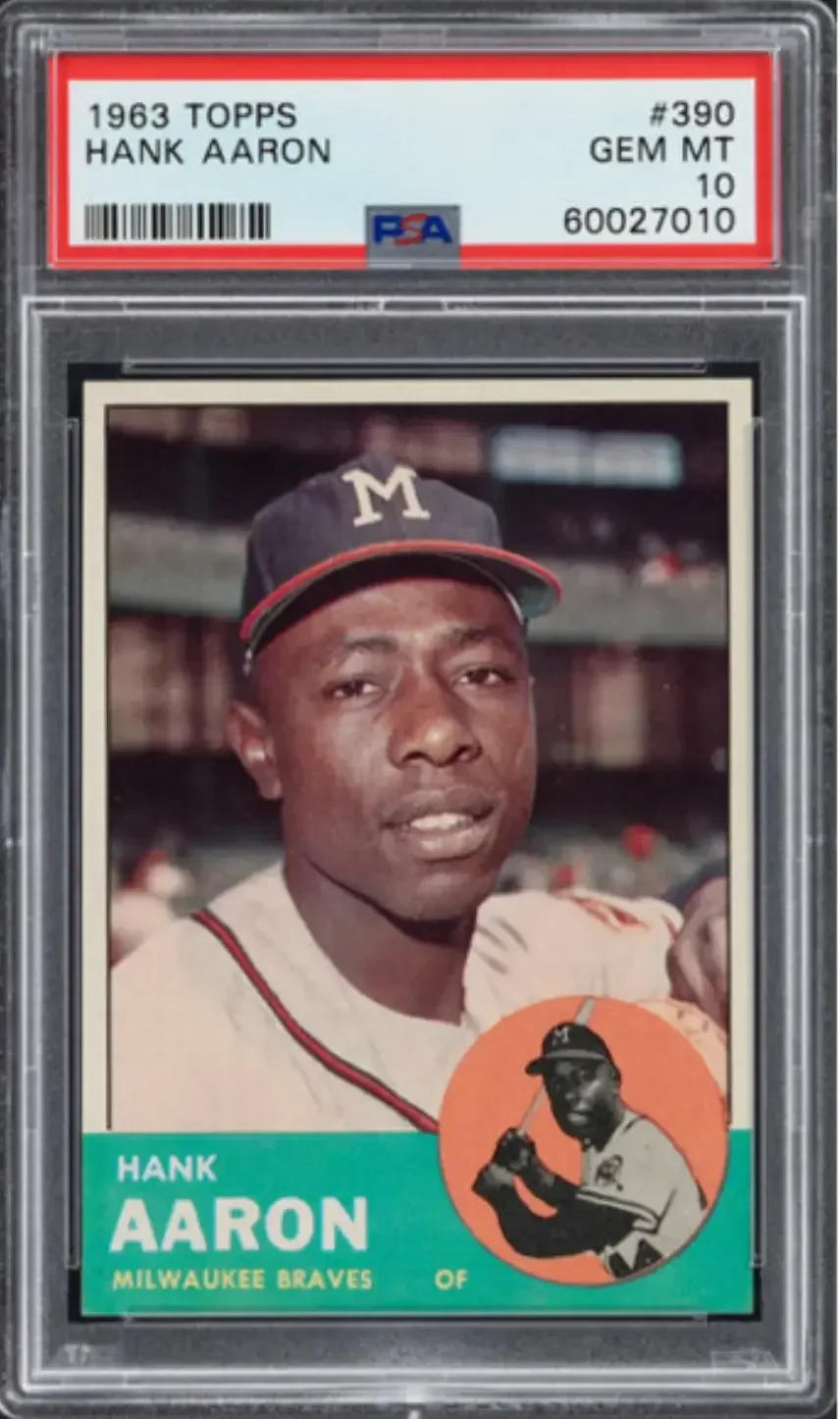
4. Hank Aaron 1963 Topps #390
Hank Aaron’s 1963 Topps card blends star power, visual appeal, and strong market history. It is one of the set’s central Hall of Fame singles and represents Aaron at a time when he was delivering one of the best all-around seasons in baseball.
In 1963, Aaron hit .319 with 44 home runs, 130 RBIs, and 31 stolen bases while leading the National League in both home runs and RBIs. That kind of production gives this card extra historical weight, especially for collectors who prioritize cards tied to peak performance years.
The top end of the market has been especially strong. The record sale is $222,000 for a PSA 10, achieved on November 18, 2022. In more common collector grades, a PSA 6 sits around $585 and a PSA 3 around $190. PSA’s population report lists 4,007 graded copies, including two PSA 10s and 38 PSA 9s.
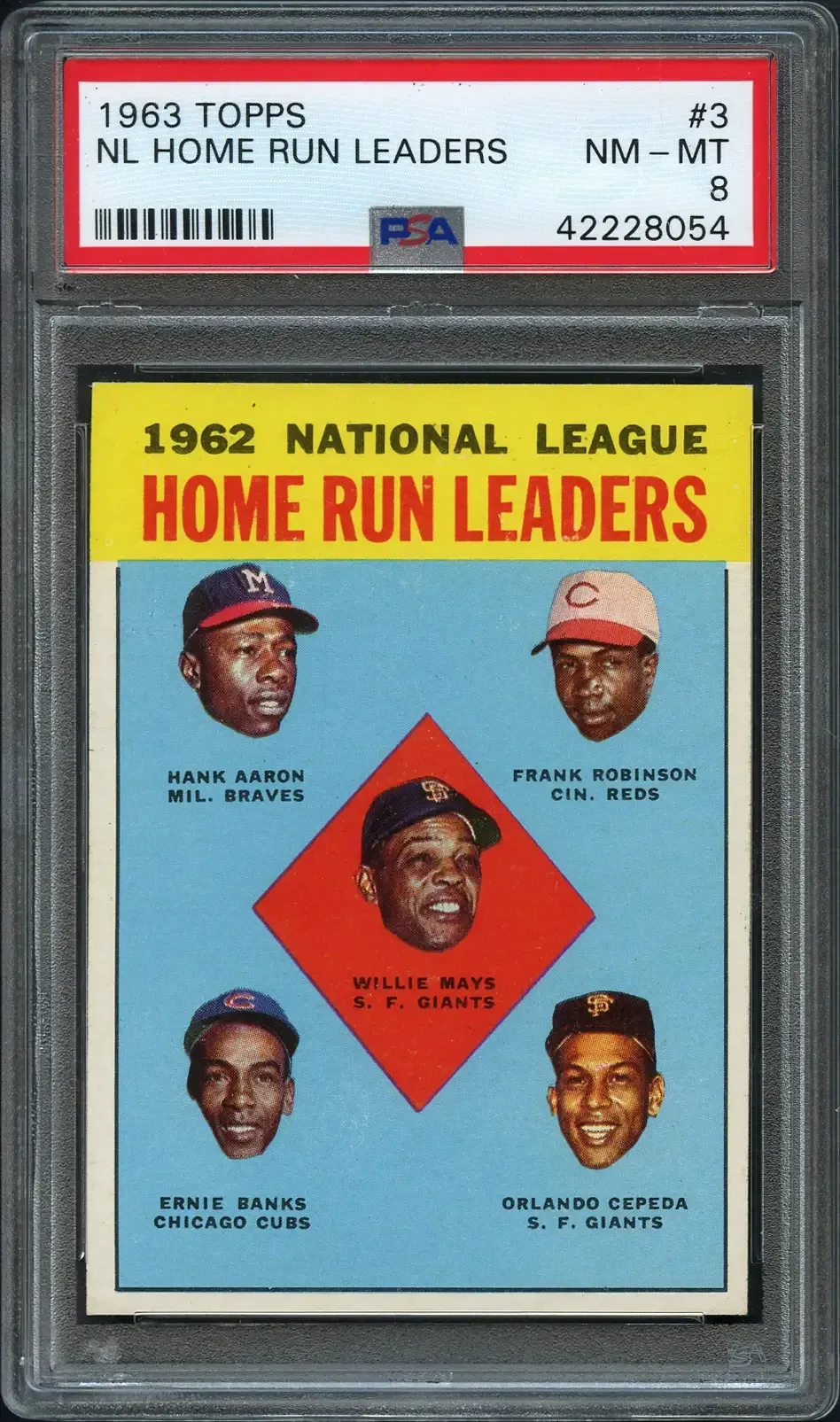
One of the more striking details with this card is how much the market has moved in recent years. A PSA 8 that could be purchased for under $200 in 2018 now sells for more than $2,000. Aaron also appears on one of the set’s notable multiplayer cards, Power Plus #242 with Ernie Banks, as well as the 1962 National League Home Run Leaders card #3 featuring five Hall of Famers: Aaron, Willie Mays, Frank Robinson, Ernie Banks, and Orlando Cepeda.
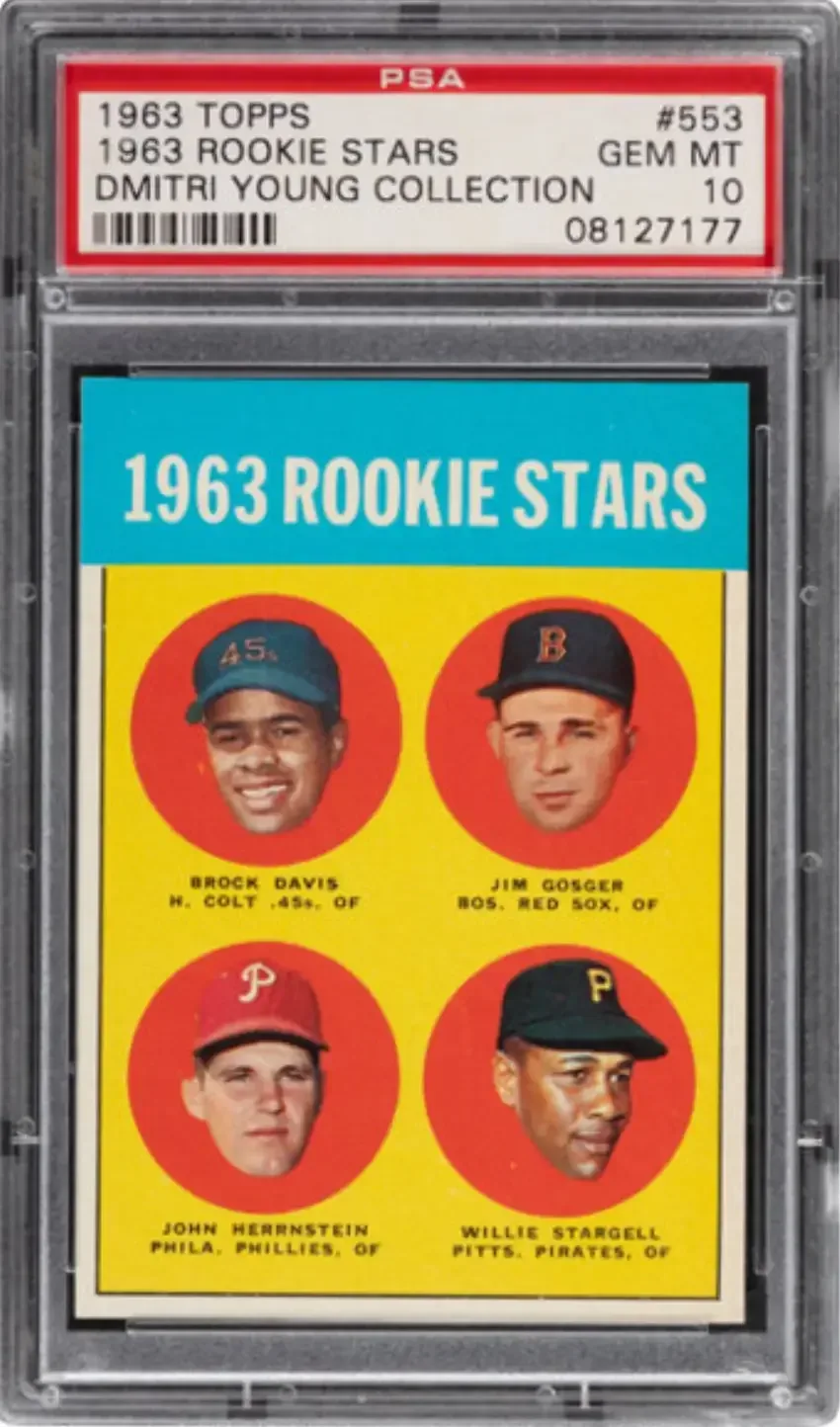
3. Willie Stargell Rookie Stars 1963 Topps #553
The 1963 Topps Willie Stargell rookie is one of the set’s most important long-term keys. Issued as a Rookie Stars card, it pairs Stargell with Brock Davis, Jim Gosger, and John Herrnstein, which was a common Topps format for the era. Even so, there is no doubt which name drives collector demand today.
Stargell is one of only two Hall of Fame rookies in the set, alongside Tony Oliva’s rookie card #228. That alone gives #553 a special place in the checklist. More importantly, Stargell went on to build a Hall of Fame career that made this multiplayer rookie a must-have for player collectors and vintage set builders alike.
The all-time high for the card is $63,000 for a PSA 10 sold on May 5, 2021. Current benchmark pricing places PSA 6 examples around $652 and PSA 3s around $234. PSA has graded 3,656 copies, with two PSA 10s and 35 PSA 9s recorded.
Collectors also appreciate the card because it predates Stargell’s greatest achievements by years, offering a true early-career piece from a player who later carved out a unique place in baseball history. In 1979, Stargell became the only player ever to win NL MVP, NLCS MVP, and World Series MVP in the same season.
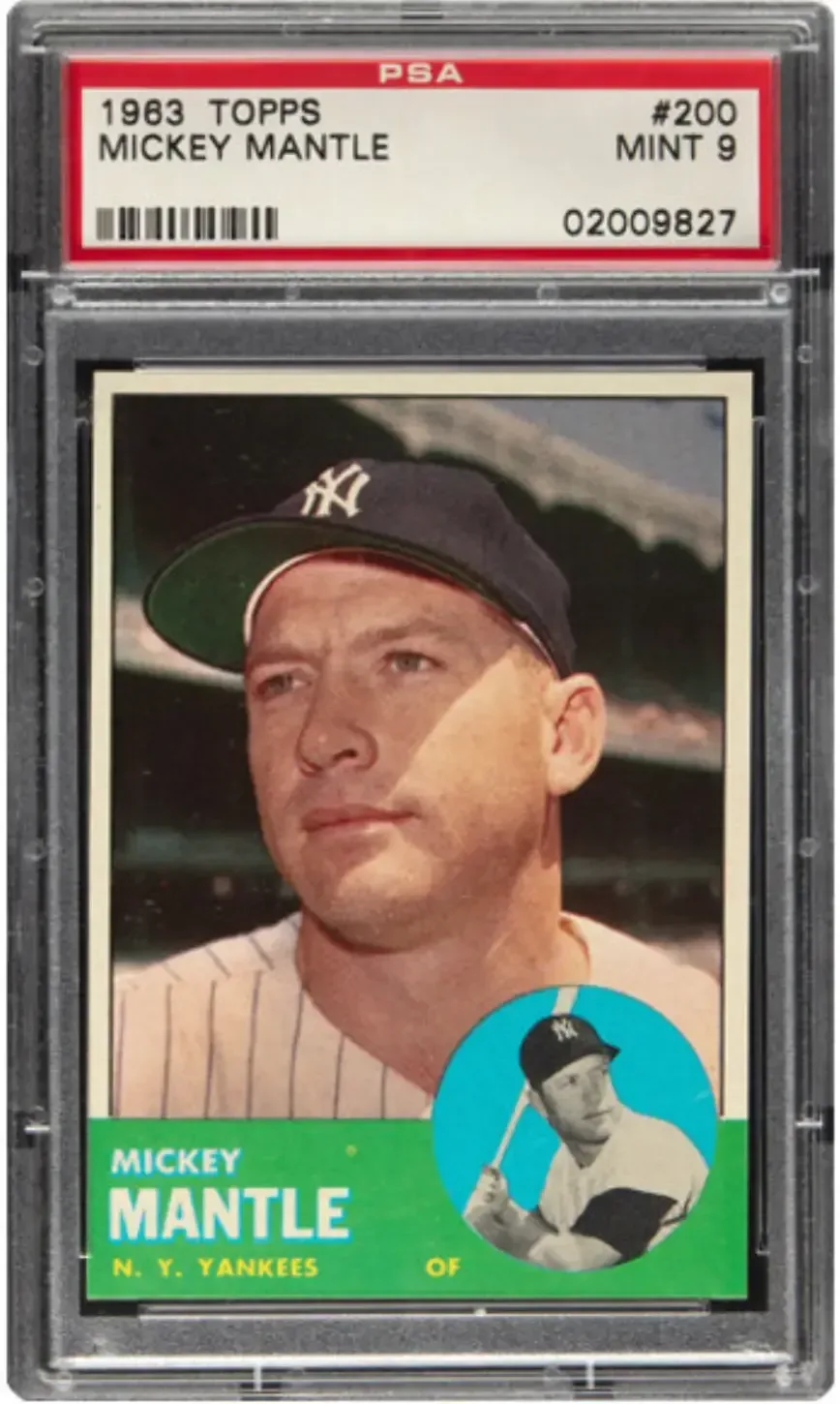
2. Mickey Mantle 1963 Topps #200
Mickey Mantle is typically the headline card in most 1960s Topps sets, and while that is slightly more complicated in 1963 because of the Pete Rose rookie, Mantle’s #200 remains one of the issue’s biggest hobby pillars. Recent sales have only strengthened that status.
A PSA 9 copy sold for $317,200 on October 24, 2026, setting a new high-water mark for the card and tripling its previous peak. That result illustrates the power Mantle still holds in the vintage market, especially when elite condition meets one of Topps’ strongest 1960s designs.
There is a dramatic long-term price story here as well. A PSA 9 sold for just $3,800 back in 2009, making the latest record one of the more eye-opening examples of high-grade vintage appreciation. Even in more modest grades, the card remains a major financial commitment, with PSA 6 pricing around $2,300 and PSA 3 around $603.
PSA has graded 8,960 copies, including two PSA 10s and 40 PSA 9s. Mantle’s large overall population reflects his popularity, but the challenge of finding clean, well-centered examples with strong color and limited border wear keeps upper-grade copies extremely competitive.
Historically, the card captures Mantle just after his 1962 MVP season. Injuries limited him to 65 games in 1963, but his place in the hobby was already cemented. Mantle also appears elsewhere in the set on the 1962 AL Batting Leaders card #2 with Pete Runnels and Leon Wagner, plus Bombers' Best #173 with Bobby Richardson and Tom Tresh.
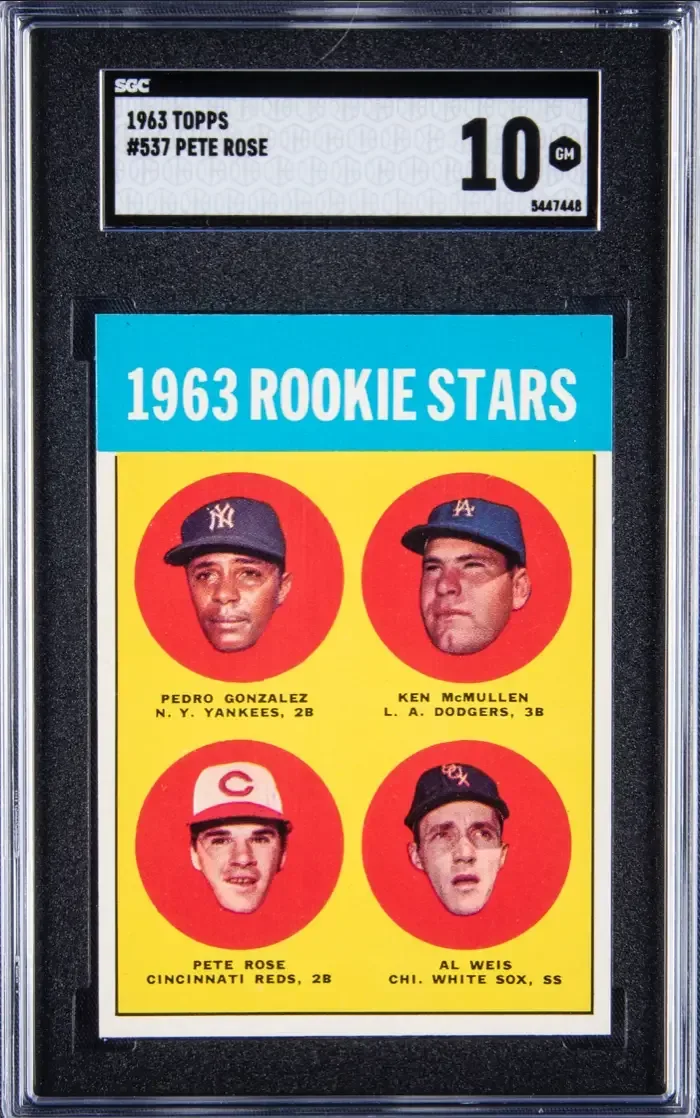
1. Pete Rose Rookie Stars 1963 Topps #537
The most iconic card in the set is Pete Rose’s 1963 Topps Rookie Stars card. For many collectors, it is not just the centerpiece of 1963 Topps, but one of the defining baseball cards of the entire 1960s.
Part of the card’s enduring importance comes from hobby classification. Although some casual collectors have confused Rose’s 1964 card for a rookie, the recognized rookie issue is the 1963 Topps floating-heads Rookie Stars card. That distinction has kept #537 at the center of the vintage baseball market for decades.
Rose rewarded that early billing immediately on the field, winning the National League Rookie of the Year award in 1963 after batting .273 with 170 hits for Cincinnati. That instant success helped tie the card to one of baseball’s best-known career arcs from day one.
The market performance has been strong across the board. The all-time high is $264,000 for an SGC 10 sold on May 24, 2021. PSA 6 copies are around $3,380 and PSA 3 examples around $1,385. PSA’s population report shows 7,712 graded copies, with one PSA 10 and 30 PSA 9s.
The lower-grade market has also climbed sharply. A PSA 2 sold for only $394 in 2020, while the last known PSA 2 sale reached $1,344. That kind of movement shows how broad the demand remains, from entry-level vintage buyers to elite-condition investors.
Other notable 1963 Topps cards to watch
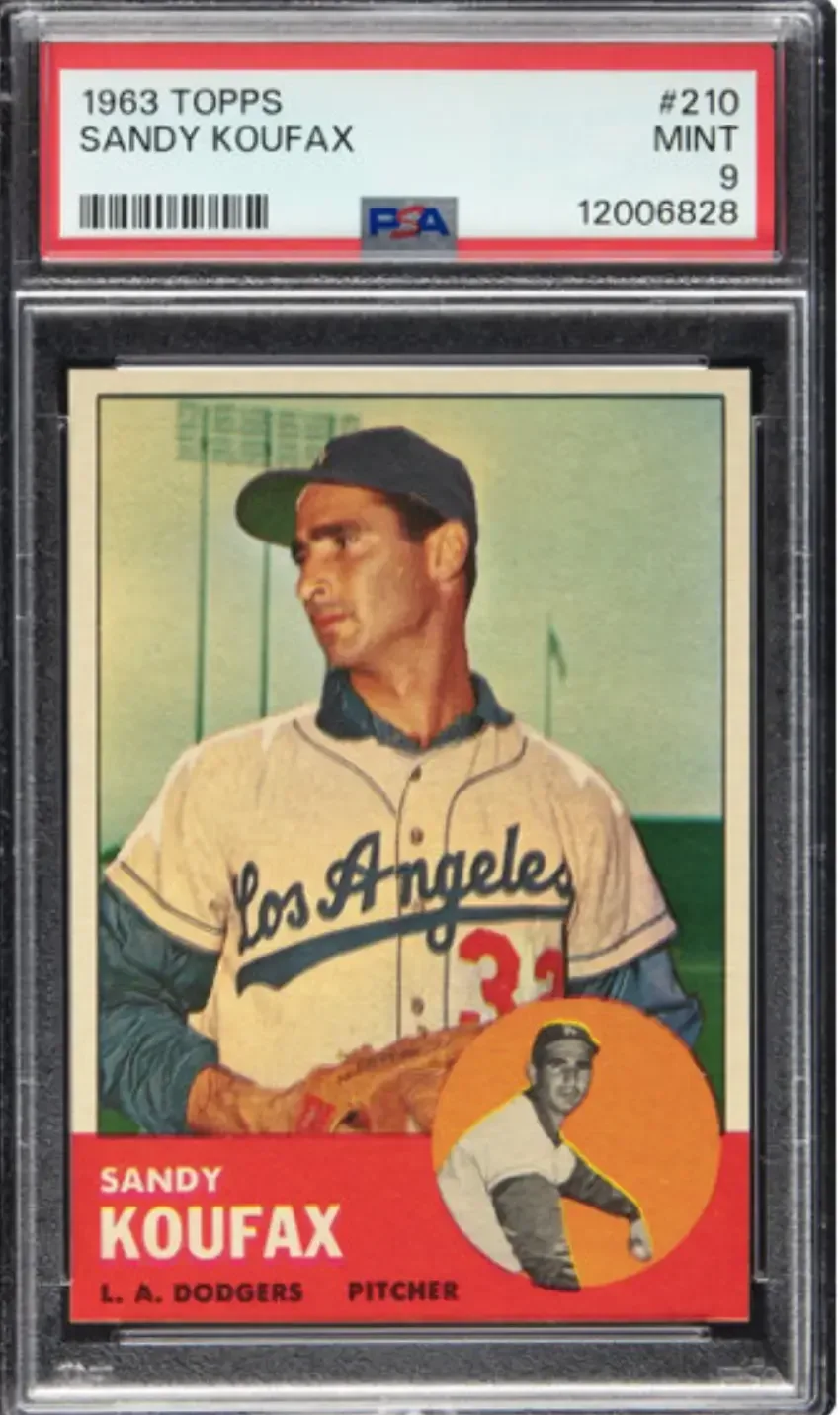
Even after the six biggest names, the set remains loaded with collector interest. Sandy Koufax #210, Yogi Berra #340, Ernie Banks #380, Bob Gibson #415, Tony Oliva rookie #228, and Bob Uecker #126 all help deepen the checklist.
For collectors working within a budget, these second-tier keys can be especially appealing because they still offer major names and strong vintage aesthetics without reaching the same price levels as Mantle or Rose. The multiplayer cards also remain a rich area for exploration, especially for collectors who enjoy unusual combinations of stars and Hall of Famers on one card.
What collectors should know about condition and scarcity
Condition is a huge factor across the 1963 Topps set. The design is attractive, but the colored bottom borders chip easily, and centering can be an issue. That makes sharp, high-grade examples much tougher than raw population counts may suggest.
Series placement matters too. Cards from the later portions of the set, especially the seventh series, are typically tougher and can carry added demand because of scarcity. That is a major reason why the Clemente #540 stands out so much among the set’s star cards.
Collectors who want a representative card from the set without chasing top pop examples can still find opportunities in mid-grade copies. The mix of iconic stars, legitimate rookie content, and memorable multiplayer cards gives 1963 Topps unusual depth whether the goal is one key single, a star run, or a full vintage build.
Photo Gallery