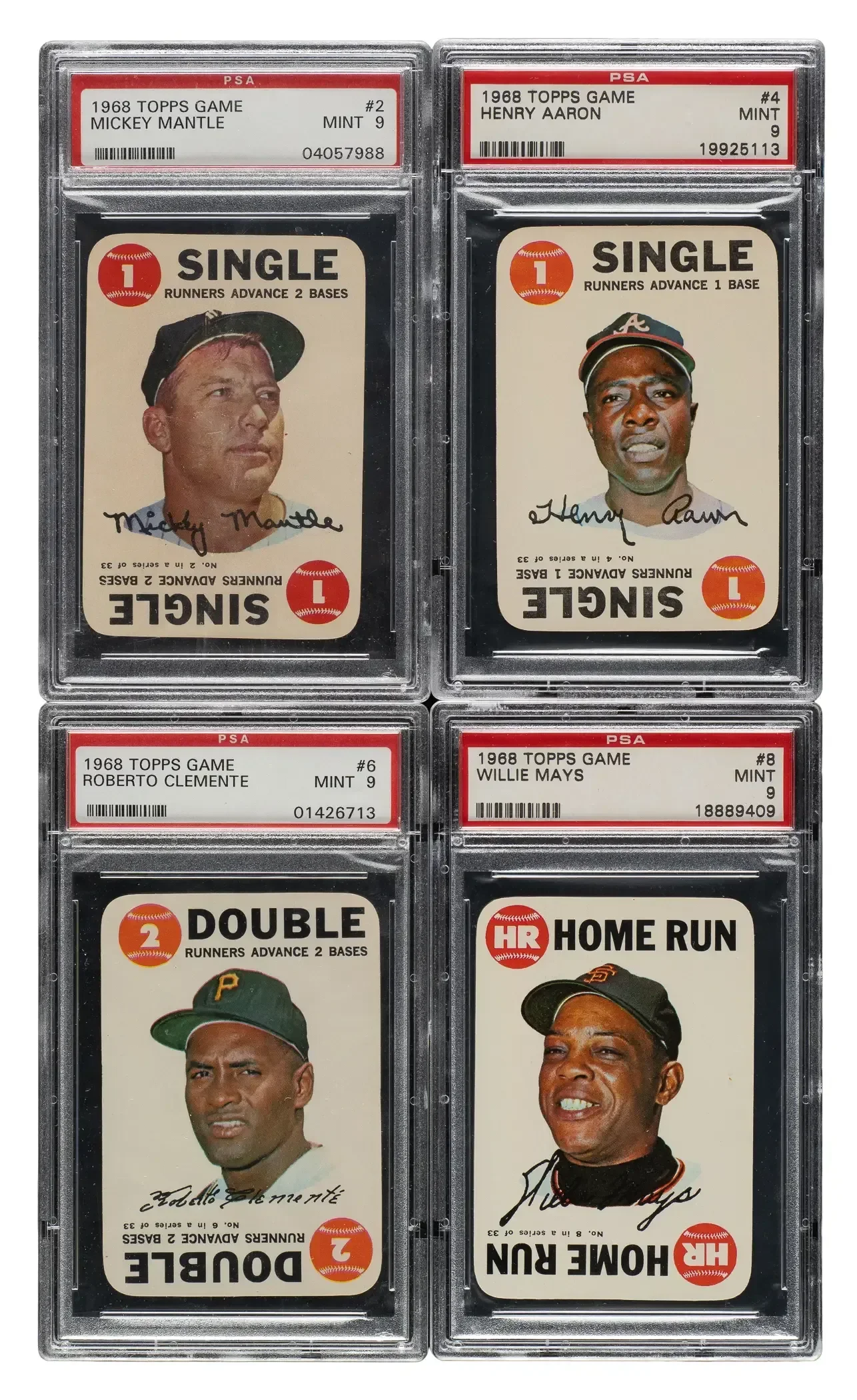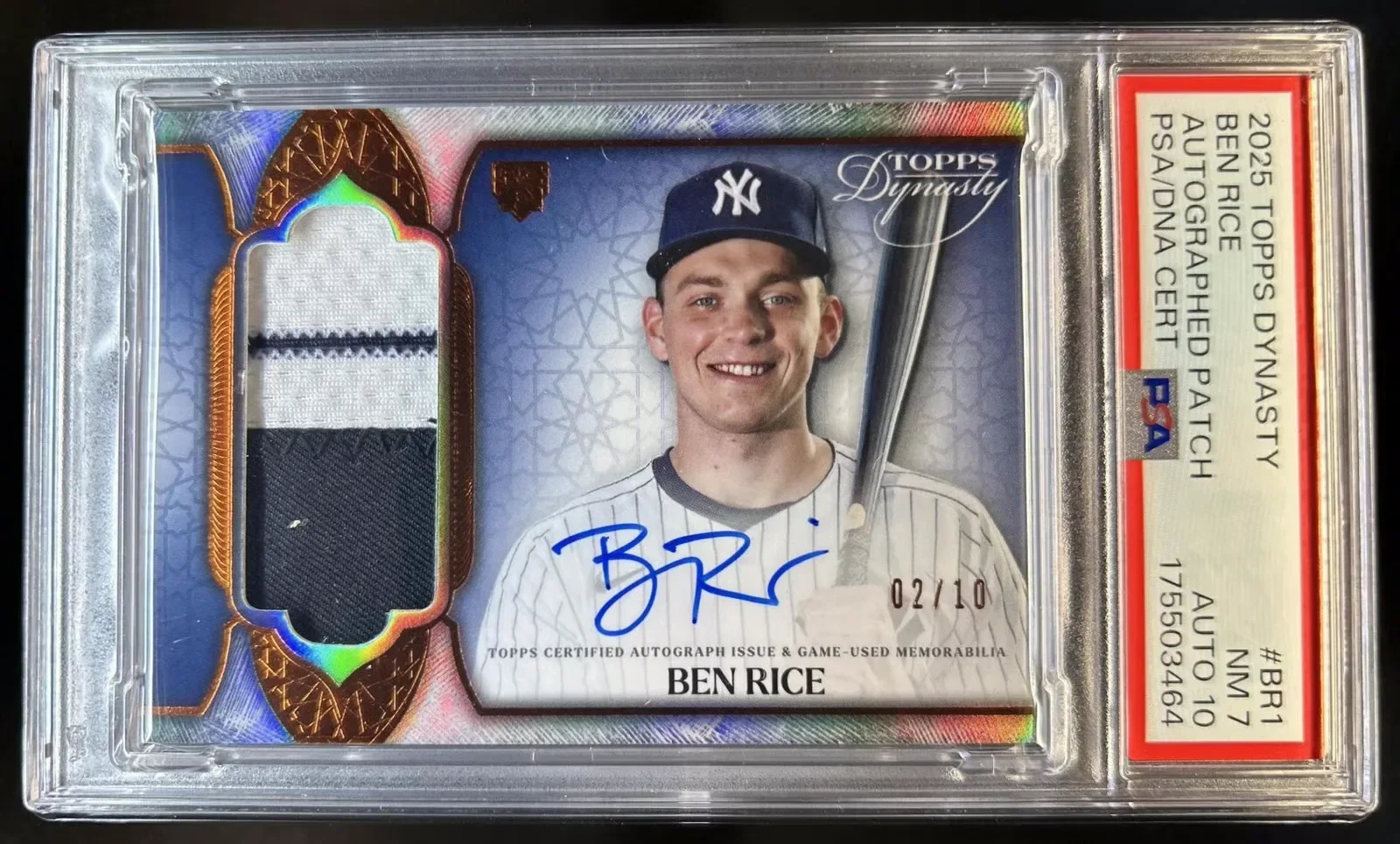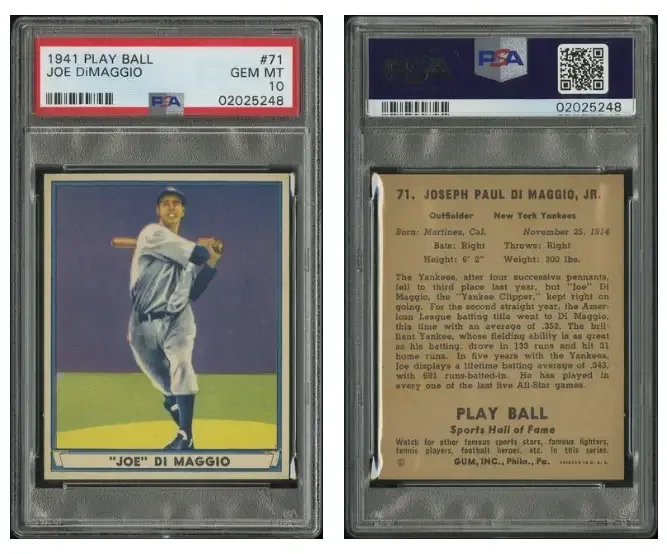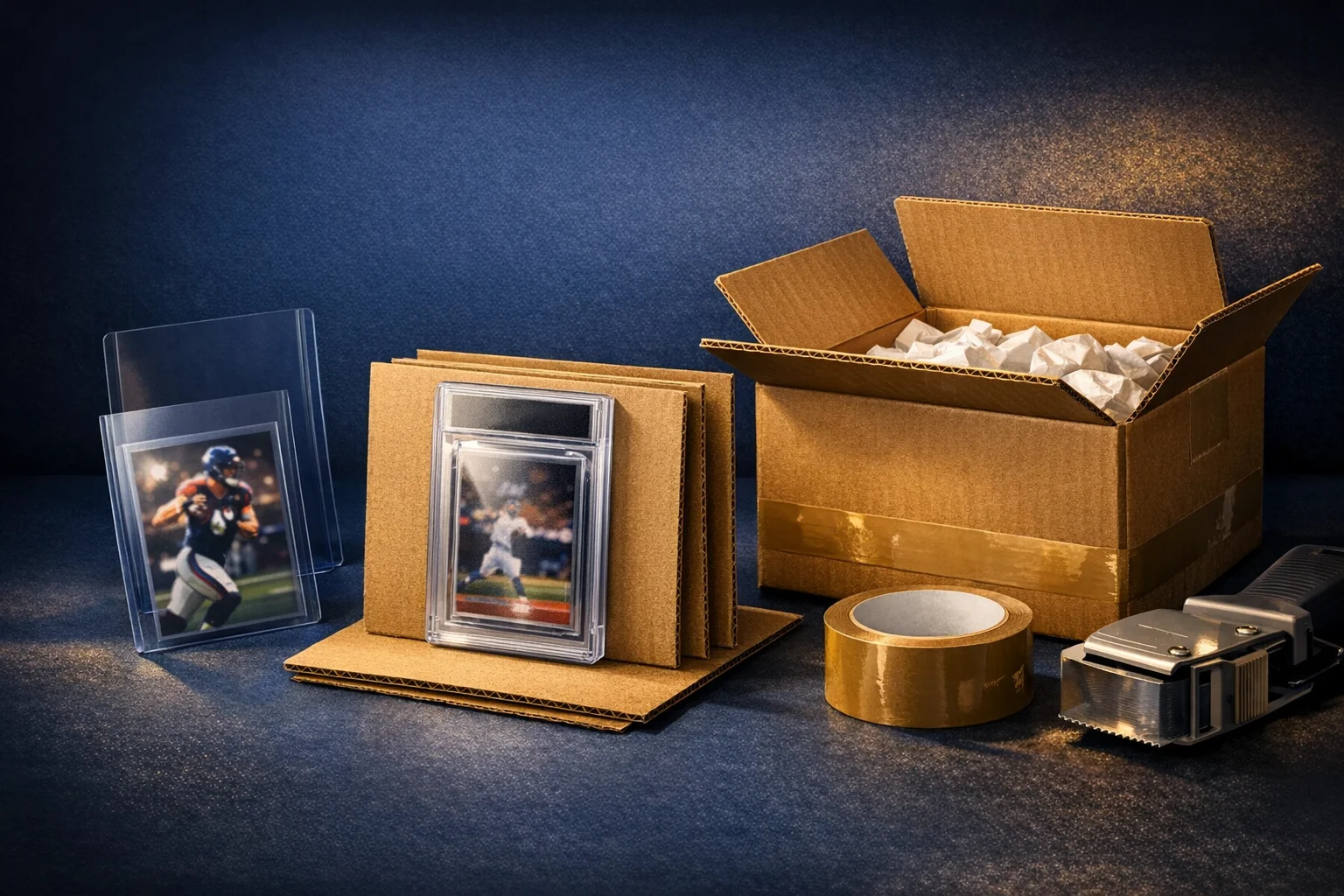
Adhesive damage usually starts with a good intention. A seller wants to stop a card from sliding, keep a holder closed, or make a stack feel secure, so tape gets added near the card. That small shortcut can leave residue, catch an edge, or create extra handling when the package is opened.
The safer approach is simpler than many collectors think: choose the right inner holder first, stabilize the package mechanically, and reserve strong shipping tape for the outside of the box. Official guidance from PSA, eBay, and SGC points in that direction, with one especially important distinction: what makes sense for the outer carton is not the same as what belongs near the card itself.
If you ship to grading, sell online, or trade with other collectors, the goal is not zero movement at any cost. The goal is controlled, thoughtful protection with as little sticky contact near the card as possible.
1. The core rule: solve movement with structure before you reach for tape
The cleanest way to avoid adhesive damage is to stop treating tape as the main protection system. The most consistent official guidance emphasizes holders, cardboard support, rubber bands, void fill, and proper boxing. In other words, build a stable package first, then ask whether any adhesive is still necessary near the card at all.
That matters because adhesive creates two risks at once. First, it can leave residue on a holder or on a bag touching the holder. Second, it forces more handling during opening. A buyer, grader, or receiving department has to peel, pull, or cut something away, and every extra motion near a card increases the chance of a mistake.
PSA’s shipping instructions are especially direct for submissions: place each card in a penny sleeve and then into a semi-rigid holder, and do not use toploaders, tape, pull tabs, or sticky notes. SGC’s official submission paperwork also points submitters to semi-rigid holders. Read together, those instructions make the larger principle clear. The first line of defense should be the correct holder and a stable bundle, not adhesive applied to each individual card package.
For collectors, the practical takeaway is straightforward. When you are deciding between adding more tape or adding more support, support is usually the better answer. A tighter package design often removes the need for tape near the card altogether.
- Think in layers: inner holder, rigid support, bundle control, outer box.
- Treat adhesive as a last resort near the card, not the default solution.
- If a package feels loose, improve the structure before adding sticky fixes.
2. For raw cards going to grading, follow the submission standard exactly
If the destination is PSA, the safest move is not to improvise. PSA’s guidance is plain: each card goes into a clear penny sleeve and then into a semi-rigid holder. Just as important, PSA says not to use toploaders, tape, pull tabs, or sticky notes on submission holders.
That last part is where many collectors create avoidable problems. A taped semi-rigid may feel more secure on your desk, but it adds friction for the grader who must remove the card. Pull tabs and sticky notes may seem helpful, yet PSA explicitly says not to use them. If your goal is to reduce handling risk and avoid delays, the cleanest path is to send the holder exactly as requested.
PSA’s older how-to-submit guide reinforces the same approach. It points collectors toward a sleeve or mylar sleeve inside a Card Saver-style holder and warns against labels or stickers on those holders. The continuity between the live shipping guide and the older official PDF matters because it shows this is not a one-off preference; it is a long-standing submission expectation.
A useful habit is to separate your shipping workflows by destination. Build one routine for grading submissions and another for marketplace sales. That avoids a common mistake: borrowing a sale-shipping habit, like sealing a top loader, and applying it to a grading order where the grader has asked you not to.
As of the research date, collectors sending to PSA should treat penny sleeve plus semi-rigid holder, with no tape or tabs on the holder, as the baseline standard rather than a suggestion.
- Submission workflow: penny sleeve, then semi-rigid holder.
- Do not add tape, pull tabs, sticky notes, or labels to submission holders.
- Avoid substituting a top loader when the grader specifically requests semi-rigids.
3. For raw cards sold to other collectors, the holder choice can change
Sale shipments are different from grading submissions, and your packing choices can widen a bit. eBay’s official sports-card shipping guidance says that for raw cards in the relevant value bands, the card should go into a penny sleeve before being placed into a card saver, a top loader, or a cardboard sandwich. That gives collectors more flexibility than a grading submission workflow.
The key is to match the holder to the shipment rather than forcing one method onto every order. A semi-rigid holder works well when you want easier removal and lighter packaging. A top loader can make sense when the card is heading to another collector and the package design keeps it from shifting. A cardboard sandwich can be useful when you want flat, rigid support without relying on a plastic holder alone.
There is a tradeoff here. Greater flexibility means more opportunities to overpack the wrong way. For example, a collector may choose a top loader and then overcompensate by wrapping it in aggressive tape. The official guidance does not support that. Instead, it suggests starting with the penny sleeve and then using one of the accepted protective formats thoughtfully.
A practical scenario helps. If you are mailing a single mid-range raw card to a buyer, penny sleeve plus top loader may be perfectly reasonable if the outer mailer is snug and the card cannot migrate. If you are sending a small stack of raw cards, a card saver or organized cardboard sandwich may make a cleaner package because it reduces the temptation to tape each item individually.
The point is not that one holder is universally best. The point is that the right holder should reduce the need for adhesive, not create a new tape problem you then have to solve.
- For sale shipments, eBay supports penny sleeve plus card saver, top loader, or cardboard sandwich.
- Choose the format that minimizes shifting and unnecessary handling.
- Do not assume the grading-submission method is the only acceptable sale-shipping method.
4. If you seal a top loader, use lower-residue options and keep it minimal
Collectors often want a yes-or-no answer on taping a top loader, but the better answer is conditional. For PSA submissions, the answer is no because PSA says not to use toploaders, tape, pull tabs, or sticky notes on submission holders. For collector-to-collector sales, eBay’s official sports-card page takes a more practical view and says top loaders can be sealed with blue painter’s tape or masking tape to help prevent slippage without leaving sticky residue behind.
That does not mean every tape labeled painter’s tape or masking tape is magically harmless in every situation. eBay’s guidance supports them as preferred low-residue options in this use case; it does not promise universal, brand-independent residue-free performance. So the safest reading is modest: if you must secure a top loader for a sale shipment, use the lower-residue tape options eBay identifies rather than a high-tack alternative.
Minimal use matters too. The more adhesive area you create, the more force the recipient must use to open the holder. In practical terms, your goal is closure, not mummification. A small amount of appropriate tape can help stop a card from sliding out of a top loader in transit. Multiple strips wrapped tightly around the holder create a new problem for the person opening it.
This is also where collector judgment comes in. If the top loader is already secured inside a snug cardboard sandwich or well-fitted mailer, you may not need to tape the top loader at all. That is analysis, not an official measurement, but it follows the broader evidence-backed principle: rely on package structure first and use the least adhesive necessary near the card.
For buyers, this rule can also become a checklist when evaluating sellers. Ask yourself: was the holder chosen sensibly, or did the shipper lean on excess tape to compensate for a loose package design? The answer often tells you how carefully the rest of the shipment was built.
- For PSA submissions: no tape on holders.
- For eBay-style sale shipments using a top loader: blue painter’s tape or masking tape is the officially suggested choice.
- Use the smallest practical amount if tape is actually needed.
5. Mechanical stabilization beats sticky fixes for stacks and bundles
One of the most useful official instructions for adhesive avoidance has nothing to do with tape choice. It is the recommendation to stabilize card stacks mechanically. PSA says to place the stack between two cardboard dividers and secure it with two to three rubber bands, tight enough to prevent shifting but not so tight that you create pressure damage. PSA’s older submission PDF describes the same larger idea: slightly larger cardboard pieces around the stack, held together without packing too tightly.
This is an important mindset shift. Many adhesive mistakes happen because collectors try to secure each card one by one instead of securing the bundle as a whole. Once a stack is aligned, sandwiched, and held in place properly, the package usually needs much less fiddly inner taping.
Mechanical stabilization works especially well for grading submissions and grouped raw-card shipments. Semi-rigids inside a cardboard-protected stack are easier to handle, easier to unpack, and less likely to arrive with residue issues than a pile of individually taped holders. SGC’s submission guidance, while shorter, fits the same theme by directing collectors to Card Saver I or Ultra Pro semi-rigid holders to prevent delays.
There are honest tradeoffs. Rubber bands used carelessly can be too tight. Cardboard cut too small can expose corners. A stack packed too densely can create pressure, while a stack packed too loosely can shift. But those are design problems you can inspect and correct before shipping. Residue or tearing from adhesive often shows up after the fact, when the recipient is already opening the package.
A practical checklist helps here. Make sure your cardboard dividers are slightly larger than the holders. Make sure the stack is snug enough not to rattle. Make sure the securing pressure is firm but not compressive. If you can gently shake the packed inner bundle and nothing moves, you have likely solved the right problem without adding adhesive near the cards.
- Use cardboard dividers larger than the holders.
- Secure the stack firmly but not tightly enough to damage edges or corners.
- Test for movement at the bundle level before sealing the outer package.
6. Slabs need rigid support and void control more than adhesive tricks
With graded cards, the official evidence is less about anti-residue tape technique and more about physical support. eBay’s sports-card guidance says graded cards should go into a cardboard sandwich before shipping. It also says that when you are shipping more than 15 raw cards or two graded cards, you should move up to a small box with tissue paper or bubble wrap used as fill.
That is a useful priority order for slab shipments. First, protect the slab from bending or edge impact with rigid support. Second, prevent movement inside the package. Third, size the package to the shipment. None of those steps requires adhesive directly on the slab itself.
This is where collectors should be careful not to overstate hobby habits as official rules. Many people use graded-card sleeves, resealable bags, or other slab-wrapping techniques in ordinary practice, but the strongest primary guidance here does not give a detailed official bagging method focused on adhesive avoidance. So the defensible takeaway is narrower: the official emphasis is on cardboard support for a graded card and box-plus-fill for multiples.
In practical terms, a single slab often benefits from a rigid sandwich that keeps the holder from flexing and protects it in transit. Two or more slabs usually deserve a small box with enough fill to stop internal movement. If slabs can knock into each other inside the box, you have not finished the job, even if the outside seam is taped perfectly.
A useful self-check before sealing is to imagine the package turned on each side. Does the slab stay centered? Can the contents shift enough to create impact points? If yes, add support or fill, not more adhesive to the slab. That approach lines up with the official guidance that exists and avoids pretending there is a fully documented primary-source slab-taping standard when there is not.
- Single graded card: cardboard sandwich is the official baseline.
- Multiple graded cards: use a small box with void fill.
- Prioritize immobilization through fit and fill, not by taping directly to the slab.
7. The biggest packing mistake is confusing inner-package rules with outer-box rules
Collectors often blend together two very different jobs: securing cards inside the package and sealing the package for shipment. The tools for those jobs are not the same. PSA’s shipping guide is explicit on both sides of that divide. Inside the package, it says not to use tape, pull tabs, or sticky notes on submission holders. Outside the package, it says to seal all seams of the shipping box with packing tape and to avoid painter’s tape, scotch tape, or reused tape for that purpose.
That distinction is easy to miss because painter’s tape appears in legitimate hobby guidance for one narrow use: eBay suggests it or masking tape for sealing a top loader in a sale shipment. But that does not mean painter’s tape is appropriate for the carton itself. PSA says the opposite for outer-box sealing. A collector who uses low-tack tape on the shipping box may end up with a weak outer seal even while trying to be careful.
So think of your shipment as two zones. The inner zone, where the card or slab lives, calls for restraint and low handling. The outer zone, where the package faces sorting, friction, and transit stress, calls for proper shipping-grade tape on the seams. Mixing those rules usually leads to either residue risk inside or inadequate sealing outside.
This distinction is also helpful when supplies are limited. If you only have one roll of quality packing tape, save it for the box. Do not use it to close a top loader. If you have blue painter’s tape for a top loader in a marketplace shipment, do not assume it is good enough to replace proper carton sealing tape. The package works best when each material does its own job.
Collectors who internalize this two-zone approach tend to build cleaner shipments overall. They stop trying to solve every problem with the same tape and start matching materials to the risks that actually exist.
- Inner package: minimize adhesive near the cards.
- Outer package: use proper packing tape on box seams.
- Do not substitute painter’s tape or reused tape for outer-box sealing.
8. Three practical packing workflows you can use right away
A good packing guide should end with decisions you can actually apply. Here are three evidence-based workflows built from the official guidance, with analysis added only where a collector must make a practical choice.
Workflow one: raw card to a grader. Use a penny sleeve and then a semi-rigid holder. Do not add tape, pull tabs, or sticky notes to the holder. Group the cards into an orderly stack, place them between slightly larger cardboard dividers, and secure the bundle so the cards cannot shift. Then place the protected bundle into the shipping box with enough cushioning as needed, and seal the outside seams with proper packing tape. This is the cleanest path when the destination is PSA, and SGC’s semi-rigid instruction supports the same general holder choice.
Workflow two: single raw card sold to a buyer. Put the card in a penny sleeve and then choose a card saver, top loader, or cardboard sandwich. If you choose a top loader and the card could slip, eBay’s guidance supports blue painter’s tape or masking tape as the preferred sealing option because it helps prevent slippage without leaving sticky residue behind. Then place that protected card into a rigid mailer or appropriately sized outer package so the holder itself does not rattle around.
Workflow three: one or two slabs sold online. Use a cardboard sandwich for a single graded card. If you are shipping multiple graded cards, move up to a small box and use tissue paper or bubble wrap to control movement inside. The official evidence here is about support and void fill, so focus on immobilization and fit rather than inventing elaborate taped-on-slab techniques.
In all three cases, the same decision tree applies. First ask what the destination requires. Next choose the holder that fits that destination. Then build a stable inner package that limits handling and movement. Only after that should you decide whether any adhesive is needed near the card, and in many well-built packages, the honest answer is very little or none.
That is the larger lesson behind all the official guidance. A shipment is safest when your protection comes from the right holder, smart support, and correct box sealing, not from a desperate last layer of sticky improvisation.
- Grading submission: penny sleeve plus semi-rigid, no tape on holders.
- Marketplace raw sale: penny sleeve plus accepted holder; low-residue tape only if truly needed on a top loader.
- Slabs: cardboard support for singles, small box with fill for multiples, packing tape reserved for the outer carton.
Illustration generated for this guide; not a photograph of an actual card, product or event.
Photo Gallery