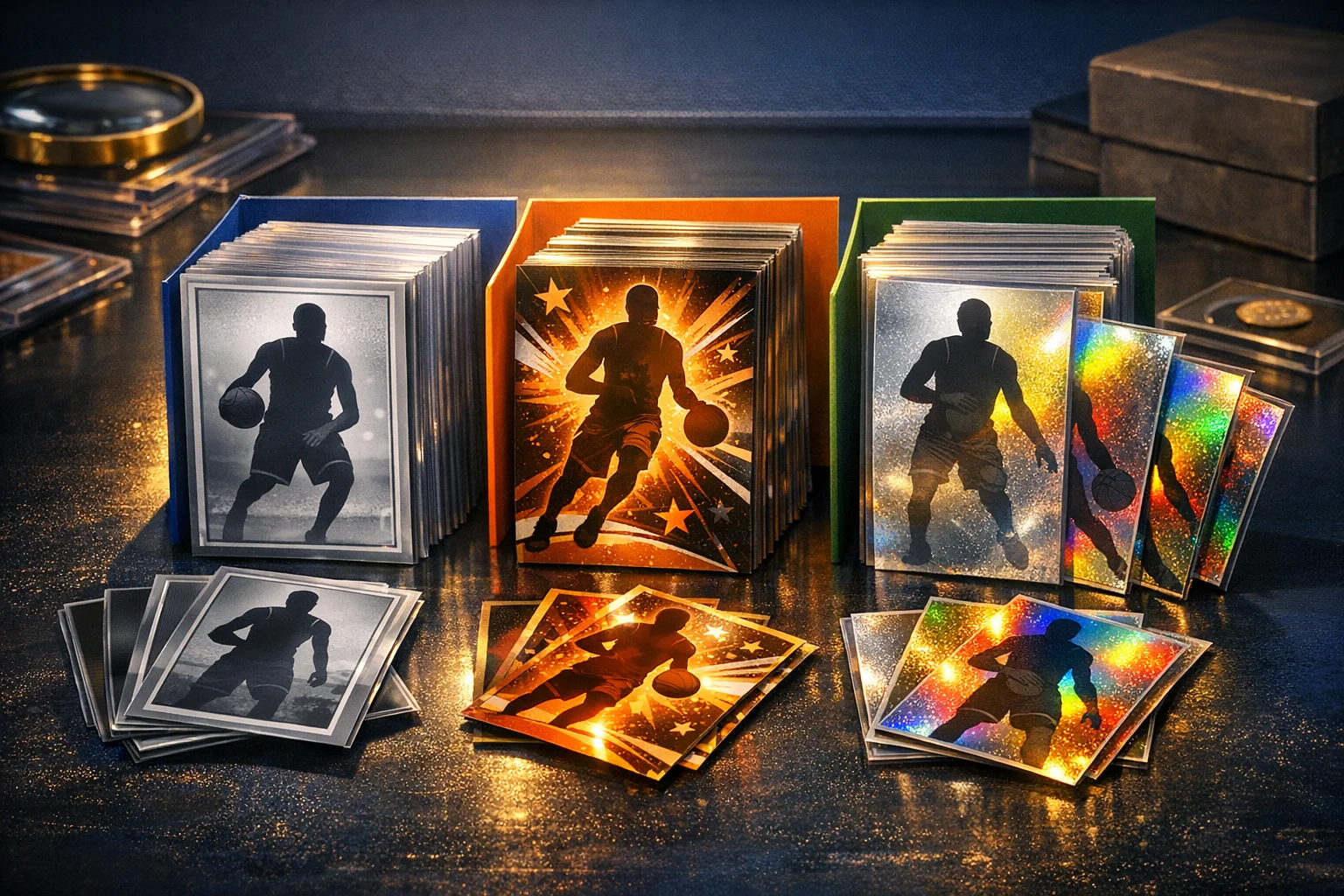
1997 Metal Universe Basketball is having a moment that goes far beyond rare inserts. In 2026, collectors have pushed several base cards from the set to levels that would have looked unrealistic just a few months earlier, with major jumps showing up across stars, rookies, and iconic names from the era.
The most eye-catching move may be Tim Duncan’s rookie. A PSA 9 copy recently sold for $395 after similar sales around $35 in April, a gain of more than 1,000 percent in less than five months. Michael Jordan’s 1997 Metal Universe #23 in PSA 9 moved from $300 on May 27, 2025 to $3,183 on September 7, 2026. Kobe Bryant’s #81 in PSA 9 climbed from $154 on September 6, 2025 to $1,650 on September 8, 2026.
Those are not obscure parallels, serial-numbered short prints, or once-in-a-blue-moon insert sales. They are base cards from a product released nearly 30 years ago. That makes the spike especially notable and suggests the market is re-evaluating the set itself, not just reacting to isolated player demand.
Why the 1997 Metal Universe base set is suddenly getting re-priced
The easiest explanation is that collectors are starting to treat 1997 Metal Universe as one of the defining basketball releases of the 1990s. For years, the hobby has viewed the decade as loaded with memorable products but lacking one clear flagship set that stands above the rest in the way 1986 Fleer does for the 1980s.
For more collector background, read 1997 Metal Universe Football Marvel Metal Inserts Surge as 1990s Card Demand Climbs.
Metal Universe now has a real argument. It checks multiple boxes at once: a loaded star lineup, key rookie cards, unforgettable design, deep nostalgia, and one of the most important parallel brands the hobby has ever seen. When collectors decide a set matters historically, attention often starts at the top and then spreads through the checklist. That pattern seems to be unfolding here.
The early gains have centered on the names most likely to move any basketball market: Jordan, Kobe, Duncan, and Shaq. But the broader story is that collectors appear to be assigning more importance to the release as a complete set, not just cherry-picking a single rookie or star card.
The PMG halo effect is likely driving base card demand
It is impossible to separate 1997 Metal Universe from Precious Metal Gems. The red and green PMGs from this release are among the most recognizable and coveted basketball cards ever made. They have long existed in a different tier of desirability, with prices that placed them out of reach for nearly every collector.
That matters because the base cards and PMGs use the same player images and core visual presentation. In other words, collectors who cannot buy a Jordan, Kobe, or Duncan PMG can still own the same iconic image on the regular Metal Universe base card.
Recent PMG sales show the magnitude of that brand power. A BGS 8.5 green Kobe Bryant PMG, numbered to 10, sold for $2 million in 2022. A PSA 5 red Michael Jordan PMG, numbered to 90, sold for $640,000 in March 2026. On August 13, 2026, a 1997 Metal Universe Michael Jordan PMG numbered to 90 sold for $1.473 million. Weeks later, the standard Jordan base card using that same image sold for $1,400 on September 3.
Collector Mark Tanaka offered a direct explanation for why that crossover may be happening. In his view, the appeal of the 1997 Jordan is tied less to the date on the back and more to the cultural weight of the PMG version. That logic extends to other players in the set as well. The PMGs became legendary first. Now the hobby is reconsidering the images underneath them.
For many collectors, the base card has become the accessible version of a grail visual. That is a powerful pricing force, especially when the artwork is already ingrained in hobby memory.
The design still looks different from almost everything else
Another reason behind the surge is simpler: these cards still look incredible. The 1997 Metal Universe set leans fully into a comic book aesthetic with planets, futuristic backgrounds, fire, metallic textures, and exaggerated action poses. The cards feel loud, dramatic, and unapologetically 1990s.
That look was not an accident. Fleer/SkyBox was owned by Marvel Entertainment at the time, and Marvel artists helped shape the visual identity behind the set. The result is a basketball release that does not just capture the decade, but practically defines one of its most collectible visual styles.
The Jordan base card is a perfect example. He is shown attacking the rim with a flaming basketball against a cosmic background. It is bold in a way that many modern cards still chase. Even today, some of the hobby’s hottest inserts rely on comic-inspired visual energy because collectors respond to cards that stand out immediately in a display case, online listing, or social post.
That visual strength is helping 1997 Metal Universe age extremely well. Plenty of 1990s products are nostalgic. Fewer still feel as instantly recognizable and visually complete as this one.
Nostalgia is hitting at the right time
The collector base has also changed. Many hobby participants who grew up in the 1990s now have more spending power than they did during the first wave of the pandemic boom, and far more than they did when these cards were originally issued. When nostalgia meets capital, recognizable sets often get re-rated in a hurry.
1997 Metal Universe is especially well positioned for that kind of demand because it delivers a very specific memory. It does not just remind collectors of 1990s basketball. It reminds them of peak 1990s card design, peak insert culture, and a period when manufacturers were experimenting with style as aggressively as possible.
That matters in a market where collectors increasingly want cards with identity. A lot of products have stars. Fewer have a look that can be identified from across the room.
The checklist lands at a near-perfect point in NBA history
Timing is a major part of the set’s appeal. The 1997-98 NBA season sits at a crossroads of basketball history, and Metal Universe captures that transition in a single release.
Jordan was still leading the Bulls dynasty and would go on to win his sixth championship that season. Kobe Bryant was entering his second year and beginning the rise that would make him one of the hobby’s biggest pillars. Tim Duncan and Tracy McGrady arrived as rookies. Allen Iverson was entering his second season after one of the most memorable rookie campaigns of the decade.
At the same time, the league still featured prime or near-prime versions of Shaquille O’Neal, Hakeem Olajuwon, David Robinson, Patrick Ewing, Grant Hill, Scottie Pippen, Karl Malone, Kevin Garnett, and many other major names. Very few sets manage to connect so many eras at once. That gives 1997 Metal Universe a broad collector base and a deep roster of cards that can rise if momentum continues.
The sales pattern suggests this is spreading through the set
One of the more interesting parts of the current run is how the action appears to be widening. Jordan and Kobe were natural early movers because they sit near the top of basketball collecting in any era. Duncan followed with a sharp jump fueled by rookie-card demand and renewed interest in the set.
Duncan’s growth has been particularly aggressive. His raw 1997 Metal Universe rookie had been selling for under $10 earlier in 2026 and later moved above $60. A PSA 10 reached $2,280 after sitting around $250 in April. That kind of move goes far beyond the normal lift that comes from a strong player market and points back to the set-specific thesis.
Shaquille O’Neal has also joined the run. His PSA 9 card #50 sold for around $30 in May, then reached $550 in a sale on September 9. Shaq’s broader market has been hot, but a base card climbing by that magnitude in a few months is still difficult to ignore.
Tracy McGrady may be another signal that the market is expanding deeper into the checklist. His PSA 10 recently sold for $600 after similar levels around $100 in April. Less than a year earlier, that same grade was closer to $50. McGrady has a strong following, but not typically the kind of buying base that produces sixfold or tenfold jumps without a wider set-driven catalyst.
If the current pattern keeps spreading, names such as Allen Iverson and Kevin Garnett could attract more attention as collectors work farther down the checklist looking for recognizable stars, Hall of Famers, and key era cards that still trail the biggest names.
Population data adds another layer to the story
Part of the appeal here is that while these are base cards, gem-mint supply is not endless. Michael Jordan’s 1997 Metal Universe #23 has a PSA 10 population of 154 and a total PSA population of 8,263. Those numbers are not ultra-low by 1990s insert standards, but they are also not so large that high-grade copies can absorb unlimited new demand without price movement.
For context, the 1986 Fleer Michael Jordan rookie has a PSA 10 population of 341 and a total PSA population of 31,361. The comparison does not make the cards equivalent, but it does show that even an iconic mainstream issue can remain relatively scarce in top condition when demand is deep enough.
That dynamic is especially important for foil-era and condition-sensitive products. When a set gets reclassified by collectors from “cool old base card” to “key card from a historically important release,” the available supply of strong grades can tighten quickly.
Could 1997 Metal Universe become the signature basketball set of the 1990s?
That is the real question behind the recent sales. There is no realistic path for any 1990s basketball release to replicate the status of 1986 Fleer in a literal sense. The hobby environment was too different, the product count exploded, and no single 1990s rookie class can match the concentration of Hall of Fame rookie cards found in 1986 Fleer.
Still, 1997 Metal Universe may not need to be a direct equivalent to occupy a similar place in hobby memory for its own decade. It has Michael Jordan in an iconic pose, a second-year Kobe card that carries major visual cachet, rookies of Tim Duncan and Tracy McGrady, a deep Hall of Fame checklist, Marvel-era artwork, and the origin point of Precious Metal Gems as a defining basketball parallel.
That combination is difficult to match. If collectors continue to view the set as a cornerstone release rather than a backdrop for PMGs, the base cards may keep establishing new price levels, especially in high grade. The next wave to watch is whether demand broadens beyond the current leaders and starts lifting more of the Hall of Fame checklist card by card.
Photo Gallery