NFL card collectors are dealing with an awkward but important transition. Boxes from Panini are still all over shops, breaks, and secondary listings. Older Topps football cards never disappeared. And yet, as of October 20, 2026, the current officially announced exclusive NFL and NFLPA trading-card rights sit with Fanatics Collectibles and Topps, not Panini.
That does not make older Panini NFL cards illegitimate, and it does not mean every card with a 2025 product name was released in 2025. It means you need a cleaner way to separate three things: the current rights holder, prior licensed products that were fully real in their own time, and product naming that can obscure when a new licensing era actually began.
If you buy sealed wax, chase rookies, build team collections, or just want to avoid sloppy seller language, the practical goal is simple: learn what “officially licensed” means in this moment, and stop using older boxes as proof of current rights.
Start with the clearest line: who holds the current official NFL card license
As of October 20, 2026, the strongest public statement comes from the joint announcement made by Fanatics Collectibles, the NFL, and the NFLPA on April 2, 2026. That announcement says Topps became the NFL and NFLPA’s official exclusive trading-card licensee under a multi-year arrangement. It also spells out the visual rights included in the deal: team logos, names, marks, helmet designs, uniforms, and official NFL branding on cards and packaging.
For collectors, that matters because licensing arguments often get muddied by habit. People remember years of Panini football and assume that old shelf presence equals current control. The cleaner approach is to treat the latest primary announcement as the current rule. If a football product is being presented today as an officially licensed NFL trading-card release with team branding and league marks, the public announcement points to Topps and Fanatics as the active rights holder.
That does not answer every niche question about every parallel, signer, or format, but it is the best top-level rule for navigating the market. If you need one sentence to organize your buying decisions, use this one: current official NFL trading-card rights are in the Topps and Fanatics era, beginning with the April 2026 announcement.
- Use current licensing announcements, not memory, to judge present rights.
- Official NFL visuals include logos, uniforms, helmet designs, team names, and league branding.
- Treat “current exclusive licensee” as a present-tense statement, not a retroactive judgment on older cards.
Why older Panini NFL cards are still legitimate collectibles
Collectors sometimes overcorrect when rights change. The mistake is assuming that because Topps holds the current official position, prior Panini NFL products somehow became fake, unofficial, or invalid. That is not supported by the licensing history described in the public record.
Panini announced in 2014 that it had reached an exclusive long-term agreement with NFL Players Inc., the NFLPA’s licensing arm, beginning with the 2016 NFL season. Product materials from Panini’s football run also show official NFL-branded releases with league imagery and references to team logos and NFL shields. Later Panini posts in 2025 continued promoting 2024 NFL-branded football products, including premium lines familiar to collectors.
The practical takeaway is simple. Older Panini NFL releases belong to a previous licensing cycle. They are still legitimate products from that period. If you collect 2020 Certified, 2024 National Treasures NFL, or 2024 PhotoGenic NFL, you are not collecting a workaround product or an imitation. You are collecting cards made under an earlier rights structure. What you should not do is use those older boxes as evidence that Panini still holds the current exclusive official NFL card license in late 2026.
- Older licensed products do not lose legitimacy when rights change hands.
- A past Panini NFL box proves a real prior product run, not present-day control.
- When describing a Panini box, say it is from the previous licensed era rather than implying current rights.
Older Topps football is licensed too, but it belongs to a different chapter
Topps creates a different kind of confusion because it has both a past and a present in NFL cards. Fanatics and NFL announcements describe the 2026 deal as Topps’ return to licensed football, and specifically its first licensed football cards since 2016. That gives collectors a clean dividing line between the earlier licensed Topps era and the new licensed Topps era.
This matters when you are buying singles or sealed product from mixed inventory. A seller can truthfully list an older Topps NFL release as officially licensed for its time, and a seller can also truthfully say Topps now holds the current official NFL and NFLPA card rights. Those are not contradictory statements. They just refer to different periods.
For team collectors and player collectors, this is useful because it keeps you from flattening the whole Topps catalog into one block. Pre-gap licensed Topps football and post-return licensed Topps football are both official within their own eras. The distinction is timing. The new official cycle starts in April 2026, even though product naming can make that less obvious at a glance.
- Older Topps NFL cards are not the same thing as the 2026 return, even though both are licensed in their own periods.
- When evaluating a Topps football card, ask which licensing era it belongs to.
- Do not assume a familiar brand name means continuous rights across every year.
The rights stack is not one simple switch: league marks, player groups, and autographs can differ
A lot of hobby confusion comes from treating licensing as one single on-off button. In practice, collectors benefit from separating at least three layers: league and team intellectual property, player-group licensing, and athlete-specific autograph relationships.
The April 2026 announcement is unusually explicit on league and team presentation. It says the deal includes team logos, names, marks, helmet designs, uniforms, and official NFL branding. That is the clearest evidence for who controls the fully licensed NFL visual package on trading cards right now. Separately, the older Panini announcement shows NFL Players Inc. was central to player-group rights in its era. NFLPA licensing pages explain the logic behind that model: one group license can open access to a full roster of players.
Then there is autographs. Topps football product pages and the April 2026 announcement emphasize autograph content, but the same announcement also refers to Fanatics Collectibles exclusive athletes. That language is a reminder that autograph access is not always identical to base licensing access. A company may have league and player-group rights while still handling some autograph signers through separate athlete-specific deals.
For collectors, the tradeoff is that a product can be fully licensed and still not include every player as an autograph signer. If you are buying sealed wax for a specific athlete auto, the smarter move is to check the checklist or product description rather than assuming the licensing headline covers every autograph scenario equally.
- League and team rights govern logos, uniforms, helmets, and branding.
- NFLPA group licensing relates to rostered player access as a category.
- Autograph signers may involve separate athlete-specific arrangements.
- Do not equate a licensed base set with guaranteed autograph availability for every star or rookie.
The date trap: a product can say 2025 and still launch the new era in 2026
One of the easiest ways to get tripped up is by confusing a card year or product year with the actual calendar release date. The first official product in the new Topps NFL era is called 2025 Topps Chrome Football, but the new licensing announcement came on April 2, 2026, and the product was presented as available beginning April 15, 2026.
That means two statements can both be correct at the same time. First, 2025 Topps Chrome Football is the first official product of the new Topps NFL license. Second, it released in 2026. Collectors who do not keep those ideas separate can end up saying the wrong thing in listings, trade talks, or hobby arguments.
This is not just a technicality. If you are building a timeline of a player’s licensed NFL cards, release date may matter more than branding year. If you are discussing when the rights changed hands publicly, the answer is 2026. If you are cataloging a set, the product name still matters. The clean habit is to mention both when accuracy matters: the card-year branding and the actual release timing.
- Card-year branding and release date are not always the same.
- For timeline debates, say “2025-branded product released in 2026” when needed.
- Use release date when discussing licensing changeovers; use product name when identifying the set itself.
How to identify which era a football card product belongs to before you buy
For most collectors, licensing matters most at the point of purchase. The easiest way to keep yourself out of confusion is to run through a simple identification checklist before buying sealed product or a big single tied to branding claims.
Start with the release framing. Is the product being sold as a current officially licensed NFL release with team names, uniforms, helmets, and logos? If so, the public licensing framework as of October 20, 2026 points you toward Topps and Fanatics. Next, look at the product year and actual release date separately. A 2025-branded Topps football product can still belong to the new era if it launched after the April 2026 announcement.
Then ask whether you are looking at a previous-era Panini box. If it is 2024 Panini NFL product or an earlier Panini NFL line, that does not make it less real. It usually means you are holding inventory from the prior licensed cycle. That distinction matters for cataloging and context, not because the cards somehow lost status.
Finally, if autographs are your reason for buying, do not let licensing language do all the work for you. Check the checklist, insert descriptions, and signer callouts. A fully licensed product may still have selective signer coverage, especially when athlete-exclusive relationships are involved.
- Ask: Is this being described as a current officially licensed NFL release, or an older licensed release from a prior cycle?
- Check both the product year and the actual release date.
- Separate licensed logos and uniforms from autograph availability.
- If the listing language is vague, ask the seller to clarify the release year and manufacturer era.
Practical buying scenarios collectors will actually face
Consider a common scenario: you see a 2024 Panini National Treasures NFL box next to 2025 Topps Chrome Football. If your goal is to buy a current-era officially licensed NFL release under the latest announced rights, the Topps product fits that description. If your goal is to buy a premium NFL product from the previous licensed cycle, the Panini box is still entirely valid. The right answer depends on what you mean by current, not on which brand you liked more five years ago.
Another scenario is the online listing that says “official NFL cards” without explaining whether the box is older or current. In that case, ask direct questions. When was this product released? Is it from the pre-2026 Panini cycle or the Topps return? Does the listing rely on older packaging photos or current licensing language? Clear questions usually expose whether the seller understands the distinction.
A third scenario involves singles. Suppose you collect one rookie across college issues, pre-NFL branded cards, and fully licensed NFL cards. Licensing precision becomes part of organization, not judgment. A college football card, a previous-era Panini NFL rookie-era card, and a new Topps licensed NFL release can all be legitimate pieces of the same player collection, but they belong to different categories. Mixing them carelessly leads to sloppy comparisons.
This is also where subjective design preference deserves a separate label. You may prefer Panini’s past football designs, Topps Chrome surfaces, or older Topps aesthetics. That is a taste call, not a licensing fact. The healthier habit is to keep those debates separate: rights are one question, design appeal is another.
- Buying “current licensed NFL” and buying “older licensed NFL” are different goals.
- Ask sellers for release timing, not just manufacturer name.
- For player PCs, organize by era and license type instead of collapsing everything into one pile.
- Design preference is analysis, not proof of current rights.
Common wording mistakes that create confusion in listings and conversations
A lot of hobby friction comes from imprecise wording rather than bad intent. One common mistake is saying “Panini has the NFL license” as a present-tense blanket claim in late 2026. The safer wording is that Panini produced legitimate NFL products in the previous licensing period. That keeps the history intact without making a current-rights claim the public announcements do not support.
Another mistake is saying “Topps football came back in 2025” just because the first product is called 2025 Topps Chrome Football. If you are describing the public relaunch of the official licensed NFL relationship, the important dates are in 2026. Again, both product branding and release timing matter, but they are not interchangeable.
A third mistake is treating NFLPA player-group rights and full NFL visual rights as if they were identical concepts. They overlap in practice, but they are not the same category. Collectors do not need a law degree to talk clearly about this. They just need to avoid collapsing every kind of right into one vague word like licensed.
If you sell cards, these wording fixes make your listings better. If you buy cards, they help you spot which sellers know the product and which ones are repeating assumptions.
- Say “previous licensed Panini era,” not “current Panini NFL license,” when discussing older boxes in late 2026.
- Say “2025-branded product released in 2026” when timeline precision matters.
- Avoid using “licensed” as a catch-all when you really mean team logos, player groups, or autograph signers.
What the public record still does not fully answer
Collectors also need to know where certainty ends. The public material here gives a strong current-rights answer, but it does not solve every historical or contractual question. The available sources do not provide a precise public expiration date for every prior Panini NFL or NFLPA arrangement. That means you should be careful about making hard claims about the exact day one era ended unless you have a primary source that states it plainly.
The same caution applies to autograph architecture. The sources clearly show autograph-heavy Topps NFL products and also mention Fanatics Collectibles exclusive athletes, which signals that separate athlete-specific relationships matter. But the public pages do not lay out a full signer-by-signer contract map. So if you are trying to infer why one star appears in one product and not another, treat that as analysis unless the checklist or company statement confirms it.
This uncertainty is not a weakness in your collecting process. It is just a reminder that the safest claims are often the simplest ones. As of October 20, 2026, Topps and Fanatics hold the publicly announced current exclusive official NFL and NFLPA trading-card license. Older Panini NFL products remain legitimate releases from the prior cycle. Beyond that, careful wording beats false precision.
- Do not invent exact prior contract end dates that the public sources do not state.
- Do not assume every autograph omission has the same cause.
- Use firm language only where the public record is explicit.
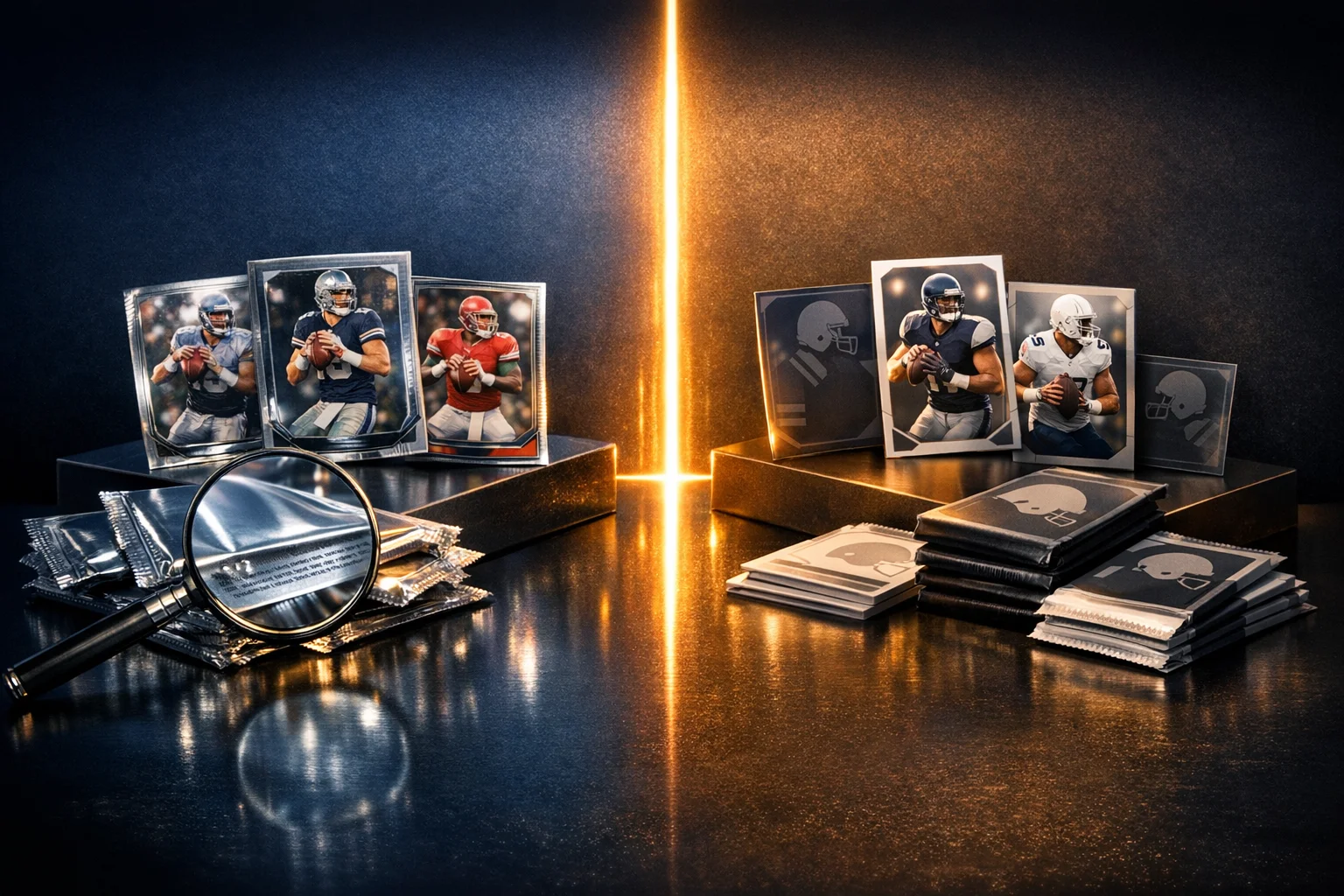
Illustration generated for this guide; not a photograph of an actual card, product or event.
Photo Gallery