WNBA card collecting gets much easier once you stop trying to collect everything at once. The modern market gives you several appealing directions, but the collectors who stay happiest usually choose a lane before they start buying boxes or chasing singles.
A strong plan is simple: pick one set lane, one player lane, and one spending lane. That keeps your collection coherent, makes your buying decisions easier, and helps you avoid turning a fun project into a pile of disconnected purchases.
As of October 18, 2026, the clearest modern options are Prizm as the flagship chrome-style lane, Origins as the premium autograph-and-centerpiece lane, Select as a rookie-focused tiered lane, and Donruss as the lowest verified sealed entry point on Panini’s WNBA shop page. The key is matching the product to the way you actually want to collect.
Start with a collecting mission, not a shopping cart
A focused collection is not just a smaller one. It is a collection with rules. In WNBA cards, that usually means deciding three things before you buy: what kind of set format you want, which players or rookie classes matter most to you, and how much money you are willing to commit over a season or a year.
Skipping that step is how many collections lose shape. A collector opens a blaster for fun, notices Prizm parallels, decides to chase an Origins autograph, then adds Select rookies because the designs look different. None of those choices is bad by itself. The problem is that they can create a collection with no center.
A practical way to avoid that is to write a one-sentence mission for the collection. You might decide to collect one flagship rookie and one parallel for four modern stars. You might decide that you only want autograph cards of MVP-level players. Or you might decide to build only one rookie class across one or two sets and stop there. The sentence does not need to be perfect. It just needs to give every future purchase a test to pass.
It also helps to separate sealed wax from the actual collection plan. Opening packs can be part of the fun, but sealed product should not automatically define your whole project. If a box rip is entertainment, treat it that way. If the collection itself is supposed to be focused, each important card should earn its place by fitting the mission you already set.
- Ask yourself whether you care most about player coverage, autographs, rookie classes, or design.
- Decide whether you want a binder-style collection with depth or a small display collection with impact.
- Set a finish line before you begin, even if it is only for one year or one rookie class.
Choose your set lane first: Prizm, Origins, Select, or Donruss
For most collectors, the set choice should come before the player choice because the set determines how your collection will look and how complicated it can become. In the current WNBA space, four lanes stand out for different reasons.
Prizm is the clearest flagship-style release. Panini’s 2024 and 2026 materials present it as the color-and-parallels driven product with broad player coverage, rookie cards, inserts, and autographs. Panini’s 2024 hobby description says hobby boxes average 24 Prizms, 10 inserts, and 2 autographs. If you want the modern WNBA set style that most easily supports stars, rookies, parallels, and graded-card style projects, Prizm is the obvious starting point.
Origins serves almost the opposite mood. Panini’s 2024 Origins WNBA description highlights 2 autographs, 1 memorabilia card, and 2 inserts per hobby box on average, along with short-print style content such as Sneaker Spotlight, Tiger Eyes, and Blank Slate. That makes Origins a natural fit for collectors who would rather own fewer standout cards than manage a long run of base and parallels.
Select offers a middle path for collectors who like structure and variety. Panini framed 2024 Select WNBA heavily around the rookie class led by Caitlin Clark and Angel Reese, which makes Select especially appealing if your collection is meant to document a specific rookie wave rather than chase every flagship parallel.
Donruss appears to be the lowest verified sealed entry point. On Panini’s WNBA shop page as of October 17 and 18, 2026, a 2026 Donruss WNBA Hobby Blaster was listed at $25 and a 2026 Donruss WNBA Hobby at $324.95. That does not prove more than product existence and listed pricing, but it does give budget-minded collectors a much clearer sealed entry than starting straight with a roughly $350 hobby box.
- Prizm suits broad player coverage and parallel-driven projects.
- Origins suits autograph-focused and display-focused collections.
- Select suits rookie-class collectors who want a distinct structure.
- Donruss suits lower-entry sealed experimentation.
Why Prizm is the easiest foundation and the easiest place to overspend
If you want one modern WNBA set to act as home base, Prizm is usually the cleanest answer. It gives you broad player coverage, recognizable rookie cards, many parallels, inserts, and autograph content. That makes it flexible enough for almost any style of project: a star collection, a team collection, a rookie-class collection, or a single-player run with escalating rarity.
That flexibility is also the danger. Parallel-heavy products make almost any collecting goal feel expandable. You buy the base rookie, then decide a silver-style version would be nice, then one numbered parallel, then a color match, then maybe the autograph if one exists. The format makes the next step feel logical even when it was never part of the original plan.
A better way to use Prizm is to define a stopping point before you buy the first card. For example, you might collect only three levels for each target player: base, one unnumbered parallel, and one numbered parallel. Or you might build only one class year, such as 2024 or 2026. Or you might focus on one team’s checklist rather than every major star in the league. Those kinds of limits let the set’s structure work for you instead of against you.
Panini’s own pricing helps underline why that matters. As of the research date, Panini listed the 2026 Prizm WNBA hobby box at $349.95. That does not say anything about the eventual value of singles, but it does show that sealed hobby ripping is not the low-cost route. For many collectors, Prizm works best as a singles roadmap rather than as a reason to keep opening more boxes.
Analysis: if you enjoy organization, consistent design, and a set that can tie many players together, Prizm is probably the strongest foundation. If completion anxiety gets you every time, it is also the set most likely to stretch your budget beyond what you intended.
- Good Prizm projects include one player’s rookie plus two upgrades.
- A one-year rookie class in base and one parallel level can stay manageable.
- A team-only binder is often more realistic than a full star chase.
Origins is for collectors who want centerpiece cards, not volume
Origins makes the most sense when your collection goal is impact rather than quantity. Panini’s 2024 Origins WNBA description points to a premium-feeling format with 2 autographs, 1 memorabilia card, and 2 inserts per hobby box on average. It also spotlights short-print style content like Sneaker Spotlight, Tiger Eyes, and Blank Slate, which naturally pushes the product toward display-first collecting.
In practical terms, Origins works for the collector who would rather own six memorable cards than sixty cards that blur together. A signature from a major star, a standout insert, and one or two key rookies can create a small collection that still feels intentional and substantial.
This lane is especially useful if your player list is already narrow. Suppose your mission is one premium card each of A’ja Wilson, Breanna Stewart, Caitlin Clark, and one legend. Origins fits that kind of project because the product structure is built around centerpieces rather than around large base runs. It does not guarantee a better outcome from a box. It simply matches the taste of a collector who wants the collection to look curated quickly.
The tradeoff is variance. A hit-driven product can feel harsher when the players or card types you pull do not match your goals. That is a collecting-risk observation based on how the box is configured, not a market-return claim. For budget-minded collectors, Origins often makes more sense as a singles lane than as a steady sealed habit.
Analysis: Origins is ideal for the collector who wants cards that feel like the point of the collection. It is less ideal for anyone who wants broad league coverage or the slow satisfaction of building a larger set over time.
- Strong Origins-style goals include one autograph each from three stars.
- A small active-star-and-legend display can feel complete without many cards.
- If you rip Origins, decide in advance whether you are chasing enjoyment or a keeper-focused result.
Select and Donruss make sense when your real goal is cleaner structure or lower entry
Not every focused collection needs to start with the hobby’s most obvious flagship. Sometimes the better lane is the one that matches your actual habits instead of the one with the loudest reputation.
Select is appealing because it gives rookie-focused collectors a distinct look and a more tiered feel than Prizm. Panini’s 2024 Select WNBA coverage centered heavily on Caitlin Clark and Angel Reese, making the set a natural lane if your collection is mainly about the 2024 class. If your goal is to document one draft wave in a format that feels separate from flagship chrome, Select can keep you concentrated on the players rather than on an endless comparison of parallel colors.
Donruss serves a different purpose. Based on Panini’s own WNBA shop page, a 2026 Donruss WNBA Hobby Blaster at $25 is the clearest verified low-entry sealed option available from the allowed evidence. That does not mean it is automatically the best product in a value sense, and it does not tell us enough to compare its exact hit structure with Prizm or Origins. What it does mean is that collectors who simply want to open some current WNBA packs have a more accessible starting point than a hobby box priced in the low-to-mid $300s.
A practical compromise is to assign different jobs to different products. You might use Donruss for occasional low-cost sealed fun while choosing Prizm or Select as the actual long-term singles lane. That way your collection remains recognizable, while your ripping habit stays limited and intentional.
- Select is useful when one rookie class is the entire point.
- Donruss is useful when sealed enjoyment matters but budget still matters more.
- A two-lane plan can work: one set for collecting, one lower-cost product for occasional fun.
Pick player buckets instead of chasing every popular name
Once you choose a set lane, the next job is choosing player buckets. This is often more durable than trying to rank every player one by one because buckets give the collection a logic that can survive new releases and changing tastes.
The first bucket is modern franchise anchors: active stars whose accomplishments already define the league’s current era. As of October 8, 2026, A’ja Wilson was named the 2026 WNBA MVP and the league described her as the record holder with five MVP awards. Breanna Stewart, a former MVP and one of the era’s defining stars, fits the same anchor role. Caitlin Clark belongs in a different way but just as clearly, since the WNBA lists her as the 2024 No. 1 draft pick and Panini built major 2024 rookie-year product attention around her.
A second bucket is elite stars who make a collection feel informed without being purely obvious. Napheesa Collier appears prominently in official league survey context, which supports her place in any serious modern-star lane. Angel Reese also deserves consideration because Panini spotlighted her in 2024 rookie-year WNBA products and announced an exclusive autograph and memorabilia partnership with her in 2024.
A third bucket is rookie-class collecting. This is where discipline matters most. Instead of collecting every prospect name you hear, use official WNBA draft status and actual WNBA product inclusion as the guardrails. Panini’s 2026 Prizm WNBA coverage specifically named Azzi Fudd, Olivia Miles, and Awa Fam among the rookies in that release. That is a much firmer starting point than college buzz alone.
Analysis: buckets help you build a collection that still makes sense when you look at it later. You are not just buying whoever is hot that week. You are building a story: active MVP-level stars, a breakout rookie class, or a curated mix of stars and legends.
- Anchor bucket example: A’ja Wilson, Breanna Stewart, Caitlin Clark.
- Second bucket example: Napheesa Collier, Angel Reese, and one personal favorite.
- Rookie bucket example: 2024 class only or 2026 class only.
Understand licensing before you build an autograph-focused collection
One of the most useful distinctions in WNBA collecting is the difference between group licensing and player-specific autograph rights. They are related, but they are not the same thing, and knowing the difference helps you make smarter choices.
In November 2025, Panini and the WNBPA announced a multi-year renewal that expanded Panini’s exclusive rights across physical, digital, and on-demand trading card platforms. That same announcement also explained that the players association reclaimed its group licensing rights from the league in 2018 and then partnered exclusively with Panini in 2019. For modern licensed WNBA cards, that is important context.
Autographs can still depend on separate player-level arrangements. Panini also announced exclusive multi-year autographed trading card agreements in April 2026 with Breanna Stewart and A’ja Wilson, along with an exclusive autographed trading card agreement with Sue Bird later that month. If signatures are your main priority, those public player-specific announcements matter more than broad assumptions about who should appear everywhere.
The practical takeaway is simple. A WNBA card can be officially licensed because of the broader group rights, while autograph availability may still be shaped by separate player agreements. So if your collection plan depends heavily on ink, it is smarter to track documented signer relationships than to assume that every major star will have the same autograph presence across products.
That understanding can also simplify your project. An autograph-first collection often becomes more coherent when it is built around players with clearly announced signing relationships instead of around a vague hope to collect every star.
- Group licensing helps explain official modern card production.
- Player-specific autograph deals help explain who may be central to autograph-focused collecting.
- If you collect autos, check the player agreement context as carefully as the set itself.
Build your budget with allocation rules, then choose a blueprint you can finish
Because the available evidence here is stronger on product formats and listed sealed prices than on sold singles data, the safest budget advice is to use allocation rules instead of guessed card values. That approach is more honest and usually more useful anyway.
If your total budget is around $100 to $250, a singles-first strategy is usually the cleanest. You might allow one or two low-cost sealed purchases if opening packs is part of the enjoyment, but most of the money should go toward a small number of target cards in one lane. A verified $25 blaster exists. A roughly $350 Prizm hobby box also exists. That gap alone shows how quickly sealed can consume a modest budget.
If your budget is around $300 to $750, treat the year as one meaningful project. That might mean one hobby box plus a reserve for targeted singles, or no hobby boxes at all and a concentrated star trio collection. This is often the range where focus matters most because there is enough money to build something memorable, but not enough to support every format you admire.
At $1,000 and above, the temptation is to broaden out. Often the smarter move is the opposite. Pick one premium objective and go deeper: a single-player autograph run, a full rookie-class flagship project, or a carefully chosen premium-set lane. Bigger budgets usually create better collections when they add depth instead of chaos.
Three practical blueprints stand out. First, a modern stars flagship binder: Prizm only, with A’ja Wilson, Breanna Stewart, Caitlin Clark, and one additional star, collecting one base or rookie and one parallel each. Second, a 2024 rookie class capsule: 2024 Select, 2024 Prizm, and 2024 Origins, but only for Clark, Reese, and selected classmates from that draft wave. Third, an autograph-first stars-and-legends project: Origins first, then selective Prizm autograph subsets, built around Wilson, Stewart, and Sue Bird because Panini publicly announced exclusive autograph-card relationships with all three in April 2026.
The best blueprint is the one with a visible finish line. If you know what completion looks like, the hobby feels less like constant catching up and more like building something with shape.
- Under $250: mostly singles, with sealed treated as optional entertainment.
- $300 to $750: choose one annual project, not several side chases.
- $1,000 and up: go deeper in one lane instead of sampling every lane.
- Before buying, ask whether the card advances the mission or just satisfies a short-term urge.
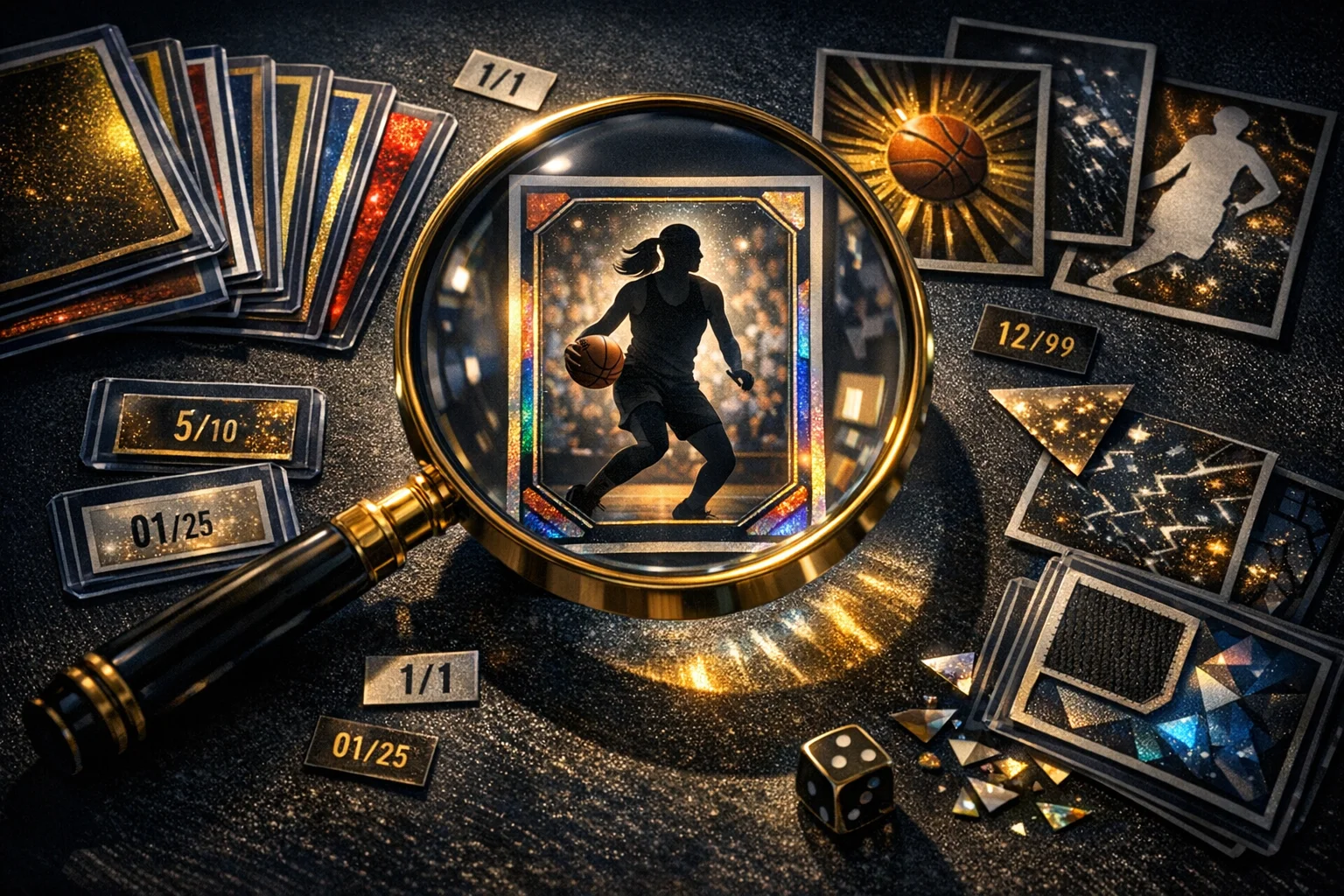
Illustration generated for this guide; not a photograph of an actual card, product or event.
Photo Gallery