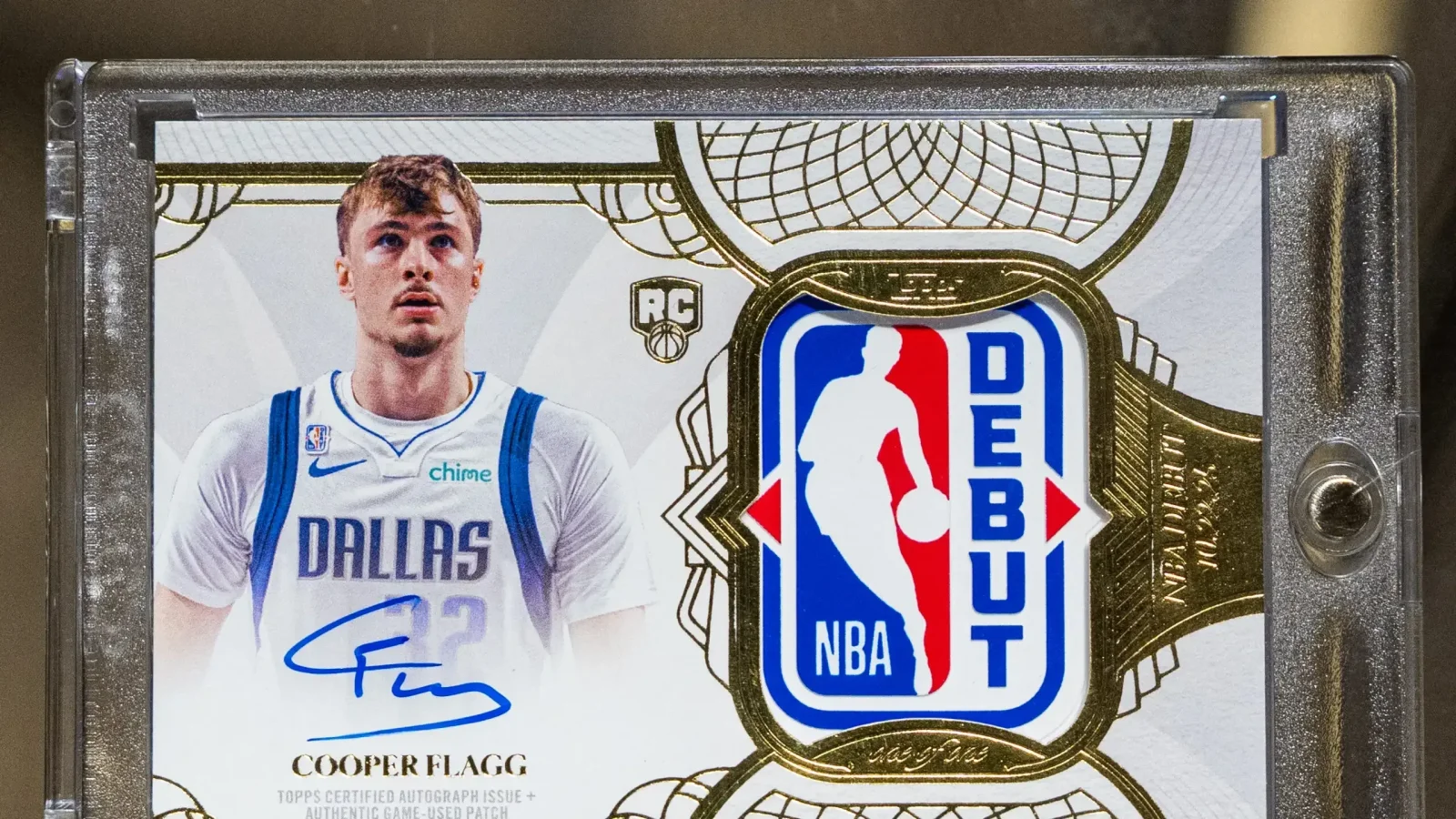
Football autograph cards look simple until you try to buy one carefully. The front may show a signature, a team logo, and a familiar brand name, but those details do not answer the questions that matter most to collectors: who had the rights to make it, whether the player signed the card itself or a sticker, whether the autograph was live in packs or promised later as a redemption, and what kind of authenticity claim you are actually relying on.
The good news is that these questions are answerable if you slow down and separate them. A modern football autograph card is really a stack of decisions and rights layered onto one object. Once you know how those layers work, product listings become easier to read, red flags stand out faster, and your buying choices can match your collecting goals instead of hobby shorthand.
1. Start with licensing, because a football autograph card is more than a signature
The first mistake many collectors make is treating an autograph card as if the autograph is the only thing that matters. In modern football cards, the signed element is only one piece of the package. A manufacturer may need rights tied to league branding, team identities, and active player group rights before it can produce a fully licensed NFL card that shows names, marks, helmet designs, uniforms, and other protected visual elements.
As of the October 23, 2026 research date, Fanatics Collectibles and Topps hold the official exclusive NFL and NFLPA trading-card license described by the NFL announcement in April 2026, with the first set under that deal identified as 2025 Topps Chrome Football, released April 15, 2025. That matters because licensing tells you why a card can look fully integrated with NFL branding rather than generic or logo-free.
This is also why older assumptions can trip up newer collectors. Panini’s earlier era began with an NFLPA-exclusive arrangement announced in 2014 for cards starting with the 2016 NFL season. That history is useful, but it does not mean all football-card rights were always identical or bundled in exactly the same way. Public pages clearly establish major licensing frameworks and timing, but they do not publish every carve-out for individual autograph deals, retired players, or legends.
For you as a buyer, the practical lesson is simple: when you see a football autograph card, do not ask only, “Is the autograph real?” Also ask, “What rights made this exact presentation possible?” That mindset helps explain why some cards carry full NFL visual identity, some do not, and some products should be evaluated differently even before you get to condition or price.
- Use licensing to understand presentation, not just prestige.
- Treat active-player group rights and team or league marks as separate concepts that can overlap on one card.
- When in doubt, judge the card by the specific product and year, not by brand reputation alone.
2. On-card and sticker autos are not hobby slang for the same thing
Collectors often use “auto” as if all autograph cards belong in one category, but manufacturers do not define them that way. Topps’ collector glossary makes a clean distinction. An on-card autograph means the player signed directly on the card. A sticker autograph means the player signed a sticker or label that was later applied to the card.
That difference matters because the collecting experience is different even when both are pack-issued and manufacturer-certified. On-card autos tend to emphasize the card as a single finished object. Sticker autos separate the signing event from the completed card design. Some collectors strongly prefer the first format for aesthetic reasons, but preference should still be stated honestly as preference, not universal law.
Product descriptions show why this cannot be guessed from the word “autograph” alone. Topps promoted 2025 Topps Cosmic Chrome Football as including on-card autographs. Earlier Panini football materials likewise highlighted some products or inserts as on-card, including Panini One, Origins rookie autographs, and select Impeccable autograph content. The useful takeaway is not that one company always does one thing; it is that autograph format is product-specific and sometimes insert-specific.
That means a listing title like “rookie auto” is incomplete. If a seller does not state whether the autograph is on-card or sticker, you still have work to do. A careful buyer checks the product page, checklist, odds, or sell sheet instead of filling in the blank with assumptions.
- On-card means signed directly on the card.
- Sticker means signed on a separate label later placed on the card.
- Never infer autograph format from brand, year, or player alone.
3. Why collectors usually prefer on-card ink, and where that preference has limits
The case for on-card autographs is easy to understand even without claiming any hard market rule. Many collectors simply like the visual unity. The signature interacts with the design, the photo, and the surface intended for that release. When the card was built to be signed directly, the result can feel more deliberate and less modular.
That does not automatically make every on-card autograph the better purchase. Some on-card cards have weak pen placement, streaky ink, or rushed signatures. Some sticker autos are bold, clean, and well-centered on attractive designs. A beautiful sticker auto can be more satisfying than a sloppy hard-signed card. Design preference is analysis, not a measured law of value.
There is also a practical tradeoff. The more a product emphasizes direct signing on finished cards, the more it may run into timing and logistics pressure. That pressure can affect release schedules, checklist depth, and redemption volume. In other words, the qualities collectors praise in on-card autos can also make them harder for manufacturers to execute consistently at scale.
A smart way to buy is to define your own priority in advance. If your goal is visual presentation for a personal collection, it may be worth passing on a sticker autograph entirely. If your goal is assembling a specific player run across many products, excluding all sticker autos may remove too many legitimate cards. The right answer depends on whether you collect by look, by player, by set, or by release type.
- Use clear photos to judge ink quality, not just format.
- Ask whether your priority is aesthetics, player coverage, or set completion.
- Remember that on-card preference can be reasonable without being absolute.
4. Sticker autographs are normal, not automatically second-class
Sticker autographs exist because card production is a manufacturing system, not just a wish list. Public policy and company explanations do not reduce sticker use to one single cause, but they do support the broader point that autograph fulfillment and release deadlines do not always line up neatly. Panini’s explanations around redemptions note that card components may not arrive in time for final production and that demand for autographs, especially hard-signed autographs, has increased alongside longer player fulfillment timelines.
That context helps explain why sticker autos remain common. They give manufacturers flexibility when finished cards cannot all be hand-signed on the schedule needed for packout. A company can secure signatures on labels, apply them later, and keep a release moving. You may not love that tradeoff as a collector, but understanding it beats pretending sticker autos survive only because collectors are careless.
There is also a cataloging advantage. For player collectors, stickers can expand autograph checklists across more products, more insert families, and more parallel structures than might be practical with only on-card signing. The downside is obvious: the autograph can feel detached from the rest of the card, especially if the sticker placement interrupts a carefully designed front.
So the useful framing is not “good versus bad.” It is “what compromise is being made?” A sticker auto usually reflects a compromise in production and presentation. Whether that compromise is acceptable depends on the exact card, the exact player, and your own threshold for design interruption.
- Sticker autos can support broader checklists and faster product completion.
- They often involve a presentation compromise, not necessarily an authenticity compromise.
- Judge the specific card’s placement and visual integration before dismissing it.
5. Redemptions are a fulfillment warning label, not a card type to treat casually
A redemption card means the promised card was not ready for packout. That point is easy to blur in hobby conversation, where people sometimes discuss redemptions as if they were a parallel format. They are not. They are a workaround used when a required component, often the signed card itself, was not received in time for production.
Panini’s current support language says redemptions are used when components were not received in time to make final production. Its FAQ also outlines a general 6-to-8-week delivery estimate once cards are available, plus comparable-card provisions after 4 months or 8 months depending on the option chosen during reservation. Topps uses a different framework. Its redemption and authenticity program says codes can be redeemed one time, that a voluntary substitution may be requested after 6 months if the completed card is still unavailable, and that substitution value is pegged at 200 percent of current market value as determined by Topps. If Topps cannot fulfill because of events beyond its control, such as player refusal or death, it says it can provide substitute cards, Topps.com credit, or FanCash at 300 percent of current market value.
Those differences are not small. They affect how you should think about unopened wax, secondary-market redemptions, and products known to lean heavily on deferred autograph fulfillment. A live autograph card in hand and an unredeemed promise are not the same asset, even if a checklist lists them as the same insert.
A practical buying rule helps here: if you are considering an unredeemed football autograph, value it as a claim subject to policy, timing, and substitution risk. Do not price it mentally as if the finished card were already in your possession. That sounds obvious, but many collectors only feel the difference after a delay or an unexpected replacement.
- A redemption is evidence the final card was not ready at packout.
- Read the current manufacturer policy before assigning value.
- Treat open-ended wait time and substitution terms as part of the card’s risk profile.
6. Authentication has two layers, and collectors often blur them together
One of the most useful distinctions in football autograph collecting is the difference between manufacturer certification and third-party authentication. They overlap, but they are not the same thing. If a card was issued as a certified autograph by the manufacturer, that means the card company is making its own authenticity claim about the signature as issued on that card.
Topps states that it guarantees the authenticity of its unaltered Topps certified autograph issue cards. Its policy also acknowledges that grading companies make independent decisions, and says that if leading grading companies will not authenticate an unaltered Topps autograph card, Topps may remake the card, secure new autograph or autographs, provide substitute card or cards, or issue Topps.com credit valued at 200 percent of current market value. Panini’s FAQ likewise frames autograph cards as cards bearing an actual signature and provides general anti-fraud guidance, including checking serial numbering and physical characteristics where relevant.
Then there is the second layer: the outside opinion. PSA describes its autograph authentication as an independent examination process using methods such as ink analysis, structure analysis, object evaluation, and side-by-side comparison, followed by cert verification and security features tied to encapsulation. That means a pack-issued card can still receive a separate yes-or-no decision from a third-party authenticator or grader.
For collectors, this distinction matters most when buying higher-end cards or cards with controversy attached to them. “Certified autograph” answers one question. “Accepted by a third-party authenticator” answers another. Sometimes those answers align neatly. Sometimes they do not. If you understand that from the beginning, you will make calmer decisions when evaluating raw cards, slabbed cards, or cards whose value depends heavily on buyer confidence.
- Manufacturer certification is one confidence layer.
- Third-party authentication is an independent second layer.
- Do not assume one automatically guarantees the other.
7. Pack-pulled does not mean problem-free
Collectors sometimes talk about pack-issued autographs as if the sealed product chain eliminates all risk. It reduces some risks, but not all of them. A historical example makes the point clearly. In a public statement involving 2016 Dak Prescott Prizm autographs issued as redemptions, Panini said that after contact from an autograph authenticator and internal review, it determined a limited quantity may not be authentic.
That example should not be stretched into a blanket indictment of all manufacturer-certified autographs. It does, however, destroy the lazy assumption that pack-pulled equals immune from scrutiny. Even a legitimate product release can produce edge cases, remediation, and collector headaches.
The practical lesson is to separate provenance from certainty. Provenance matters. A card coming from a sealed product and bearing manufacturer certification is meaningful. But provenance is not a magic shield against fulfillment errors, authentication disputes, or card-specific issues. If a card is especially important to your collection or budget, it is reasonable to seek more than one confidence layer.
This is where temperament matters as much as knowledge. A careful collector is not paranoid; a careless collector is not bold. The goal is simply to avoid outsourcing all your judgment to the wrapper history of the card.
- Pack-issued provenance is valuable, but not absolute.
- Use notable exceptions to sharpen your process, not to panic.
- The larger the purchase, the more useful independent review can become.
8. How to read a football autograph listing before you buy
Most buying mistakes happen because collectors ask one vague question instead of four specific ones. A listing should help you answer: is the card licensed, is the autograph on-card or sticker, is it live or a redemption, and what authentication claim is actually being made? If even one of those is unclear, the listing is incomplete for a serious buyer.
Start with identity. Confirm the exact product, year, insert set, and if relevant the parallel. Then check whether the card belongs to a licensed NFL release with official team marks or whether it is a different kind of product presentation. Move next to autograph format. If the seller says “certified auto” but never says on-card or sticker, verify that point through a product page, checklist, odds sheet, or sell sheet.
Then evaluate fulfillment status. If the card is in hand, good. If it is an unredeemed code or a claim ticket, stop and review the current manufacturer policy before deciding what you are willing to pay. Finally, look at authentication language. A raw pack-issued certified autograph is one thing. A card that has also been authenticated or graded by a third party is another. Neither description is interchangeable with the other.
A practical scenario shows how this helps. Imagine two listings for the same player: one is a live sticker auto from a licensed NFL product, the other is an unredeemed on-card rookie auto from a premium set. The second may sound better in hobby shorthand, but if the redemption is old and you are collecting for immediate possession, the first card may be the more sensible buy. The better card on paper is not always the better purchase in context.
- Identify product, year, insert, and parallel first.
- Verify on-card versus sticker with product documentation.
- Treat a redemption as a policy-based claim, not just a delayed card.
- Know whether you are buying manufacturer certification alone or an added third-party opinion.
9. Build a buying plan that matches your actual collecting goal
Once you understand the moving parts, football autograph cards become less mysterious and more customizable. The right purchase depends on what you are trying to build. If you want the cleanest visual experience, you may prioritize on-card autos from clearly documented products and accept a narrower checklist. If you want broad player coverage, sticker autos may be completely reasonable. If you dislike uncertainty, you may avoid open redemptions entirely. If you buy expensive raw autograph cards, you may prefer an independent authentication layer before stretching your budget.
That kind of planning is more useful than chasing broad hobby rules. “Always buy on-card” is too simple. “Never buy redemptions” is too simple. “Pack-pulled means safe” is too simple. Better questions create better collections: What level of licensing matters to me? What kind of presentation do I enjoy? How much delay risk am I willing to absorb? When do I need third-party confirmation?
As of the October 23, 2026 research date, the licensing landscape for licensed NFL football cards sits in the current Fanatics and Topps era, while the hobby still operates with a mix of on-card autos, sticker autos, live cards, and redemptions. None of those categories is self-explanatory. Each needs to be read carefully in context.
That is the real skill. Not memorizing which format sounds more premium, but learning to decode what a football autograph card actually is before you decide what it is worth to you.
- Choose priorities before shopping: look, player coverage, timing, or extra authentication.
- Avoid one-size-fits-all rules that ignore context.
- A better process usually saves more money than a faster trigger finger.
Illustration generated for this guide; not a photograph of an actual card, product or event.
Photo Gallery