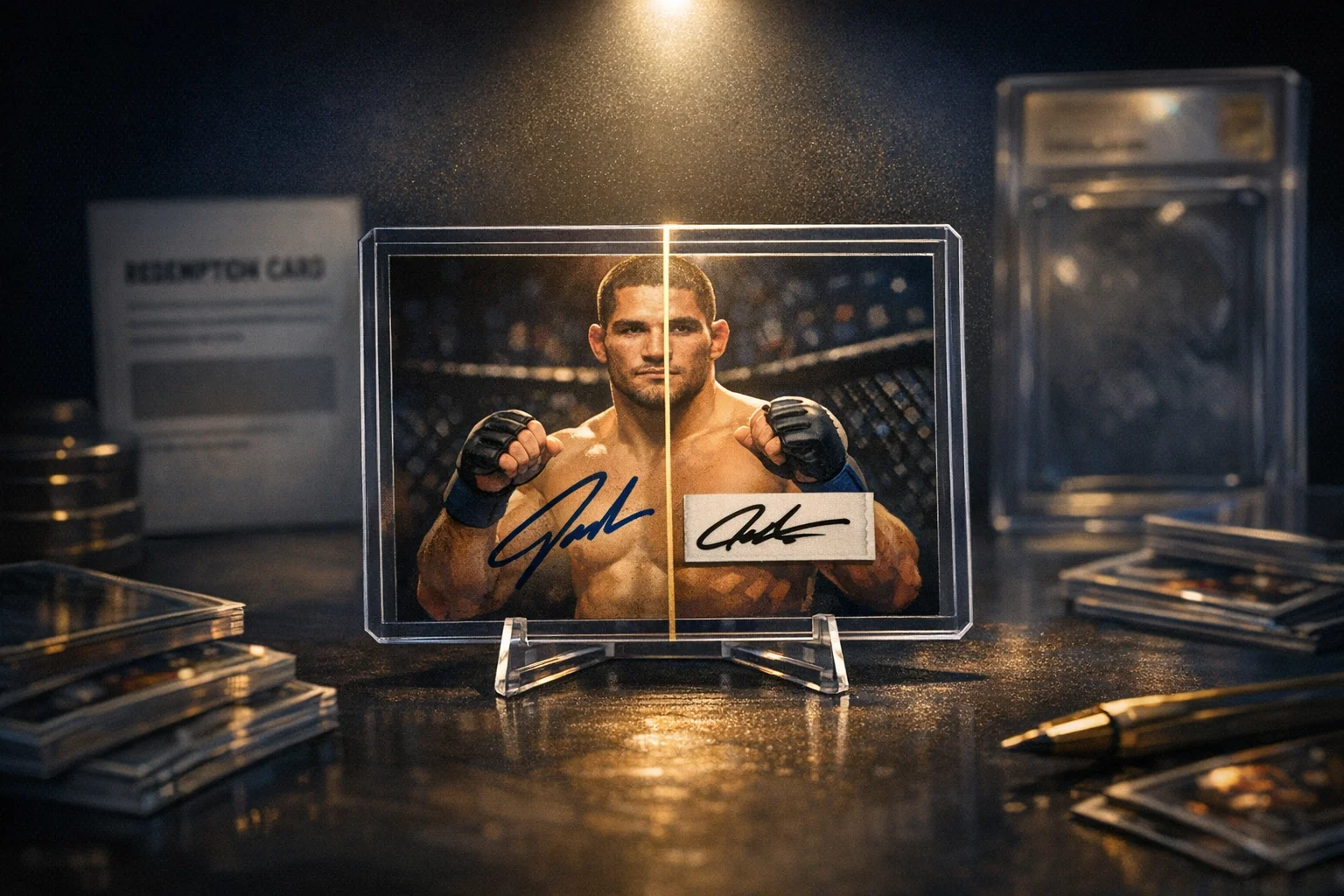
If you collect UFC autograph cards, start with one rule: never assume every licensed Topps UFC autograph is made the same way. Some releases are clearly advertised with signatures written directly on the card. Others openly use signed stickers applied to the surface. Some autos are packed live. Others are issued as redemption cards that must be claimed later.
That matters because different collectors want different things. You might care most about presentation and want the signature to sit naturally within the card design. You might care more about owning an officially issued autograph of a favorite fighter, regardless of whether it was signed on the card or on a label. You might be comfortable waiting on a redemption, or you might want the exact card in hand immediately.
The easiest way to avoid disappointment is to slow down and separate four questions before you buy: what product is the card from, what autograph format does that product use, is the card live or a redemption, and if a problem ever comes up, are you dealing with the card issuer or a third-party authenticator. Once you sort those out, UFC autograph collecting becomes far less confusing.
1. Start with the exact UFC release, not the logo on the box
Licensed UFC cards currently come from Topps under the Fanatics Collectibles umbrella, but that does not mean every autograph across the line shares one format. The important fact for you as a buyer is that autograph construction is product-specific. A card from one UFC release may be promoted as an on-card autograph product, while a different UFC release may explicitly use sticker autos.
That is why broad marketplace descriptions can mislead you. A listing that says only “Topps UFC auto” does not tell you enough. Two cards with that same shorthand label may come from products with very different autograph formats, different odds, and different collector expectations. The brand confirms the card is from the licensed UFC card maker. It does not tell you whether the fighter signed the card itself, signed a sticker, or signed nothing yet because the card is still a redemption.
Recent products make the distinction clear. Stadium Club UFC has been described as an on-card autograph release, and Knockout UFC has also used direct on-card wording. By contrast, UFC NYC explicitly described its base-card autograph parallels as using surface-applied stickers. Those statements are not in conflict. They show that you need to identify the release first and then judge the autograph within that release’s own rules.
Think about a simple buying scenario. Suppose you see two autographs of the same fighter at similar prices. One comes from Stadium Club UFC. The other comes from UFC NYC. If your only information is the photo and the seller’s short title, you may assume the cards are interchangeable because both are licensed UFC autos. They are not interchangeable if autograph format matters to you. The product name is the key that unlocks the rest of the decision.
- Treat each UFC set as its own autograph environment.
- Do not assume every licensed Topps UFC auto is on-card.
- If a listing omits the set name or subset, ask before buying.
2. What on-card and sticker autographs actually mean
These terms are easy to repeat and easy to blur. On-card means the fighter signed the actual trading card. Sticker autograph means the fighter signed a sticker or label that was later attached to the card. That is the core distinction.
For collectors, the meaning goes beyond vocabulary. An on-card autograph usually gives you a more integrated look because the signature sits directly on the designed surface. If you are building a display-focused collection, that may matter a lot. A sticker autograph places a signed label onto the card, so the autograph is genuine but visually separate from the artwork underneath. That difference in appearance is why some collectors feel strongly about one format over the other.
Just as important, format is not the same thing as legitimacy. A sticker auto in a licensed Topps UFC product is still presented as a genuine signed autograph. If you avoid sticker autos, you are making a presentation choice, not rejecting them as automatically fake or unofficial. That distinction keeps your buying standards clear. You can say, “I only collect hard-signed cards,” without suggesting that licensed sticker autos are counterfeit.
It also helps to understand why sticker autos exist. They can make it easier to include more athletes or keep a product on schedule when direct signing on finished cards is harder to arrange. In a sport where fighter schedules, travel, event timing, and roster changes can complicate logistics, that practical difference matters. You do not have to like stickers, but you should know they are a planned product format rather than an accident or a hidden downgrade.
- On-card means the athlete signed the card itself.
- Sticker means the athlete signed a label later applied to the card.
- Both formats can be genuine pack-issued signatures in licensed products.
3. Which UFC products currently point you toward on-card autos
If hard-signed cards are your priority, look for products that say so directly. Stadium Club UFC is one of the clearest examples. Product language has described it with premium on-card autographs and framed its autograph program as on-card throughout. That is the kind of wording you want because it gives you a concrete basis for the purchase.
Knockout UFC is another useful release for on-card-focused collectors. Product material has told buyers to look for on-card autographs, and that language has appeared in more than one place tied to the release. For you, the practical lesson is simple: explicit wording beats hobby assumption every time. If the set itself tells you to expect on-card autos, you are on much firmer ground than if a seller simply uses phrases like “hard signed” without context.
This matters most when you are shopping for singles instead of sealed product. Once a card is removed from the box and sold by itself, the product promise becomes easy to lose. Sellers may crop photos tightly or write short titles. The card may still be exactly what you want, but you should reconnect it to the original set description before paying a premium for the format you prefer.
Imagine you are building a one-autograph-per-fighter run and you care most about visual consistency. In that case, your process should be strict. Favor cards from releases that plainly identify on-card signatures. If you cannot verify that a card comes from one of those products or one of those autograph subsets, treat the uncertainty as a reason to pause rather than a detail to sort out later.
- Choose releases that explicitly advertise on-card autographs.
- Stadium Club UFC and Knockout UFC provide recent product-level on-card language.
- Verify the set before paying extra for a supposedly hard-signed single.
4. Which UFC products clearly use sticker autographs
If you want to identify a sticker-auto UFC release, the best case is a product page that says so directly. UFC NYC provides that kind of clarity. Its base-card autograph parallels were described as using surface-applied stickers, with an approximate total for sticker autographs listed in the product information. That is a straightforward disclosure, which means you can buy or pass with open eyes.
That kind of transparency is helpful because it lets you match the card to your own standards before money changes hands. If you enjoy event-specific products and like the design or checklist, a documented sticker-auto release may fit your collection perfectly well. If your rule is that every autograph in your case must be signed on the card, you have the answer immediately and can move on without second-guessing.
A useful way to think about sticker-auto releases is not “good” or “bad,” but “right for this goal” or “wrong for this goal.” Suppose you are chasing a card tied to a particular UFC event, and the event release offers an autograph of a fighter you collect. If that connection to the event is what excites you, the sticker format may be a tradeoff you accept. If your goal is to assemble the cleanest signature presentation possible, the same card may not make sense for you even if the fighter is important.
The key is to avoid buying a sticker auto under the mistaken belief that it was signed on the card. Once you know the format, you can evaluate design, numbering, fighter appeal, and price with a clear head instead of feeling surprised after the package arrives.
- A disclosed sticker autograph is a documented format, not a mystery.
- Use product descriptions to decide before buying, not after delivery.
- Judge whether the release fits your collecting goal, not someone else’s rulebook.
5. Redemptions change the transaction, even when the autograph is desirable
After format, your next question should be whether the autograph is live or a redemption. A redemption card is not the signed card itself. It is a claim that you submit in order to receive the autograph later if and when it is fulfilled. That distinction sounds obvious, but many buying mistakes happen because collectors treat “autograph redemption” and “autograph card” as though they were the same thing.
Current UFC examples show that redemptions remain part of the landscape. Topps NOW UFC product pages have listed autograph redemption parallels for named fighters. That means you should not assume every UFC autograph parallel is sitting physically in the pack ready for immediate delivery. In some cases, what you pull or buy is the right to request the card later rather than the card itself.
That difference matters in practical ways. If you are buying for a birthday gift, a trade deadline, or an upcoming show-and-tell display, a redemption may not suit your timeline. If you are patient and mainly care about eventually landing the card, a redemption may be acceptable. The point is not to declare one approach wiser than the other. The point is to understand that a redemption adds a second stage to the collecting process.
Picture two hypothetical purchases. In the first, you buy a live autograph of a favorite contender and can inspect the centering, autograph placement, and surface condition before paying. In the second, you buy an unredeemed parallel of the same fighter. You are not evaluating the same kind of item. One is a card in hand. The other is a claim with future fulfillment attached. If you keep that distinction front and center, your expectations stay realistic.
- A redemption card is a fulfillment claim, not the autograph card itself.
- Some current UFC autograph programs still use redemptions.
- Ask whether the listing is for a live card, an unredeemed code, or a submitted claim.
6. How to handle a UFC redemption without creating avoidable problems
If you pull or purchase a redemption, organization matters. Submit it promptly through the issuer’s process, keep your confirmation details, and save screenshots or emails showing exactly what you claimed. Those basic habits matter more than collectors like to admit, because confusion later often starts with missing records or forgotten deadlines.
One detail worth remembering is the image-inspection step tied to a vault-confirmation email. If you receive that message, there is a short window to inspect the images and report concerns. That means fulfillment is not a process you should ignore once the status changes. Pay attention when the card is about to ship so you do not miss the chance to flag a problem quickly.
It also helps to think through logistics before the card is ready. If you move, update your address. If you bought the redemption secondhand, make sure it is still valid and has not already been used. If you are tracking several claims at once, label them clearly so you do not confuse parallel levels or fighters. None of that is glamorous, but it is the kind of routine discipline that protects you from turning a promising pull into an avoidable headache.
Consider a hypothetical example. You buy an unredeemed UFC auto at a show because the fighter is a personal favorite and the code appears clean. If you toss it in a box for six months, forget your login, and miss later communication, the problem is no longer only about fulfillment speed. It is also about your own process. Redemptions reward collectors who treat them like active claims, not like ordinary singles.
- Submit redemptions promptly and save your records.
- Watch for the vault-confirmation email and review images quickly.
- Keep shipping and account details current while the claim is open.
7. Authentication has two lanes: issuer authenticity and third-party review
Collectors often use the word authentic as if it answers every question at once. In reality, you are usually dealing with two separate lanes. The first lane is issuer authenticity: is this a genuine pack-issued autograph from the licensed manufacturer. The second lane is third-party review: will an outside company authenticate and encapsulate the card under its own standards.
For licensed Topps UFC cards, the issuer’s position is the starting point. Product education states that both on-card and sticker autos in Topps products are genuine player signatures. That means format alone does not change whether the company treats the autograph as authentic. A sticker auto is still a genuine signed autograph in that sense, even if it is not the format you prefer.
There is also a public issuer program covering redemption and authenticity issues. For certain problems involving unaltered autograph or relic cards, potential remedies can include remaking the card, providing a substitute card of equal or higher value, or offering store credit valued at 200 percent of current market value as determined by the issuer. You should read that as a remedy framework, not as an automatic outcome for every complaint. Still, it is important because it tells you there is a formal path if a pack-issued unaltered card later becomes a problem.
The practical takeaway is simple. If you pull a licensed UFC autograph and something about it raises a serious authenticity concern, your first question should be whether the issuer has a remedy path for that kind of card. That is different from asking whether a third-party grader will slab it. Mixing up those two questions wastes time and can send you to the wrong place first.
- Issuer authenticity and third-party authentication are separate issues.
- Licensed on-card and sticker autos are both presented as genuine signatures.
- Potential issuer remedies exist for certain unaltered autograph-card problems.
8. What PSA can and cannot do for your UFC autograph card
PSA occupies the second lane. It is not the issuer of licensed UFC cards, and it does not replace the manufacturer’s own pack-issued authenticity position. Instead, PSA offers its own authentication and grading services under its own standards. For autographed sportscards submitted through the combined card-and-autograph process, both the card and the autograph must pass review to be encapsulated.
That means a UFC autograph can be genuine as an issued Topps card and still receive a separate yes-or-no outcome from PSA. If the autograph does not pass inspection, or if the card shows issues that matter under PSA’s standards, encapsulation may be declined. That does not rewrite the card’s original pack-issued status. It tells you only that the card did not clear that independent third-party process in the requested manner.
Why submit at all? Usually because you want a standardized holder, grading, or broader market comfort when selling or trading. If those goals matter to you, PSA can serve a useful role. If your goal is simply to own and enjoy the card, you may decide that pack-issued authenticity and your own inspection are enough. The right choice depends on what you want the card to do for you after you buy it.
A practical scenario helps. Suppose you own a clean on-card UFC autograph and expect to keep it long term. You may choose not to submit because the card already meets your purpose. Now imagine you plan to sell that same card to a buyer who prefers third-party encapsulation. In that case, PSA review may make sense. The important point is to use PSA for the problem it actually solves, not as a substitute for issuer support.
- PSA’s role is separate from the card issuer’s authenticity position.
- For combined card-and-auto submissions, both elements must pass review.
- Submit when standardized encapsulation or market presentation matters to you.
9. A buying checklist that keeps UFC autograph decisions clear
When you are looking at a UFC autograph, move through the same questions every time. What product is it from? Does that product describe the autograph as on-card, sticker, or leave the format unstated? Is the item a live card or a redemption? If you care about third-party encapsulation later, are you prepared for a separate review process rather than assuming the issuer and PSA will treat the card identically?
That routine keeps you from making the most common mistakes. It prevents you from paying for a format you did not actually verify. It helps you distinguish a claim from a card in hand. It also reminds you that licensed status, product format, redemption status, and third-party grading are different parts of the same purchase rather than one blurry concept called “an auto.”
It is also worth keeping licensing language precise. UFC has announced an exclusive multi-year trading-card deal with Fanatics Collectibles, with Topps returning to the sport. That tells you who currently makes the licensed UFC trading cards. It does not eliminate the need to verify each set’s autograph format individually. Exclusive trading-card rights at the brand level do not turn every product listing into the same type of autograph release.
If you keep that framework in mind, your buying decisions get cleaner. Read the exact product language. Decide whether you care about on-card versus sticker presentation. Treat redemptions as their own category. Know when a concern belongs with the issuer and when you are really considering third-party review. Most expensive autograph mistakes are not mysterious. They happen when collectors skip one of those steps and buy faster than they verify.
- Ask product, format, live-versus-redemption, and grading questions in that order.
- Use the current exclusive trading-card arrangement to identify the licensed maker, not to assume uniform autograph construction.
- Buy the card that fits your collecting goal, not the one that leaves key facts unstated.
Illustration generated for this guide; not a photograph of an actual card, product or event.
Photo Gallery