Football collectors often end up choosing between two very different projects. One path is a player collection, where nearly every purchase serves a specific athlete. The other is set building, where the goal is to complete a checklist and enjoy the full shape of a release.
In 2026, that choice is easier to think through because licensed NFL cards now have a clearer structure. Modern flagship football is designed to support checklist completion, while player collecting remains the more flexible way to focus your budget on the cards and card types you actually want.
Neither path is automatically better. The smarter choice depends on whether you want a finish line, how much variety you enjoy, how much control you want over each purchase, and whether league branding matters to your collecting experience.
Start with the real difference: are you collecting a product or an athlete?
A football set builder is mainly saying, “I want this release.” A player collector is saying, “I want this person.” That sounds simple, but it affects almost every decision that follows, from where you shop to how you define success.
If you build a set, your project is shaped by a manufacturer’s checklist. In current flagship football, that means a broad base run that includes veterans, rookies, legends, team cards, combo cards, and league leaders. The project has an external structure: someone else decided what counts as complete, and you work toward that finish line.
If you build a player collection, you create the structure yourself. One collector may want only key rookies. Another may want one card from every major release. Another may care mostly about autographs, relics, or graded copies. PSA’s registry framework supports that kind of flexibility by letting collectors start with one card, add over time, and choose between looser basic goals and stricter master-style goals.
That is the first practical filter to apply to yourself. If you enjoy operating inside a defined checklist, set building will feel satisfying. If you enjoy defining the rules as you go, player collecting is usually the better fit.
- Ask yourself: do I want to finish a manufacturer’s list, or build my own list?
- If you feel relief when a project has a clear endpoint, lean toward sets.
- If you feel constrained by having to buy cards you did not choose, lean toward a player PC.
Why licensing matters more to football set builders than many collectors realize
In football, licensing is not just background legal trivia. It changes how complete a set feels on the page. As of April 2, 2026, Fanatics Collectibles, the NFL, and the NFLPA announced that Topps returned as the official exclusive trading-card licensee with rights that explicitly include team logos, names, marks, helmet designs, uniforms, and official NFL branding for cards and packaging.
That level of licensing matters especially for set builders because checklist collecting is often about league-wide immersion. Team cards, league leaders, full uniforms, and official visual identity are part of the experience. If your goal is to open pages in a binder and see the whole league represented in a consistent, fully branded form, the current license structure directly supports that.
There is also a useful historical distinction here. Earlier rights arrangements were not all identical. The 2014 NFLPA announcement involving Panini was evidence of exclusive player-group licensing beginning with the 2016 NFL season, while Panini’s 2022 NFL sticker and card promotion reflected league-level product rights in that earlier period. For collectors, the practical lesson is to separate player-group rights, league presentation rights, and autograph availability instead of treating them as the same thing.
Player collectors can sometimes be more tolerant of differences in format because their focus is narrower. If you are hunting one athlete’s autograph, parallel, or key rookie, your emotional connection may be to the card itself more than to a 400-card licensed league canvas. But if you are building a set, full NFL presentation usually matters much more.
- For 2026 football cards, treat league logos and player-group licensing as related but distinct concepts.
- If full uniforms, team marks, and official league visuals are central to your enjoyment, set building gains a major advantage.
- If your main goal is one athlete across multiple card types, licensing still matters, but often in a different way.
Set building works best when the product was designed for it
Modern football set building is easiest when you choose a release that clearly behaves like a flagship. Topps says 2026 Topps Flagship Football is a fully licensed return with a comprehensive base set spanning stars, rookies, and legends. The accompanying box guide frames that base set as 400 cards and spells out the kinds of content inside it: rookies, veterans, Future Stars, team cards, combo cards, and league leaders.
That checklist design is a major advantage because it gives you a visible endpoint. Unlike an open-ended player chase, you can look at a list of 400 cards and know what “done” means. For many collectors, that clarity is the whole appeal. You are not just buying cards; you are crossing items off a map.
Topps also makes format choice unusually important for set builders. The 2026 box guide lists Hobby at 240 cards, Jumbo at 400 cards, and Value at 72 cards. Topps explicitly describes Jumbo as the fastest route toward building the base set. That does not mean one Jumbo box guarantees one perfect 400-card set, because the available material does not promise no duplicates or ideal collation. But it does show that the product structure is intentionally friendly to volume-based checklist progress.
A practical implication follows from that. If your stated goal is set completion, your buying should prioritize formats designed to push card count, not formats that simply feel more exciting per pack. A set builder who keeps buying low-volume formats because they are fun can accidentally turn a checklist project into an expensive hit chase without meaning to.
- Before buying, identify the base set size and card-per-box structure.
- For 2026 Topps Flagship Football, Jumbo is presented as the fastest route toward base-set progress.
- Do not assume card count equals complete collation; duplicates are still part of the math.
Player collecting gives you tighter control over every dollar and every slot
Player collecting usually feels more efficient because nearly every addition is intentional. Instead of spreading your budget across a full checklist, you can direct it toward the athlete, era, card type, or grade that fits your goals. That does not automatically make it cheaper in every case, but it does make it more selective.
PSA’s registry structure helps explain why player collecting remains such a durable lane in football. According to PSA’s football registry category counts as viewed in early September 2026, there were 52,024 football registry sets, including 14,707 player sets. That does not prove player collecting is the single dominant style everywhere, but it strongly indicates a mature and well-established segment of the hobby.
The registry framework also mirrors how collectors actually build player PCs. PSA allows you to start with one card, create more than one set, and take as long as you want, subject to publication rules for inactive low-completion sets. It distinguishes basic sets from master sets, which is especially useful in football. A basic player project might mean one example of a major issue regardless of variation. A master project can require the exact card and variation for each slot.
That flexibility makes player collecting easy to scale. You can start with a single rookie card, then expand into color parallels, then decide whether autographs or relics belong in your version of the project. You are not forced to solve the entire challenge up front. For collectors who dislike all-or-nothing commitments, that is a major advantage.
- A player PC can begin with one card and still count as a real project.
- Use a basic-style goal if you want flexibility; use a master-style goal if you want precision.
- Registry counts suggest player-focused football collecting is not niche; it is a major established path.
The hidden tradeoff: a set has a finish line, but a player collection has better focus
Collectors often talk about budget first, but the more important tradeoff is psychological. Set building gives you closure. Player collecting gives you control. Most people will naturally prefer one of those feelings over the other.
A set builder gets regular moments of visible progress. Need 38 more cards, then 12 more, then 3 more. That structure can be motivating, especially if you enjoy binders, checklists, and sorting. Topps even sells football binders and accessories alongside the football line, which reinforces the traditional set-building habit of organizing and displaying a release as a whole.
Player collectors get a different reward. Every purchase can feel meaningful because it serves a narrower story. You are not opening packs hoping to reduce a list of commons. You are deciding whether a certain autograph, relic, or parallel deserves a place in your athlete-focused build. For many collectors, that creates a stronger sense of identity.
The tradeoff is that player collecting often lacks a natural stopping point. PSA’s own framework reflects that reality. A player set can keep growing, and the platform even recognizes massive player or mega sets with 1,000 or more cards registered in one set. That is exciting if you want a long runway. It is dangerous if you need firm boundaries. A set builder may spend broadly, but a player collector can spend endlessly unless the project is defined carefully.
- Choose sets if visible completion motivates you.
- Choose a player PC if each purchase needs to feel personally chosen.
- If you build a player PC, define your endpoint before the chase expands itself.
How premium card types change the decision
The more you care about autographs, relics, patch autos, and specialized player-driven content, the stronger the case for a player collection becomes. Topps’ current football materials emphasize on-card rookie autographs, dual autographs, relics, and patch autos. Those are card types that naturally pull attention toward individual athletes rather than checklist completion.
That does not mean premium content is irrelevant to set builders. In products like flagship, hits can add excitement and variety to a broader build. But if your real reason for collecting is to own a meaningful range of one player’s autograph, relic, and parallel cards, a full set can become a distraction. You may wind up spending heavily on sealed product only to obtain lots of cards that do not serve your stated goal.
There is another important wrinkle: signer availability is not perfectly uniform across players or brands. The April 2026 licensing announcement specifically said that 2025 Topps Chrome Football would include Fanatics Collectibles exclusive athletes such as Jayden Daniels, Tom Brady, Drake Maye, C.J. Stroud, Bo Nix, and Jerry Rice. For player collectors, that is a reminder to ask a practical question before committing to a long autograph-focused chase: does the specific player I want actually appear as a signer in the lane I plan to buy?
In other words, a premium-minded collector should not just choose between set building and player collecting. You should also choose between sealed exploration and targeted acquisition. If the player is the point, targeted buying often aligns better with the project than broad ripping does.
- If autos and relics are your priority, start with player goals rather than set goals.
- Check whether the athlete you want is actually represented in the autograph ecosystem you plan to chase.
- Do not let a hit-focused buying style masquerade as set building if your true interest is one player.
A practical way to choose: use three collector scenarios
Scenario one: you want to represent the entire NFL season on your shelves. You care about all 32 teams, official branding, rookies, veterans, legends, and the feeling of paging through a complete licensed release. That collector should usually lean set building, and specifically toward a broad flagship structure where the checklist is intended to be comprehensive.
Scenario two: you mainly care about one quarterback, one team star, or one rookie class name. You do not enjoy paying for piles of unrelated cards just to get occasional cards of that athlete. That collector should usually lean player collecting. PSA’s basic-versus-master concept is especially helpful here because it lets you decide whether you want breadth, precision, or both over time.
Scenario three: you like both experiences, but your budget and space are limited. In that case, the best answer is often a hybrid. Build one base set each year from a single flagship product, then maintain one tightly defined player PC on the side. The key is to keep the boundaries separate. Your set should have a checklist. Your player PC should have rules of its own, such as only rookie-year cards, only licensed flagship issues, or only one autograph per season.
These scenarios matter because many collectors make the wrong comparison. They compare an undisciplined player chase to a disciplined set build, or a disciplined player PC to an impulsive sealed-product habit. Instead, compare two well-defined projects. When each path has rules, the better fit becomes much easier to see.
- League-wide storytelling collector: favor a flagship set.
- Athlete-first collector: favor a player PC.
- Mixed collector: consider one annual set plus one clearly defined player project.
Set-identification steps that prevent expensive drift
Whichever path you choose, the biggest avoidable mistake is letting the project expand without noticing. Set builders often start by wanting only the base checklist, then get pulled into every parallel family, image variation, or short print that appears along the way. Topps’ 2026 flagship materials highlight multiple parallel families and variation content, which means the phrase “I’m building the set” can quietly change from one 400-card base chase into several overlapping sub-chases.
Player collectors drift in a different direction. They may begin with “just key rookies,” then add flagship rookies, Chrome rookies, autographs, relics, graded copies, and obscure variations until the project becomes too wide to manage. PSA’s note that checklist additions may require collector requests and can take weeks is another reminder that deeper player builds become more administrative as they get more exact.
A better approach is to write down your rules before your next purchase. For a set builder, the rules might be: base set only, no variation chase, team cards included, parallels ignored unless pulled. For a player collector, the rules might be: licensed NFL cards only, rookie-year cards plus one autograph, or one card from each major annual release but no rainbow pursuit.
Those guardrails are not about killing fun. They are about protecting the kind of fun you actually wanted. A collector who knows the target can still adapt, but a collector with no target usually gets dragged by whatever product design puts in front of them.
- For sets, define whether “complete” means base only or base plus parallels and variations.
- For player PCs, define era, card types, and whether grading matters.
- Revisit your rules after each major purchase cycle, not after every impulse buy.
The honest conclusion: most collectors should choose the path that matches how they like to make decisions
In 2026 football cards, set building is the cleaner choice for collectors who want licensed full-league storytelling, strong binder appeal, and a measurable finish line. The return of fully licensed Topps flagship football, combined with a 400-card base set and a Jumbo format explicitly positioned as the fastest route toward base-set progress, makes that path unusually straightforward.
Player collecting is the better fit for collectors who want flexibility, athlete-level focus, and selective buying across rookies, parallels, autographs, relics, and graded cards. PSA’s football registry counts show that player-focused collecting is a major established lane, and its basic-versus-master structure gives you practical ways to scale a project from one card to something far deeper.
The deciding factor should not be hype or resale assumptions. The strongest available evidence here is about licensing, product structure, and registry design, not guaranteed value outcomes. So make the decision based on how you want to collect, not on a promise that one strategy always performs better.
If you want your collection to feel complete, build a set. If you want your collection to feel personal, build a player PC. If you want both, do both on purpose, with separate rules and separate expectations. That is usually where football collecting becomes less confusing and much more enjoyable.
- Pick set building for structure, league context, and a clear endpoint.
- Pick player collecting for flexibility, personalization, and targeted card choices.
- If you combine both, define each project separately so neither one takes over the other.
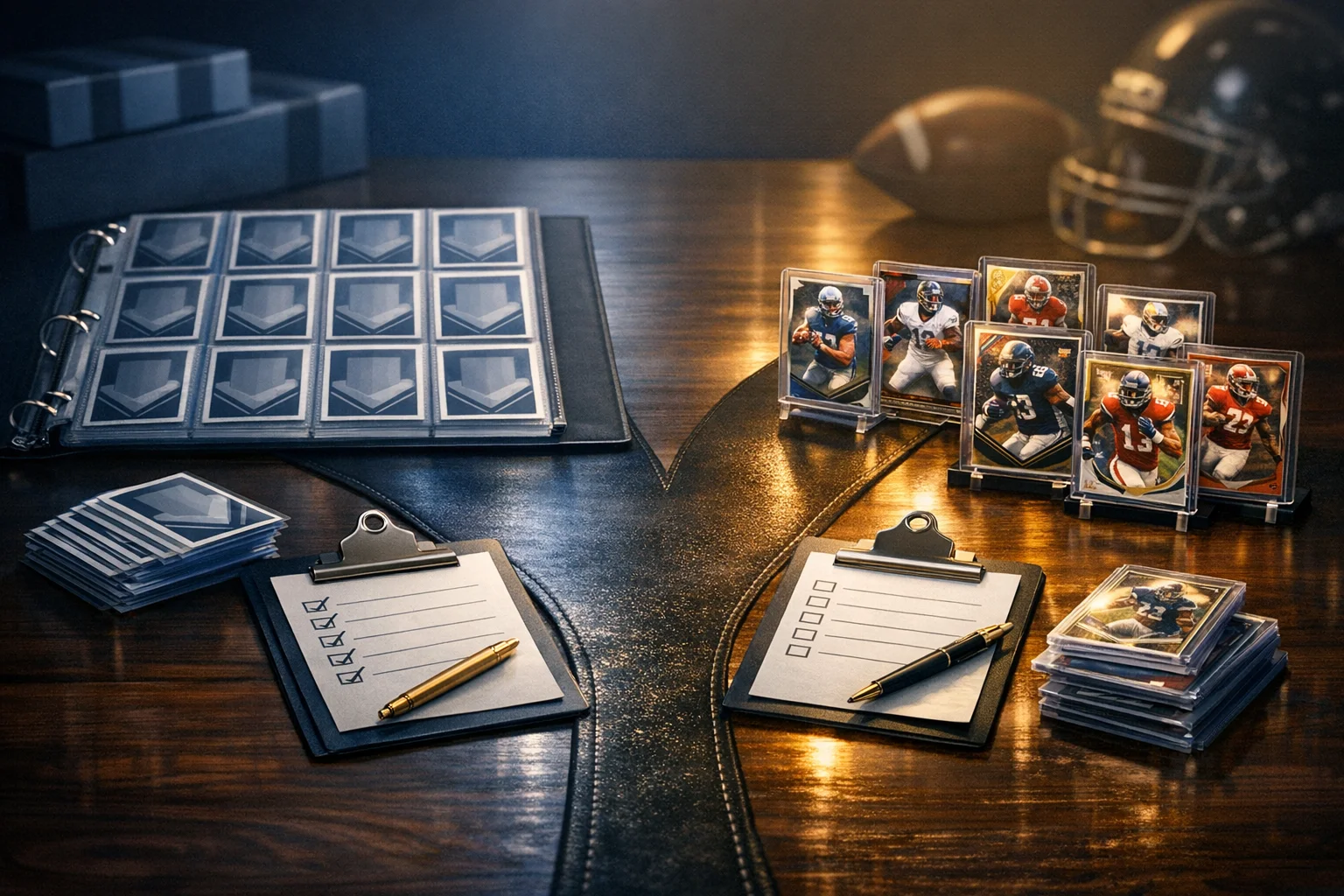
Illustration generated for this guide; not a photograph of an actual card, product or event.
Photo Gallery