Football rookie cards get confusing when two cards of the same player look important for completely different reasons. One may be a true NFL rookie card with full team branding. Another may be an earlier prospect issue. A third may be a common base rookie, while a fourth was built from day one as a premium autograph chase.
The cleanest way to sort that out is to stop asking whether a card is simply “good” and start asking four narrower questions: Is it actually a rookie-designated NFL card? What kind of licensing does it have? How available is it compared with other versions of that player? And what evidence really supports the demand story around it?
As of September 19, 2026, those four checks offer a much better collector framework than chasing whatever listing title sounds most exciting. They help you compare a 1st Bowman prospect, a flagship rookie, and an on-card auto without pretending they belong to the same lane.
First, separate an NFL rookie card from a prospect or pre-rookie card
The most important first step is simple: confirm what category the card actually belongs to. Topps makes this distinction unusually clear on its 2026 Bowman Football page. That product separates NFL rookies and veterans in the main base set from a Bowman Prospect section built around collegiate talent. Topps also states that those prospects have not yet earned NFL rookie designation, even when the card is that player’s first trading card and carries the 1st Bowman logo.
That means an early card and a rookie-designated NFL card are not interchangeable. A 1st Bowman can still be meaningful. It may be the player’s first notable card, the first card many collectors want, or an appealing way to collect a player before his NFL rookie issues take shape. But it is still a different object from a licensed NFL rookie card. Treating them as the same thing leads to sloppy comparisons and disappointing purchases.
A practical buying habit is to read the product description and not just the seller’s headline. If the manufacturer describes the player as a prospect who has not earned NFL rookie designation, then you are buying a prospect card. If the player appears in the rookie portion of an NFL set, you are in the rookie-card lane. That distinction matters whether you collect for player loyalty, set building, or long-term organization.
Collectors can use familiar hobby markers as secondary clues. PSA’s CardFacts entry for 2012 Panini Prizm Football notes that first-year players in that set carry an NFL Rookie Card RC shield. That supports the idea that RC-style logos are recognized identifiers in football-card cataloging. Still, the smarter order of operations is product context first, symbol second. A logo can reinforce a classification, but it should not replace reading what the card and product actually are.
- Ask: is this card sold as an NFL rookie, or as an earlier prospect card?
- Treat 1st Bowman importance and NFL rookie designation as separate collecting ideas.
- Use RC shields as supporting clues, not your only test.
Licensing changes the card’s identity, not just its appearance
In football, licensing is not a vague buzzword. It changes what the card can show and how clearly it presents the player’s pro identity. The NFL and NFLPA announcement on NFL.com says Fanatics Collectibles received rights to use official team logos, names, marks, helmet designs, uniforms, and official NFL branding for cards and packaging. In practical terms, that is what many collectors mean when they talk about a fully licensed NFL card.
Why does that matter? Because a card of an NFL player can still offer a very different collecting experience if it lacks official team presentation. A fully licensed rookie card anchors the player to his NFL club through uniforms, helmets, names, and logos. For many collectors, that visual package is part of the appeal of the rookie-card moment. It does not automatically make every fully licensed card more desirable than every other type of card, but it does define the category more precisely.
This is also where collectors should avoid overstating things. Some people genuinely prefer prospect imagery, college uniforms, or cleaner designs that are less dependent on heavy branding. That is a design preference, not an error. But if your goal is to evaluate a modern licensed NFL rookie card, then you should verify that the card actually includes the league and team elements that define that status.
One practical step is to inspect listing photos for the card itself rather than trusting shorthand in the title. Look for official team names, uniform details, helmets, and logos on the card image or design. Sellers often compress descriptions for search visibility. The card usually provides the more reliable answer.
- Fully licensed NFL cards can include official team names, logos, helmets, uniforms, and league branding.
- Do not assume every card of an NFL player is the same kind of licensed product.
- Design preference and licensing status are different questions.
The player-rights side matters too, especially when you compare eras
Football-card licensing has more than one layer. Team and league marks are one side. Player-group rights are another. The current NFL.com announcement is a joint NFL and NFLPA licensing deal, which is an important clue for collectors: modern football cards depend on both the league-and-team side and the player side, not just the right to print uniforms and logos.
That context becomes even more useful when you compare cards from different periods. In 2014, NFL Players Inc. announced that Panini would become the sole manufacturer of NFLPA-licensed trading cards and collectible stickers beginning with the 2016 NFL season. That marks the start of the Panini-exclusive era described in these sources. Later, the Topps return under an NFL and NFLPA exclusive trading-card license created a new fully licensed chapter beginning in 2025.
For collectors, the takeaway is not that one era is automatically better. The takeaway is that release context matters. A rookie card from the Panini-exclusive stretch and a rookie card from the post-2025 Topps return belong to different licensing eras. That can affect how collectors describe them, sort them, and sometimes prioritize them. Even before you get to design or scarcity, the year of issue places the card inside a specific licensing environment.
This is also the right place for caution. Public sources explain the broad framework, but they do not fully map every legal detail behind autograph rights and memorabilia inclusion. So the safest collector approach is to confirm what the product, league, and players-association materials clearly support, and avoid filling in contractual blanks with assumptions.
- 2016 began the Panini-era exclusive period on the NFLPA side in these sources.
- 2025 began the new Topps/Fanatics fully licensed NFL chapter.
- Era context helps explain a card’s place in the hobby even when it does not settle value by itself.
Why the 2025 Topps return matters when you compare modern rookies
The current football rookie-card landscape changed materially when Topps returned as the NFL and NFLPA’s official exclusive trading-card licensee. According to the NFL announcement, the first set under that return was 2025 Topps Chrome Football, released April 15 after a pre-order on April 3. That detail matters because collectors often assign special attention to a first release in a new licensing era, even when the card must still stand on its own merits.
A useful way to think about this is not as a guaranteed premium, but as part of the card’s identity. If you are evaluating a 2025 Topps Chrome rookie, one part of its appeal may be that it belongs to the first fully licensed Topps NFL release of the new era. Another collector may still prefer a later card because the later design is cleaner, the autograph format is stronger, or the photography is better. Both approaches can be sensible as long as you are clear about what you are rewarding.
By 2026, Topps had expanded beyond one headline return product into additional fully licensed football lines, including Topps Flagship Football and Bowman Football. That gives collectors more product families to compare: flagship, chrome, prospect-oriented crossover, and premium autograph-driven formats. Once that menu expands, asking for “the rookie card” of a player becomes less useful than asking which rookie-card lane you actually want.
A practical exercise is to compare two cards of the same player from different 2025-26 products and write down the real reasons you prefer one over the other. If your answer is only price, you are probably missing the structure of the comparison. If your answer includes first-release context, autograph type, official team presentation, and scarcity tier, you are evaluating the card more clearly.
- 2025 Topps Chrome Football marked the first fully licensed Topps NFL release of the new era.
- By 2026, collectors could choose among multiple Topps football product families.
- “First year back” is part of release context, not a universal rule of superiority.
Availability is where many rookie-card comparisons break down
Collectors often say they want a player’s rookie card as if there were one standard version. Modern football cards make that impossible. Topps Flagship Football alone shows how different rookie-card tiers can be within one release. The product includes a broad base set with rookies, plus 1957 Rookie Variations, Flagship First Signatures, Flagship First Dual Signatures, and Topps Patch Autograph Cards. Those are not just cosmetic variations of the same purchase decision. They represent different levels of access, scarcity, and intent.
The pack and box structure reinforces that point. The Topps Flagship page lists Value, Mega, Hobby, and Jumbo configurations, with Hobby including one autograph or relic card per box and Jumbo including one autograph and one relic card. Even without exact print-run data, that tells you a base rookie from the general set has a different availability profile than an autograph program or patch auto. So if two cards of the same rookie have wildly different asking prices, the first question should be whether they even belong in the same comparison group.
The same logic applies to the 2025 Topps Chrome Football launch. The NFL announcement specifically highlighted 1/1 Topps Rookie PREM1ERE Patch Autograph Cards and 1/1 NFL Honors Gold Shield Autograph Cards. A one-of-one premium autograph concept is structurally different from an ordinary base rookie or even a more standard insert. Yet collectors regularly flatten those categories because the player and release year match.
A useful habit is to assign each rookie card to a broad bucket before thinking about value: base rookie, variation, autograph, patch auto, or ultra-limited showcase card such as a 1/1. You may still prefer a clean base rookie over a premium hit, especially if you collect on a budget or value classic set-building. But you should make that choice knowing what kind of card you are declining or embracing.
- Base rookies are often the broadest entry point.
- Variations should be treated differently from standard base copies.
- Autographs and patch autos are distinct content tiers, not just prettier versions of the same card.
- A 1/1 showcase hit belongs in its own scarcity conversation.
Rookie Premiere is a production clue, not a promise
Rookie Premiere deserves a place in any football rookie-card checklist because it helps explain how modern rookie content gets built. Topps says its 2026 Rookie Premiere event is the first chance to photograph rookies in official NFL uniforms and to capture on-card autographs and memorabilia for use across the season’s products. For collectors, that is valuable because it explains why certain rookie cards arrive early with official-uniform photography and stronger autograph integration.
Topps also says rookie selection for the event considers draft position, projected playing time, collector interest, marketability, and long-term potential. Those factors matter because they show companies are not choosing event participants randomly. They are concentrating resources on players they believe can support the season’s football-card story. That does not make every selected player a future hobby star, but it does make Rookie Premiere involvement a useful context signal.
A practical collector use of this information is to compare how deeply a rookie appears across early products. Does the player get official-uniform imagery quickly? Is there meaningful on-card autograph content? Does the player seem central to the season’s rookie programs rather than tacked onto a checklist? Those are helpful clues when two cards are similarly priced and you want to know which one feels more connected to the main rookie pipeline.
The tradeoff is important. Rookie Premiere visibility can increase attention, but attention is not the same as durable demand. A player can receive strong early marketing support and still cool off if performance or collector interest changes. So use Rookie Premiere as one part of evaluation, not as the entire thesis for buying a card.
- Rookie Premiere can lead to early official-uniform photography.
- It also supports on-card autograph and memorabilia programs.
- Event visibility is a signal of emphasis, not proof of future market strength.
What demand signals are actually supported by public evidence
Broad claims about what “the market” wants are often less useful than a few narrower, documented signals. The strongest supported signals here are that quarterbacks and skill-position players “naturally carry a lot of weight in The Hobby,” according to Topps, and that product makers emphasize on-card autos, rookie variations, and patch autos as centerpiece content. NFLPA Rookie Premiere materials also describe player selection with demand and marketability in mind. Taken together, that supports a careful conclusion: collector attention tends to cluster around high-profile rookies, especially quarterbacks, and around premium rookie formats rather than ordinary base cards alone.
The limited public sales examples in these sources point the same way, but they should be handled carefully. A Cam Ward 2025 Topps Chrome Football on-card auto /499 sold for $324.99 on July 18, 2026, and a Cam Ward 2025 Topps Chrome Black rookie auto sold for $255.00 on July 10, 2026. By contrast, a 2025 Topps Chrome Black base Cam Ward RC sold for $0.99 on July 17, 2026. A 2026 Topps Flagship Fernando Mendoza rookie example sold for $10.00 on August 21, 2026. Those examples are real public sales, but they are still examples, not a complete market study.
What they do support is the basic shape of the hierarchy: licensed rookie autos can perform far above standard base rookies in individual sales, and quarterback-led interest is visible in this small sample. What they do not support is a universal ranking of every football rookie card or a guaranteed pricing rule. A few sales can be influenced by timing, listing quality, or bidder behavior as much as by long-term consensus.
That is why the right move is to use sales as signals, not shortcuts. If a premium rookie auto sells much higher than a base rookie of the same player, that likely fits the designation, licensing, and scarcity framework already visible in the product design. But if a single outlier sale seems disconnected from the card’s actual category, you should investigate rather than assume it defines the market.
- Supported signal: quarterbacks and skill-position rookies draw strong hobby attention.
- Supported signal: on-card autos and patch autos are designed as premium focal points.
- Unsupported leap: turning a few sales into a universal market law.
A practical card-by-card checklist for buyers
When you are staring at a specific listing, simplify the process. First, identify the designation. Is this an NFL rookie card, or is it a prospect issue that predates NFL rookie designation? Second, verify licensing through the card’s visuals and product identity. Does it show official team names, logos, helmets, uniforms, and NFL branding, or is it operating in a different lane? Third, identify the availability tier: base, variation, autograph, patch auto, or top-end limited chase.
Fourth, place the player in realistic demand context. As of the research date, quarterbacks and other skill-position players appear to receive especially strong hobby emphasis in the public sources, but that is still a tendency, not a guarantee. Fifth, compare the price only after the first four steps are clear. Many buying mistakes happen because collectors jump straight to price or hype before deciding what category of card they are even looking at.
This framework works best when you apply it to actual scenarios. If you are choosing between a 1st Bowman card and a later licensed flagship rookie of the same quarterback, ask what you want the card to do in your collection. If you want the earliest notable card, the prospect card may make sense. If you want official NFL rookie designation and team presentation, the flagship rookie is probably the better fit. If you are choosing between a base rookie and an on-card auto from the same release, the question becomes budget versus content tier, not simply which one is “better.”
The final step is personal and should remain personal. Decide whether you are building a player collection, chasing a favorite set design, focusing on rookie types, or staying within a strict budget. Once that is clear, many hard decisions get easier because you stop asking one card to satisfy every possible goal at once.
- Step 1: rookie designation or prospect designation?
- Step 2: fully licensed NFL presentation or not?
- Step 3: base, variation, auto, patch auto, or showcase hit?
- Step 4: is demand supported, or are you mostly buying hype?
- Step 5: does this card actually fit your collection plan?
The best comparisons happen inside the right lane
The single most useful habit for football collectors is to stop treating every first-year card of a player as a direct substitute for every other one. A 1st Bowman prospect card, a fully licensed NFL flagship rookie, an on-card Rookie Premiere auto, and a 1/1 patch autograph may all feature the same player, but they answer different collecting needs. Once you recognize that, the buying process becomes less emotional and more precise.
As of September 19, 2026, the clearest evaluation order is straightforward. Confirm the designation. Confirm the licensing context. Separate broad availability from premium scarcity. Then use demand signals carefully, with special attention to high-profile quarterbacks, on-card autographs, patch autos, and first fully licensed releases in the current Topps era. That process will not hand you a universal price guide, and it should not pretend to. What it does provide is a cleaner understanding of what kind of card you are buying.
That understanding protects collectors in both directions. It can keep you from overpaying for a card whose story is weaker than the listing suggests. It can also keep you from dismissing a card that fits your real collecting goals simply because it is not the most expensive format. Sometimes the right answer is the flagship rookie. Sometimes it is the earlier prospect card. Sometimes it is the base issue because you want the player and the design, not the premium chase. And sometimes the best move is to pass.
Football rookie cards become much easier to evaluate once you stop chasing one magic label and start comparing like with like. That is the difference between following hobby noise and collecting with a plan.
- Compare cards within the same lane before deciding which is stronger.
- Do not confuse early-card importance with official NFL rookie status.
- Use public sales as context, not as a replacement for understanding the card.
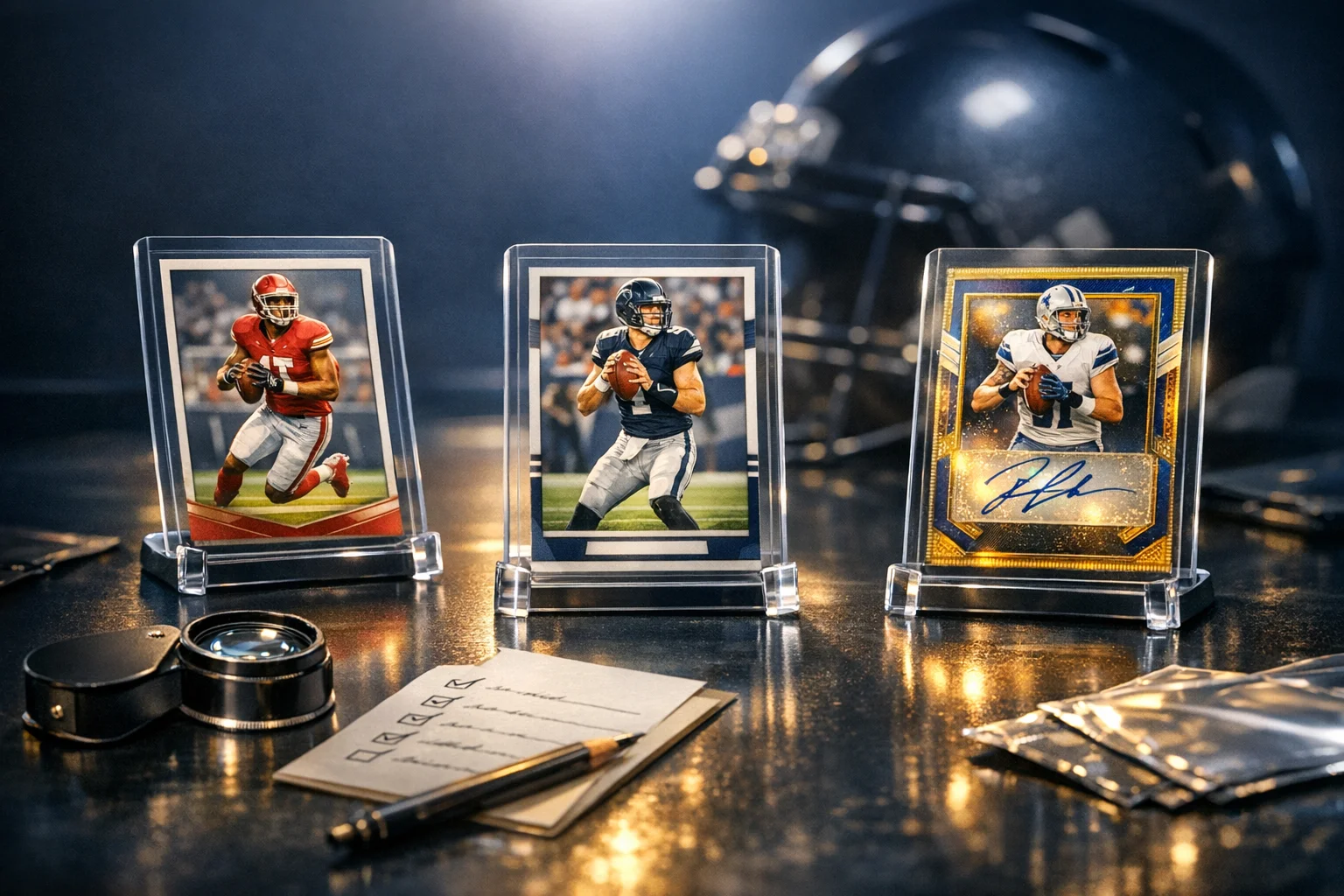
Illustration generated for this guide; not a photograph of an actual card, product or event.
Photo Gallery