Autograph cards are one of the hobby’s most popular categories, but not all signatures are valued the same way. One of the clearest dividing lines is timing. In many cases, collectors place a much higher premium on cards issued during a player’s active career than on cards signed and released after retirement.
That gap is not limited to one sport. Basketball, football, baseball, and even global soccer all show the same broad pattern. When a card connects directly to a player’s active career, key season, rookie window, or original era, collectors often treat it as a more important piece of hobby history. Later-signed cards can still be valuable, especially when they are rare, but volume tends to weaken them when compared with truly scarce playing-day material.
The result is a market that rewards context almost as much as the autograph itself. Same player, same signature, but very different outcomes depending on when the card was made and how much supply followed later.
Why playing-day autograph cards carry a premium
Collectors usually pay up for playing-day autograph cards because those releases tie the signature to the player’s actual career arc. A card produced while an athlete was still competing can represent a specific moment in time: a rookie season, a championship run, an MVP campaign, or a peak-era release from a licensed brand that defined the hobby at that point.
For more collector background, read Michael Jordan Signed Type 1 Slam Dunk Photo Leads Goldin Fall Photography Auction.
That kind of historical connection matters. A playing-day autograph is often seen as more than a signed card. It can be viewed as a period piece from the athlete’s career, not simply a collectible produced after the fact to revisit that legacy.
Scarcity also plays a major role. Many earlier autograph cards were issued in much smaller quantities than later products, especially compared with modern autograph-heavy checklists and buyback programs. When demand is paired with genuinely tight supply, prices can separate quickly from later-signed alternatives.
This does not mean every post-career autograph is weak. It means the market is usually far less forgiving when later signatures are produced in meaningful volume.
For another perspective on this story, read Why When an Autograph Was Signed Can Matter More Than the Ink Itself.
Michael Jordan shows the widest gap
Few players illustrate the market better than Michael Jordan. His autograph market has room for both extremes: ultra-premium era material that sells at historic levels, and post-career signed cards that still draw strong prices but sit far below the top tier.
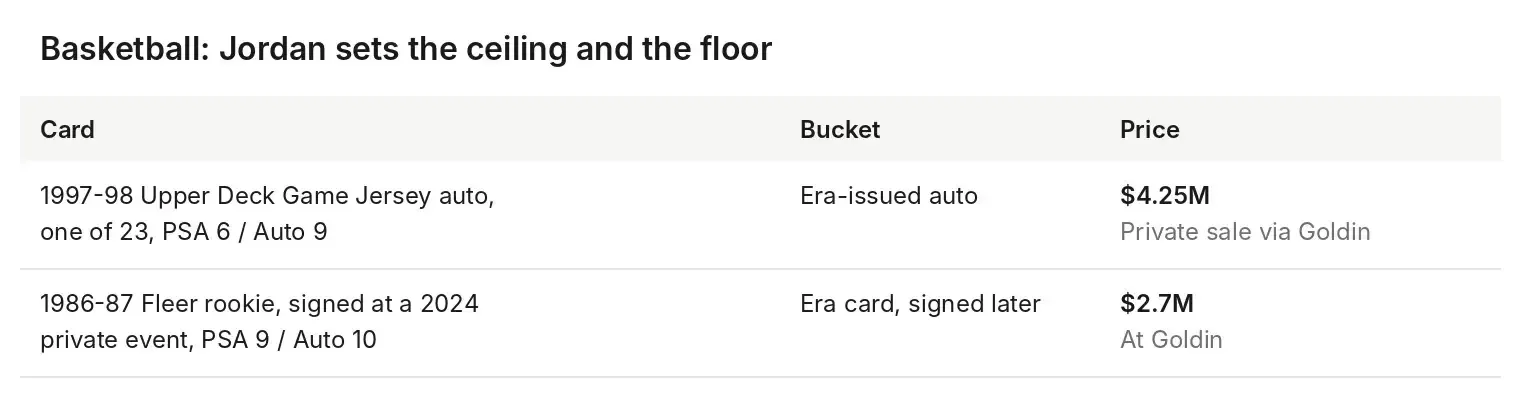
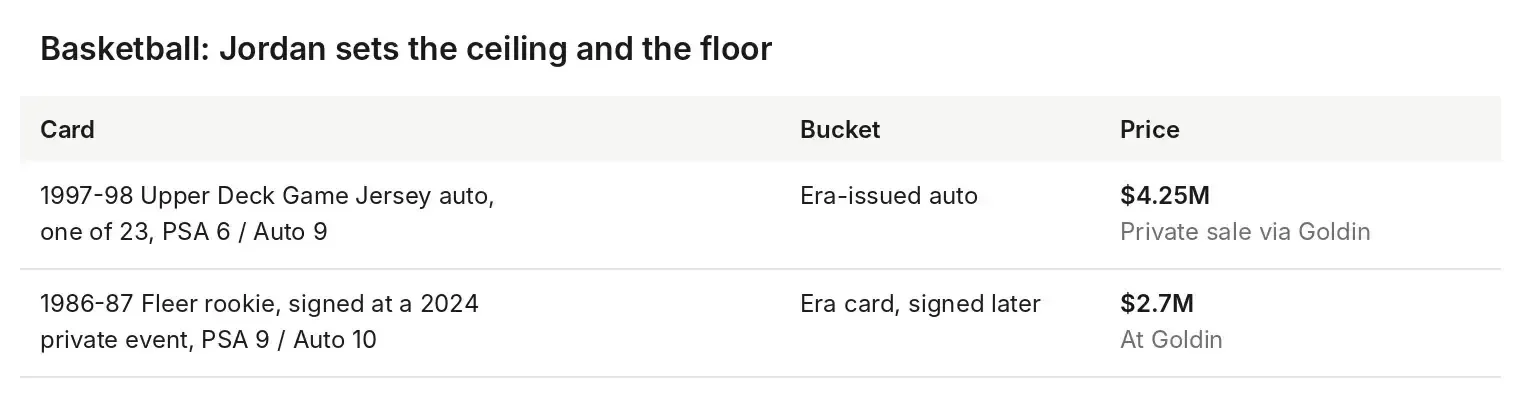
A 1997-98 Upper Deck Game Jersey Autographed Michael Jordan numbered to 23, graded PSA 6, sold privately for $4.25 million earlier this year. That card dates to Jordan’s playing days with the Chicago Bulls and sits near the top of the hobby’s autograph hierarchy.
By comparison, a 2006 Upper Deck Trilogy Auto Focus Michael Jordan in BGS 10 Pristine Black Label with a 10 auto grade recently sold for $51,600. That is still a significant result by any normal standard, but the gap between the two cards is enormous.
The difference is not about whether collectors want Jordan autographs. They clearly do. The difference is about the status of the card itself. The 1997-98 release is tied to Jordan’s active-career legacy, while the 2006 issue belongs to the later autograph market that followed retirement.
There is an important wrinkle here. Later-signed Jordan cards can still explode in value when scarcity becomes extreme. One example noted in the market is a 2006 Exquisite Collection Patches Michael Jordan 1/1 auto that sold for as much as $810,000. That result reinforces the central rule: post-career autographs are not automatically weak, but they usually need exceptional rarity to approach the top end of the market.
Issue date often matters more than signature date
One of the most useful lessons for collectors is that the card’s issue period can matter more than the date the ink was applied. In Jordan’s case, the market often responds more strongly to when the cardboard belongs than to when he physically signed it.
That distinction helps explain why buybacks and later-signed era cards can still perform well. If the underlying card is iconic enough and the supply is tiny enough, collectors may still treat it as a premium item. The autograph adds a new layer, but the original cardboard carries much of the history.
Jordan’s 1986 rookie-era cardboard signed later is a useful example of the concept. When the supply is extremely limited, collectors may price it closer to an era-level piece than to a standard post-career insert. In other words, the market is willing to pay for a famous card first and a signature second when both elements are elite.
For collectors evaluating autograph cards, that means a simple question can go a long way: is this card important because of the autograph, or because the cardboard itself already held major significance before the autograph was added?
Tom Brady and the power of active-career scarcity
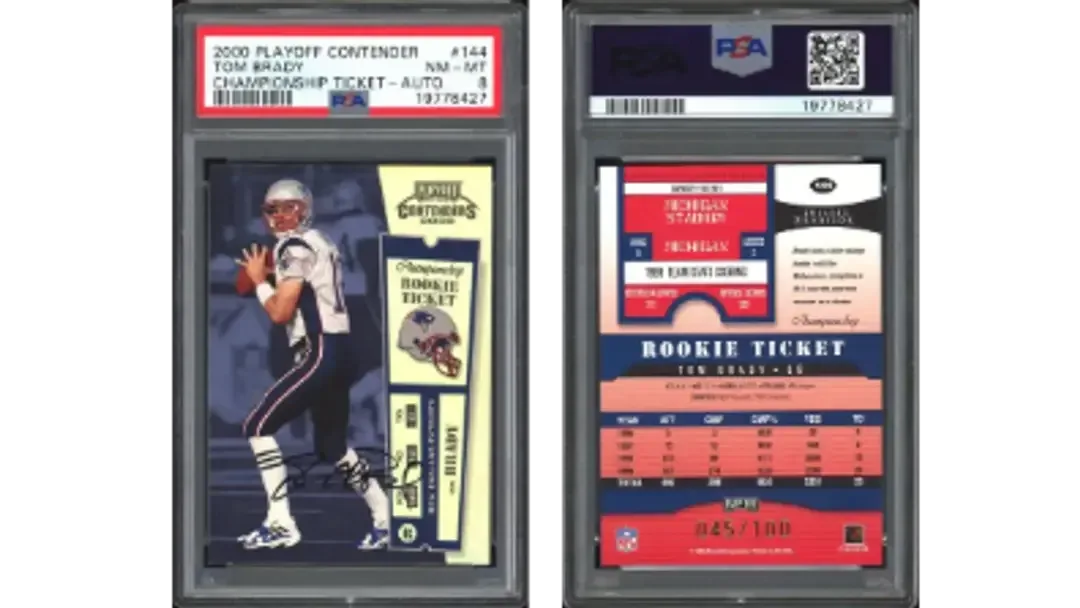
Football tells a similar story, and Tom Brady is one of the clearest examples. Brady’s most important autograph card is widely viewed as the 2000 Playoff Contenders Championship Ticket, numbered to 100. It is the only NFL-licensed, numbered Brady rookie card with his signature from his playing days.
A PSA 8 copy of that card sold for $854,000 on October 17. That result reflects more than Brady’s popularity. It reflects the strength of a card that combines rookie-year status, licensed NFL issue, signature, and relatively low supply.
Brady’s market also shows how hobby events can temporarily lift broad demand without changing the long-term hierarchy. When his first retirement was announced, collectible sales jumped 198% and rookie card sales climbed 233%. That kind of news can create a short-term surge, but it does not necessarily reorder which cards matter most over time.
Playing-day cards remained the backbone of Brady’s market anyway. Even his unsigned 2000 Bowman Chrome rookie in PSA 10 moved through dramatically different value ranges depending on the point in his career cycle, trading between about $3,000 and $10,000 at different times and getting close to $30,000 after his 2021 Super Bowl win.
The takeaway is straightforward. Retirement headlines can move attention. Career-defining cards keep the strongest long-term footing.
Baseball offers a different path with buybacks and retired-player autos
Baseball has one of the most developed markets for later-signed era cards because it produced an entire product lane around that idea. Topps Archives Signature Series is built on buybacks of original Topps cards from a player’s career, later signed on-card by retired stars, serial-numbered, and encapsulated.
That formula has been popular because it gives collectors an accessible entry point into signed vintage and modern-era cardboard without chasing the most expensive original autograph issues. A box of the 2025 product has been available around $68.25 in the current market, and each box contains one signed card numbered to 99 or less.
Products like this show why the hobby continues to support post-career autographs. They are often attractive, on-card, and linked to real playing-era designs. They can also be much more affordable than true playing-day autograph grails.
Still, the same risk appears when supply builds. If a player signs heavily after retirement across multiple programs, collectors may eventually become more selective. The more available later-signed material becomes, the more the market may concentrate its biggest premiums on original era autos and the scarcest buybacks.
Derek Jeter highlights the volume risk
Derek Jeter is one of the better baseball examples for understanding how scarcity and timing interact. After retiring following the 2014 season, he signed a multi-year autograph deal in the fall of 2016. That gave the market a steady stream of post-career signed material.
At the same time, Jeter’s rookie cards surged ahead of his Hall of Fame induction in 2021 before later falling by more than 50% from their peak. That swing shows how market excitement can rise around major career milestones, then cool off after the moment passes.
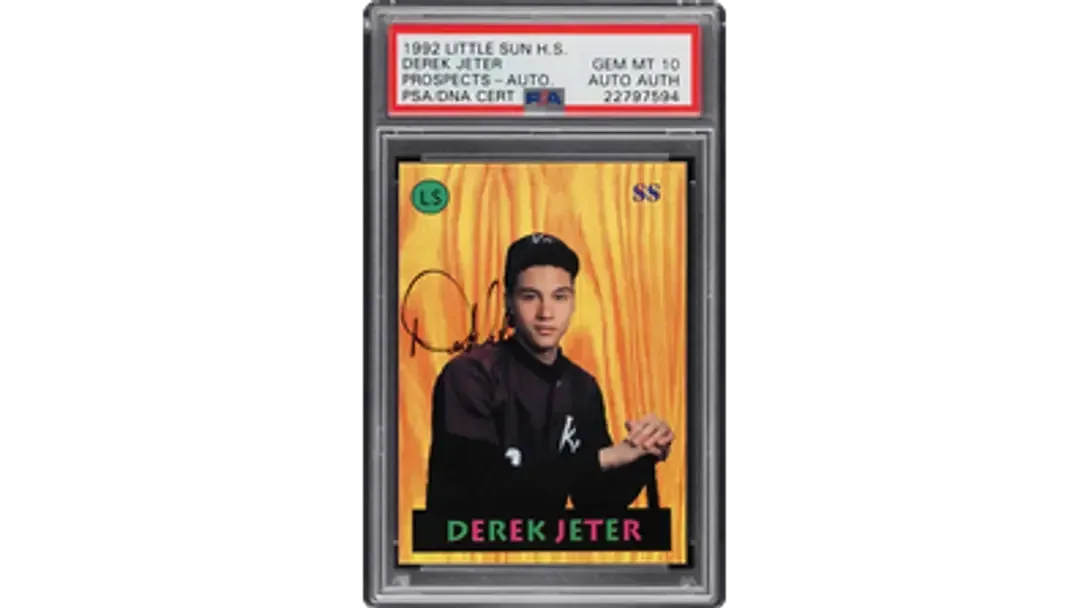
What remained especially desirable were the truly scarce items tied closely to his early career. Among them, the 1992 Little Sun High School Prospects autographed card stands out as one of Jeter’s toughest and most respected era autographs.
That contrast is central to the discussion. Jeter collectors still want autographs, but the market puts a very different weight on a scarce early-career signed issue than it does on larger pools of retirement-era autograph releases. The signature may be the same, but the card’s place in hobby history is not.
What actually loses value pressure
The broad lesson is not that post-career autograph cards are bad. It is that post-career autograph cards produced in volume often face the most pressure.
If a retired player continues signing for years across multiple products, collectors have more options and less urgency. That can soften prices, especially for cards that do not have a major design, rookie-year tie, or unusually low print run working in their favor.
By contrast, later-signed cards can still thrive when one or more of the following are true:
The underlying card is iconic.
The autograph is on-card and visually strong.
The card is serial-numbered to a very low total.
The release is tied to a meaningful original playing era.
The player does not have overwhelming autograph supply elsewhere.
Collectors do not reject later autographs outright. They simply tend to reward selectivity and scarcity much more aggressively in that part of the market.
Cross-sport comparisons tell the same story
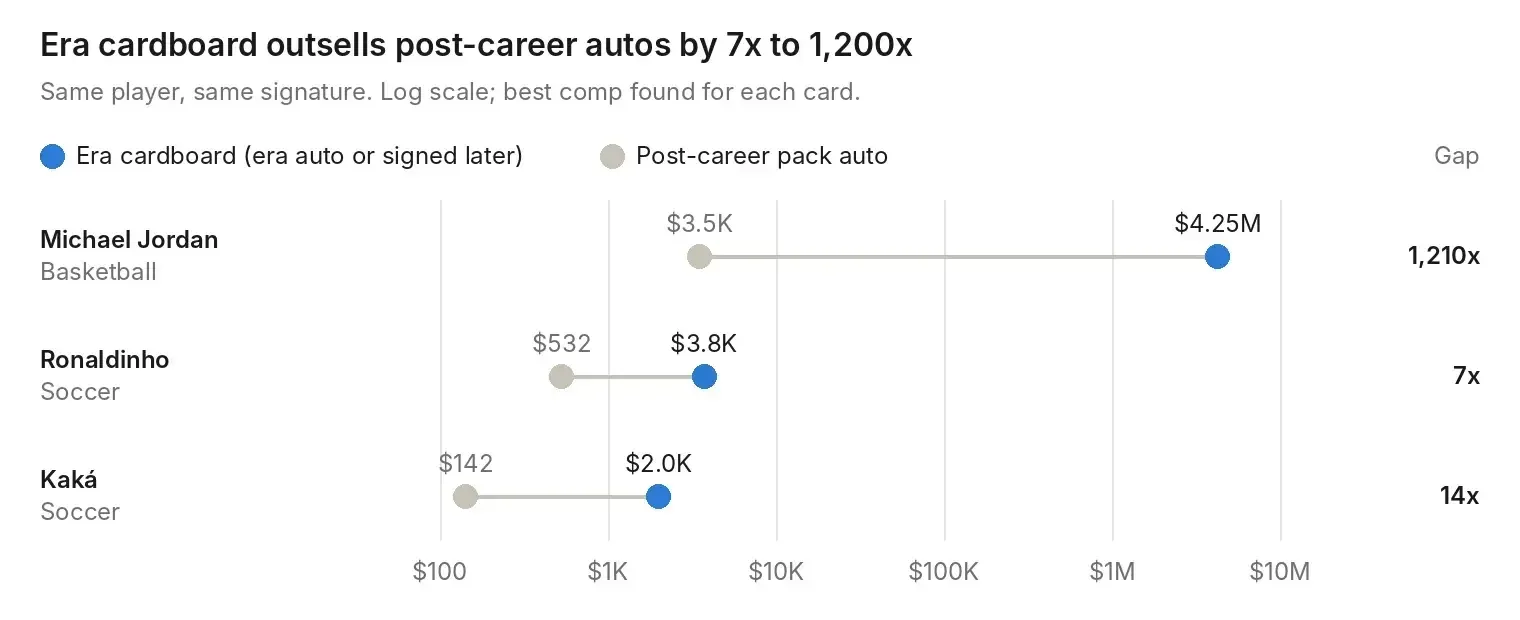
The pattern extends beyond the biggest American card markets. Cross-sport comparisons have shown major pricing gaps between era-relevant autograph cards and later-signed alternatives. In examples cited across soccer, the same player and signature can still produce huge valuation differences depending on issue context, with ratios reaching 7x for Ronaldinho, 14x for Kaká, and more than 1,200x for Michael Jordan in comparable discussions of era versus later-signed material.
That kind of spread makes one thing clear: collectors are not only buying the autograph. They are buying the moment, the card design, the issue window, and the sense that a release belongs to a player’s actual competitive timeline.
Once that idea clicks, many market results that look surprising at first begin to make much more sense.
How collectors can evaluate autograph cards more carefully
For anyone shopping autographs, the key is to separate popularity from structure. A famous athlete can sign a lot of cards, and strong name recognition alone does not guarantee long-term strength for every release. Before buying, it helps to look at a few core questions:
Was the card issued during the player’s active career?
Is it tied to a rookie season or a major career milestone?
How much autograph supply exists for that player after retirement?
Is the card rare because of true scarcity, or just because it is one of many similar later-signed versions?
Would collectors still care about the cardboard if it were unsigned?
Those questions can help explain why one autograph becomes a centerpiece card and another remains a more affordable collector option.
That affordability matters too. Not every collector is chasing million-dollar grails or six-figure rookie autos. Later-signed autograph cards can still offer strong visual appeal, authenticated signatures, and a lower entry cost for fans who simply want a signed card of a favorite player. The market has room for both approaches, but it does not value them the same way.
For collectors focused on long-term significance, the strongest premiums still tend to follow playing-day issues, iconic era cardboard, and genuinely scarce autograph supply.
Photo Gallery