The April 2026 Standard format has arrived with one major change driving everything else: the April 10 rotation removes all G regulation mark cards from legal play. That single update strips away several of the format's most familiar safety valves and power cards, including Gardevoir ex, Iono, and Counter Catcher. In practical terms, that means established deckbuilding rules have changed overnight.
For a long stretch, Gardevoir ex served as one of the format's defining forces, especially against Fighting decks that struggled to push through its efficiency and favorable typing dynamics. At the same time, Iono kept hand disruption constantly in the picture, while Counter Catcher gave slower decks a reliable comeback gust option. With all three now out of the picture, the pace and structure of Standard look very different.
One of the clearest early beneficiaries is Mega Lucario ex, a bulky Fighting attacker that seems positioned to take advantage of a less hostile field. Without the old Psychic roadblock and without the same level of hand disruption, aggressive Fighting builds have a real chance to move from fringe option to centerpiece of the April metagame.
Here is a closer look at why Mega Lucario ex is drawing so much early attention, which support cards matter most, and what damage math players need to respect in the new format.
Rotation Changes the Shape of Standard
Every format rotation creates openings, but this one feels especially important because it removes cards that influenced both tempo and decision making every turn. The absence of Iono means decks are less likely to have their resources reset at the exact moment they are trying to stabilize. That is a huge gain for strategies that want to build toward one overwhelming attacker and keep pressure on the board.
The loss of Counter Catcher matters just as much. Gust effects always shape which support Pokémon are safe to bench and when. With one of the format's best swing cards gone, decks now need to work harder to drag up an opposing support target at the perfect time. That makes Ability-based utility and evolution-driven gust effects more valuable than before.
Then there is Gardevoir ex. Its departure is not just about one deck leaving the top tables. It changes how players evaluate Fighting attackers across the board. A type that spent much of the previous environment fighting uphill now has room to breathe, and Mega Lucario ex looks like one of the first cards ready to capitalize.
Why Mega Lucario ex Is the New Early Headliner
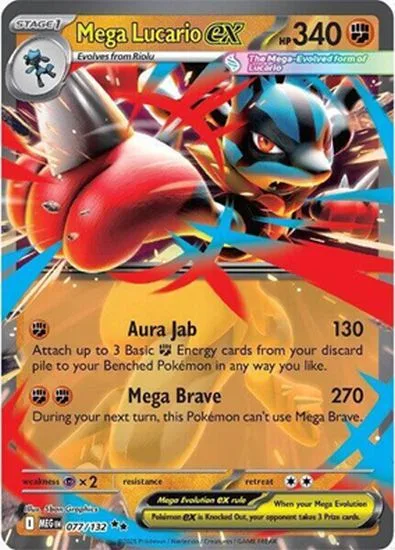
Mega Lucario ex from Mega Evolution 77 brings together two traits that are always dangerous in a fresh format: survivability and efficient pressure. As a Stage 1 that evolves from Riolu, it comes online without the clunkier turn-ending baggage older Mega mechanics were known for. That already gives it a smoother path into competitive play.
The first number that jumps off the card is 340 HP. That is an enormous total for a Stage 1 attacker and one of the main reasons the deck has immediate appeal. In a format where many decks are still being rebuilt after rotation, forcing opponents to deal with a giant Active Pokémon can create real strain on their sequencing and damage planning.
Its first attack, Aura Jab, is what turns Mega Lucario ex from a tank into a true engine card. For a single Fighting Energy, it deals 130 damage and accelerates three Basic Fighting Energy from the discard pile to Benched Pokémon in any way the player chooses. That is a rare combination of offense and setup. You are not just attacking. You are using your first meaningful swing to create the next one.
Its second attack, Mega Brave, starts at 270 damage for two Energy. That is a serious number in any Standard environment, and it becomes even more threatening when paired with modern damage modifiers. The listed drawback is that Mega Brave cannot be used on consecutive turns, but the restriction can be reset by moving Mega Lucario ex to the Bench and bringing it Active again. In other words, the deck can often play around the limitation instead of accepting it.
That overall pattern is what has helped define the emerging Aura Farm approach. Mega Lucario ex absorbs damage, attacks efficiently, reloads the Bench through Aura Jab, and then cycles in and out to keep Mega Brave online when it matters most.
The Aura Farm Game Plan
The basic structure of the deck is straightforward, but effective. You want Mega Lucario ex in the Active Spot as early as possible, pressuring with Aura Jab while discarding and recycling Fighting Energy. The goal is to turn every early exchange into a setup opportunity. Even if your first Lucario is eventually knocked out, the board behind it should already be loaded with Energy and ready to continue attacking.
That plan is particularly strong in a less disruptive format. When opponents cannot lean on Iono to shrink your hand and break up your follow-up turn, your energy flow becomes much more reliable. Aura Jab becomes more than a midrange attack. It becomes the card that keeps your whole battle plan moving.
Mega Brave then serves as the finishing blow. Once the Bench is established and the damage modifiers are available, the deck can move from sustained pressure into knockout math very quickly. That is often the difference between a good rotation-week deck and a real contender. Mega Lucario ex does not need a long list of fragile combo pieces. It mainly needs a clean setup and the right support package.
Solrock and Lunatone Provide the Draw Engine
One of the more interesting parts of this emerging build is its use of Solrock and Lunatone as a low-cost support package. In a format that just lost top-end draw Supporters like Iono and Professor's Research, Pokémon-based draw has become far more important. The Solrock and Lunatone engine helps solve that problem while also feeding Mega Lucario ex exactly what it wants.
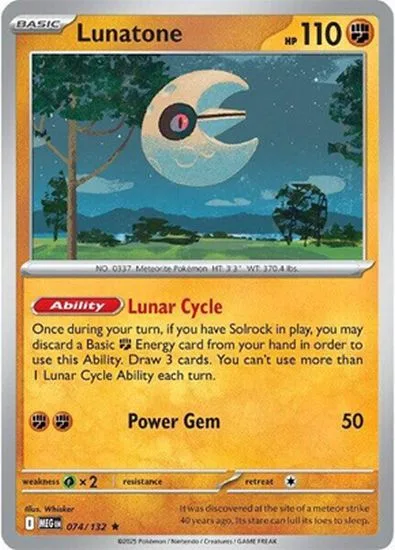
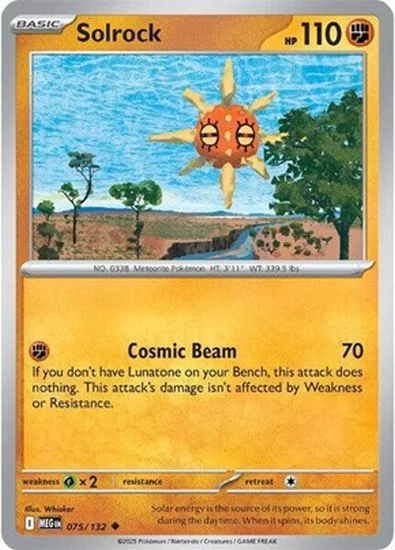
Lunatone from Mega Evolution 74 carries the Lunar Cycle Ability. As long as Solrock from Mega Evolution 75 is in play, Lunatone lets you discard a Basic Fighting Energy from your hand to draw three cards. That single text box does a lot of work. It improves consistency, helps churn through the deck, and deliberately places Fighting Energy into the discard pile for Aura Jab to recover later.
That means the engine is not just replacing lost draw power. It is also directly supporting the deck's primary attacker. Instead of treating energy discard as a cost, the deck can treat it as part of the setup loop.
There is another strategic benefit as well. Solrock and Lunatone are single-Prize Pokémon supporting a deck built around a larger, more expensive attacker. That creates awkward prize mapping for opponents. If they spend time removing the engine, Mega Lucario ex can punish them. If they ignore the engine, the Fighting player keeps drawing cards and stocking the discard pile.
In a still-forming metagame, forcing uncomfortable prize trades is often enough to generate an edge on its own.
Utility Cards Matter More After Rotation
As old staples leave Standard, utility options that might have looked secondary before can suddenly become essential. That appears to be the case with Hariyama and Meowth ex, two cards that help patch over the post-rotation gaps in gusting and consistency.
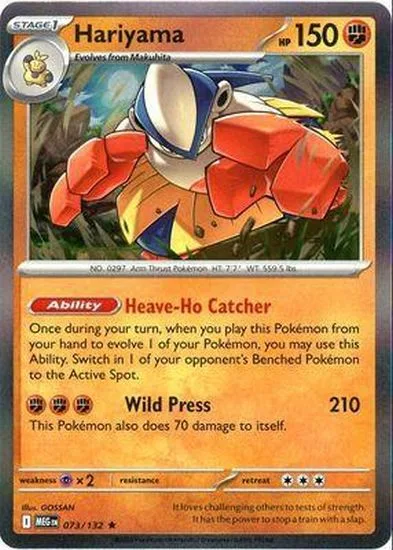
Hariyama from Mega Evolution 73 offers Heave-Ho Catcher, an Ability that lets you bring up one of your opponent's Benched Pokémon when Hariyama is played to evolve from Makuhita. In a format where Counter Catcher is gone, effects like this become much more important. It gives Fighting decks a practical way to pressure support Pokémon without relying entirely on traditional Trainer-based gust cards.
That can matter a lot in matchups where a support piece is doing the real work from the Bench. A target such as Fezandipiti ex from Shrouded Fable 38 becomes much less safe when a deck can threaten an Ability-based pull at the right moment.
Meowth ex from Perfect Order 62 adds another useful layer. Its Last-Ditch Catch Ability searches the deck for any Supporter card when Meowth ex is played to the Bench. In a thinner Supporter environment, that kind of targeted access becomes premium. Rather than hoping to naturally draw into the right hand refresh or setup piece, the deck can convert Meowth ex into the exact Supporter it needs for the turn.
Most often, that means finding Lillie's Determination from Mega Evolution 119. As a draw Supporter that shuffles the hand away and draws six cards, or eight if all six Prize cards remain, it fills an important post-rotation role. It may not replace previous format all-stars one for one, but it gives decks a new anchor for raw hand refresh.
Damage Math That Defines the Format
No strong attacker survives on base numbers alone. The reason Mega Lucario ex looks especially dangerous in April is that its attack values line up cleanly with available modifiers. Mega Brave starts at 270 damage, which is already enough to threaten a huge portion of the field. But in the new HP race, some of the most important knockouts still require help.
Dragapult ex is the clearest example mentioned early in the format. At 270, Mega Brave falls short of a clean one-hit knockout. To reach that benchmark, Lucario decks need to stack the right tools and Items.
Maximum Belt from Temporal Forces 154 is a major part of that equation. As the preferred ACE SPEC in this shell, it adds 50 damage against Pokémon ex. That pushes Mega Brave from 270 to 320 against ex targets, which is the key number for scoring a clean knockout on Dragapult ex.
Premium Power Pro from Mega Evolution 124 adds another layer. It gives Fighting Pokémon an extra 30 damage for the turn, and because it is an Item rather than a Tool, multiple copies can stack. Two Premium Power Pro in one turn adds 60 damage total, giving the deck considerable flexibility when a base attack plus Maximum Belt still is not enough for the board state in front of it.
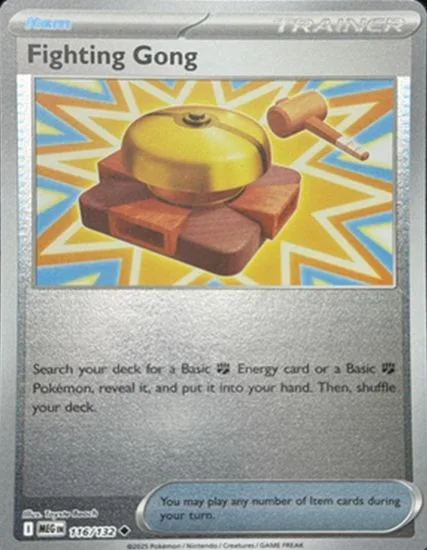
Then there is Fighting Gong from Mega Evolution 116. This card is less about finishing math and more about ensuring that the deck reaches its first important turns on schedule. It can search for either a Basic Fighting Energy or a Basic Fighting Pokémon, which makes it one of the cleanest setup cards available for activating the Solrock and Lunatone package early. Consistency tools like this tend to be especially important right after rotation, when streamlined starts often decide matches before players fully adjust to the new speed of the format.
Key Cards in the Emerging Mega Lucario ex Build
- Mega Lucario ex (Mega Evolution 77): Core attacker with 340 HP, Aura Jab for pressure and Energy acceleration, and Mega Brave as the main knockout move.
- Riolu: Basic setup piece that gives the deck access to its Stage 1 centerpiece.
- Lunatone (Mega Evolution 74): Draw engine through Lunar Cycle, while discarding Basic Fighting Energy for later recovery.
- Solrock (Mega Evolution 75): Required support piece that turns on Lunatone's draw Ability.
- Hariyama (Mega Evolution 73): Evolution-based gust option through Heave-Ho Catcher.
- Makuhita: Basic needed to access Hariyama's utility play.
- Meowth ex (Perfect Order 62): Searches any Supporter with Last-Ditch Catch when benched.
- Lillie's Determination (Mega Evolution 119): Primary draw Supporter, drawing six or up to eight cards depending on Prize count.
- Maximum Belt (Temporal Forces 154): ACE SPEC that adds 50 damage against Pokémon ex.
- Premium Power Pro (Mega Evolution 124): Damage boost Item that stacks for bigger knockout turns.
- Fighting Gong (Mega Evolution 116): Search card for Basic Fighting Pokémon or Basic Fighting Energy, ideal for early consistency.
- Fezandipiti ex (Shrouded Fable 38): Not part of the Lucario build, but a relevant support target that becomes more vulnerable in the new gust landscape.
- Dragapult ex: One of the key damage benchmarks shaping Lucario's card choices and math.
Why the Deck Could Stick Around
Early-format success does not always translate into long-term dominance, but Mega Lucario ex has several traits that suggest it could remain relevant beyond the first few weeks of April. It attacks efficiently, uses a synergistic draw engine, has access to utility that replaces lost staples, and can hit meaningful knockout thresholds with the right support cards.
Just as important, the deck appears to punish uncertainty. Rotation periods are filled with experimentation, imperfect lists, and awkward card counts as players search for the next best shell. A deck with a straightforward plan and strong numbers can take advantage of that environment quickly.
There are still open questions, of course. The format will continue to evolve as players test new counters, refine other archetypes, and identify which Supporter engines best replace the cards that rotated out. If opposing decks find faster ways to pressure Riolu, disrupt the Bench, or race Mega Lucario ex before it gets its Energy loop going, the current picture could change.
For now, though, Mega Lucario ex stands out as one of the clearest winners of April 2026's Standard reset. Fighting decks have new life, post-rotation support pieces are falling into place, and the combination of bulk, acceleration, and damage output makes this archetype one of the first decks players need to prepare for in the new Pokémon TCG meta.
Photo Gallery