Pokémon TCG 30th Celebration is set to put Espeon and Umbreon back in the spotlight, and the release structure makes the comparison impossible to miss. The expansion arrives worldwide on September 16, with Japan getting a Premium Deck Set that pairs both Pokémon together on launch day. English-language products take a different path, with separate all-foil Battle Decks scheduled for October 30 and Day and Night Ultra Premium Collections following on November 6.
That split matters because both Pokémon are being presented as opposite ends of the same collector theme. Espeon carries the daylight side, Umbreon anchors the nighttime side, and both are receiving premium promo treatment through fixed products rather than chase-card pack odds. For collectors and investors, that shifts the main question away from pull rates and toward demand. When supply is more predictable, the market often reveals which character collectors truly favor.
Looking across major side-by-side releases from the last 25 years, the historical pricing trend is difficult to ignore. In set after set where Espeon and Umbreon were printed under similar conditions, Umbreon has usually carried the higher ceiling, especially once condition becomes a serious factor.
Why Pokémon TCG 30th Celebration sets up a direct Espeon-Umbreon showdown
The new release schedule creates one of the cleanest head-to-head comparisons these two Eeveelutions have had in years. In Japan, the pair arrives together in a Premium Deck Set with Special Illustration Rare versions included. In English, buyers will see the cards split into separate retail products, first through foil Battle Decks and then through Ultra Premium Collections, with one product featuring an Espeon ex promo and another featuring an Umbreon ex promo.
Because these cards are attached to sealed products with known distribution, they are not entering the market as ultra-short-print mysteries. That generally lowers speculative upside compared with difficult pack-pulled chase cards. It does not, however, erase collector preference. If one character has consistently outperformed the other in comparable releases, that trend can still carry forward even when both cards are easier to access.
That is exactly what makes the Espeon-Umbreon comparison so compelling ahead of 30th Celebration. Their history includes several moments where both appeared in the same set, at similar rarity, and in similar print environments. Those releases provide a stronger read on pure demand than isolated cards with wildly different scarcity profiles.
Neo Discovery shows the rivalry started with Umbreon ahead
The cleanest early comparison comes from 2001 Neo Discovery, where Espeon and Umbreon made their Pokémon TCG debuts. Both cards came from the same expansion, both were Rare Holos, and both were subject to the same basic print conditions. That removes many of the usual variables collectors deal with when comparing vintage cards.
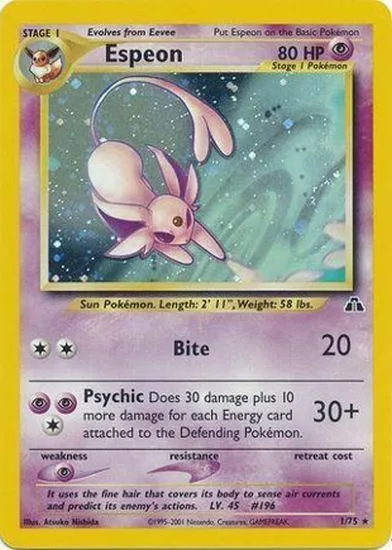
Espeon 1/75 (Neo Discovery, Rare Holo)
On the Espeon side, ungraded unlimited copies have been trading around $208. Mint graded examples have landed around $660, while Pristine copies have reached roughly $8,000. First Edition ungraded copies have been selling in the neighborhood of $356.
Those are healthy numbers for a vintage Pokémon holo and show that Espeon has plenty of collector support on its own. Still, once Umbreon enters the same conversation, the gap becomes obvious.
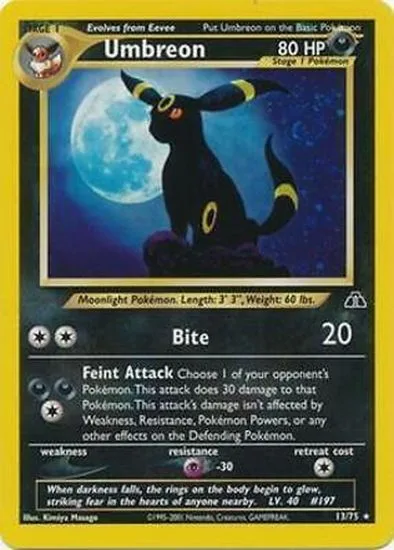
Umbreon 13/75 (Neo Discovery, Rare Holo)
Unlimited Umbreon has been selling near $400 ungraded, close to double Espeon’s raw level. In Mint condition, the spread widens sharply, with Umbreon around $2,100 compared with Espeon near $660. At the Pristine level, Umbreon has pushed to roughly $20,000, far above Espeon’s $8,000 range. First Edition ungraded copies have been around $1,273, more than triple the comparable Espeon figure.
There is no obvious structural reason for that kind of difference inside Neo Discovery. Same era, same set, same rarity, same broad availability. The market premium appears tied to character demand, and that advantage was already established early in the pair’s TCG history.
Gold Star cards narrow the raw gap but widen the graded gap
The 2007 POP Series 5 Gold Star cards offer another strong comparison point, although this one comes with a wrinkle. These cards were distributed through Organized Play instead of standard shelf product, giving them a very different release path from traditional pack-issued set cards. Even so, Espeon and Umbreon again arrived as a pair, making them ideal for comparison.
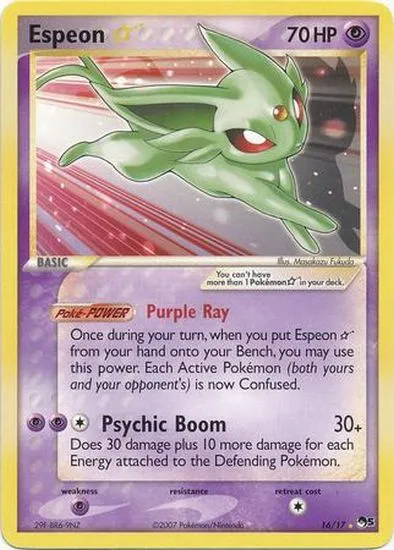
Espeon 16/17 (POP Series 5, Gold Star)
Espeon Gold Star has posted ungraded sales around $5,551. Mint graded copies have been tracking near $15,351. Pristine copies are far scarcer in the market, surfacing only occasionally, with recent sales landing between roughly $56,000 and $78,000.
Those are massive numbers that reinforce how strong demand is for Gold Star-era Eeveelutions in any grade. For many collectors, Espeon at this level is already a grail card.
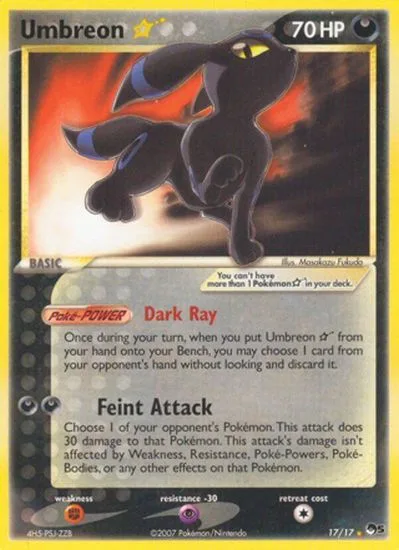
Umbreon 17/17 (POP Series 5, Gold Star)
Umbreon Gold Star can look deceptively cheaper at the raw level if a buyer relies on broad price trackers alone. That is because the card was reprinted in the 2021 Celebrations Classic Collection, and those reprints have traded near $110. In some databases, those reprint sales bleed into the original card’s market picture and drag down the headline average.
When isolating original 2007 copies, raw sales for Umbreon appear to land in roughly the same $5,500 range as Espeon. That means the discount many buyers think they see is not really there in practical terms. Once grading enters the picture, Umbreon pulls away again. Mint graded copies have been around $23,350, comfortably above Espeon’s roughly $15,351. Pristine results this year have ranged from about $105,000 to $216,000, while Espeon has sat in a range closer to $56,000 through $78,000.
This is an important pattern for collectors watching 30th Celebration. In raw form, Espeon can sometimes stay closer to Umbreon than expected. But at the high end, where condition-sensitive buyers and elite collectors compete, Umbreon has shown the stronger premium.
Prismatic Evolutions made the modern market preference even clearer
If vintage data leaves any room for debate, the modern market offers a much sharper answer. Prismatic Evolutions gave both Pokémon Special Illustration Rare cards in the same set and at the same rarity level. That makes it one of the best recent tests of direct demand under modern printing conditions.
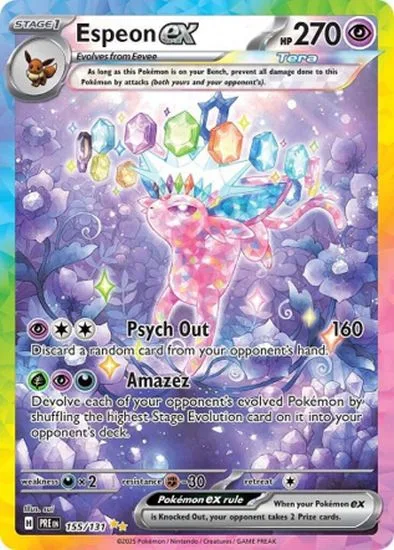
Espeon ex 155/131 (Prismatic Evolutions, Special Illustration Rare)
Espeon ex has settled around $290 ungraded, with Pristine copies near $1,100 more than a year and a half after release. That is a solid result in an era of large print runs and intense attention on alternate-art style cards.
It also establishes a useful baseline for what a popular modern Espeon can do when collectors have time to digest supply.
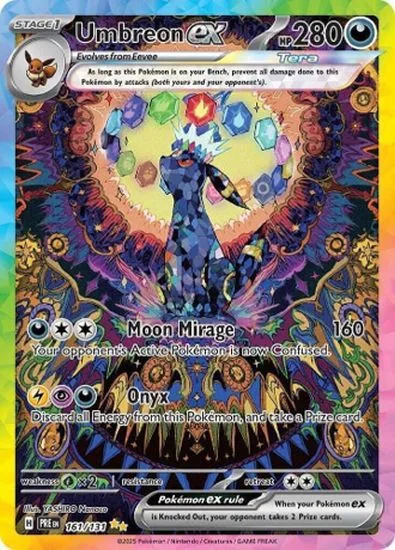
Umbreon ex 161/131 (Prismatic Evolutions, Special Illustration Rare)
Umbreon ex has been the bigger story. Raw copies have traded near $1,400, while Pristine examples have been around $5,780. That is close to five times Espeon at both the ungraded and top-condition ends, despite the two cards coming from the same release environment.
For collectors trying to project demand ahead of 30th Celebration, this may be the most relevant comparison of all. Modern buyers already showed what they were willing to pay when given a direct Espeon versus Umbreon choice under equal conditions, and Umbreon won decisively.
What fixed-product promos mean for 30th Celebration values
The upcoming 30th Celebration promos are not exact equivalents to Neo Discovery holos, POP Series 5 Gold Stars, or Prismatic Evolutions SIRs. Their biggest difference is access. These new cards will be tied to fixed sealed products rather than randomized chase mechanics. That usually places a cap on short-term price explosions, especially when buyers know exactly where to get the card.
Collectors should be careful about treating those promos like instant flip opportunities. Guaranteed inclusion and transparent product pricing often limit how fast a promo can climb, at least while sealed inventory remains easy to find. The Japanese Premium Deck Set and the English Battle Deck and Ultra Premium Collection formats both point in that direction.
Still, predictable supply is not the same thing as equal demand. If one product becomes the clear favorite with collectors, sealed demand can rise, singles can separate, and high-grade copies can still command a serious premium. That is particularly true for Pokémon with established hobby followings.
What the long-term data says about Espeon vs. Umbreon
Across the three clearest comparison points in the source data, Umbreon consistently outperformed Espeon when both cards were issued side by side:
- In Neo Discovery, Umbreon commanded roughly double or more in several key conditions.
- In POP Series 5 Gold Star, original raw prices were similar, but Umbreon held a major advantage in Mint and Pristine grades.
- In Prismatic Evolutions, Umbreon widened the gap dramatically in both raw and Pristine form.
The pattern is not limited to one era of the hobby. It shows up in vintage, trophy-adjacent Organized Play material, and modern high-demand releases. That breadth makes it harder to dismiss as a one-off cycle or a temporary social-media spike.
Espeon remains one of the strongest Eeveelution names in the Pokémon TCG market, and its cards have reached impressive price levels on their own merits. But when collectors are given a direct either-or choice between the two, Umbreon has historically attracted the heavier spending.
Collector angle heading into release day
For anyone buying into 30th Celebration, the answer may depend on collecting goals more than speculation. Espeon could appeal to buyers looking for the more affordable premium promo tied to the set’s day-and-night concept. Umbreon, based on past market behavior, looks more likely to draw the strongest demand if the two promos begin to separate on the singles market.
Collectors chasing sealed product may also want to watch whether the English split between Battle Decks and Ultra Premium Collections changes the buying pattern. When the same theme is spread across multiple product types, preferences can show up through both singles pricing and sealed box demand. If history holds, Umbreon’s side of the line should have the stronger pricing support, especially once grading and long-term collector demand enter the picture.
With Pokémon TCG 30th Celebration approaching, the historical market record points in one direction: Espeon has lasting appeal, but Umbreon has been the tougher card to catch, the more expensive card to grade at the top, and the more reliable premium performer whenever the two share the same stage.
Photo Gallery