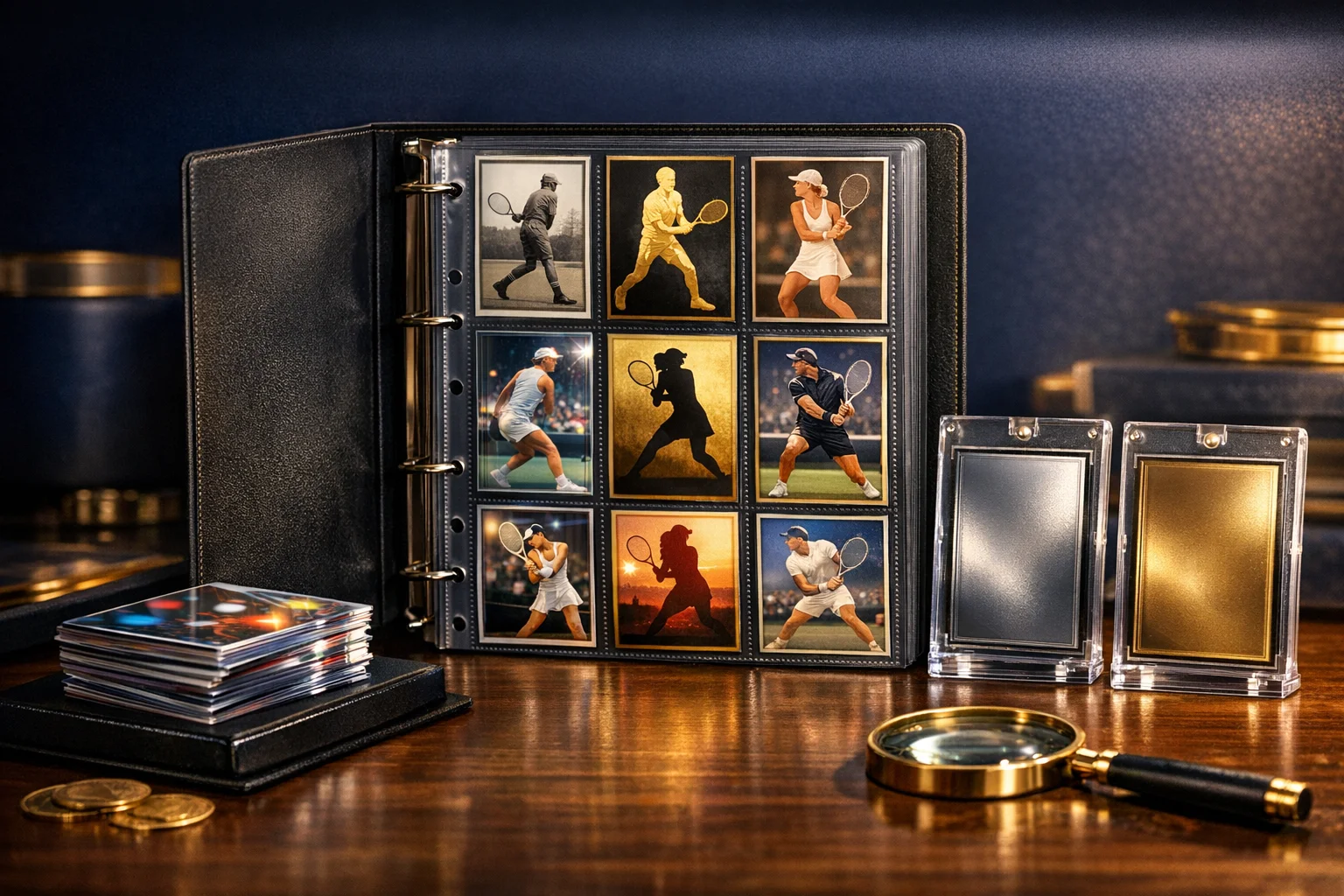
Tennis cards appeal to many collectors for the same reasons tennis itself does: the sport is global, star-driven, and full of moment-based storytelling. The challenge is that modern tennis cards do not present one simple flagship path. The documented 2026 landscape points instead to a mix of event-based singles, multi-sport checklist appearances, and autograph-centered products.
That makes focus more important here than in many larger team-sport categories. If you try to buy every notable player, every brand, and every format, you can spend a surprising amount without ever building something that feels intentional. A stronger approach is to define your lane first, then let that choice narrow your players, card types, and budget.
The most practical framework is simple: choose one collecting lane, one player archetype, and one spending ceiling. Whether your budget is closer to $100 or well into four figures, that structure gives your collection shape and keeps you from drifting into unrelated purchases.
Why focus matters so much in tennis cards
A focused tennis collection starts with one basic reality: the market is spread across different release models. You can find modern event cards sold individually, tennis names included in multi-sport products, and autograph-heavy tennis releases that cater to a very different buyer. That variety is not a problem by itself. In fact, it creates opportunities. The problem begins when you treat every option as part of the same project.
If you mix lanes too early, your collection can become a pile of disconnected decisions. Imagine spending one week on a current star’s low-cost event card, the next week on a cross-era checklist single from a multi-sport set, and then stretching your budget for one premium autograph from an entirely different product style. Each card might be attractive on its own, but together they may not tell any clear story.
Focus fixes that. Instead of asking which tennis cards are good, ask what you want your tennis collection to be six months from now. Do you want a one-player run tied to recent results? A binder page that spans eras? A small but deliberate autograph group? Once you answer that, most cards become easier to judge. The question is no longer whether a card is appealing. The question is whether it belongs in the collection you chose.
- A fragmented category rewards planning more than impulse buying.
- Your first decision should be collection style, not blind brand loyalty.
- A strong card can still be the wrong card for your project.
Pick one collecting lane before you pick specific cards
The cleanest way to stay disciplined is to choose one lane from the start. The first lane is current-star collecting through event-driven singles. This suits collectors who enjoy following active players and buying cards tied to fresh moments rather than opening sealed product. Official direct pricing shows that the entry point can be modest for base singles, while autograph versions rise much faster.
The second lane is a mixed-era checklist approach built from selective singles. A multi-sport set family can still work very well for tennis if your goal is recognizable names rather than one modern player. This route is especially useful if you like building binder pages that pair current stars with all-time greats in a way that feels curated instead of repetitive.
The third lane is autograph-first collecting. Some collectors know that unsigned cards will never fully satisfy them. If that is you, forcing yourself through months of small base-card purchases often ends with frustration. A dedicated autograph route is narrower and more expensive, but it is at least honest about what you actually enjoy.
None of these lanes is automatically better. They simply lead to different kinds of collections. If you care most about current form and tournament moments, the event-single lane is logical. If you care more about names across generations, the checklist lane makes sense. If your excitement is tied almost entirely to signatures, save for the autograph lane instead of pretending cheaper cards will scratch the same itch.
- Current-star lane: modern moments bought one at a time.
- Mixed-era lane: selective singles from a documented checklist ecosystem.
- Autograph-first lane: fewer cards, higher stakes, clearer priorities.
Choose a player archetype, not an endless star list
Many tennis collections lose their shape because the player target is too broad. “All the stars” sounds reasonable until you realize that it combines active contenders, retired legends, early-card targets, and premium autograph names that live at very different price levels. That is how a collector ends up with constant decision fatigue and no clear finish line.
A better move is to pick one player archetype for your first year. One option is the current-elite lane. A rankings snapshot can help here, as long as you treat it as a dated filter rather than a permanent truth. If you are drawn to top-of-the-sport relevance, start with a very short list and keep it short. One active player is ideal. Three is still manageable. Ten is how focus disappears.
Another option is the early-recognized-card lane. Within a documented checklist ecosystem, a rookie notation can help you build a compact project around a few specific targets instead of chasing every later issue. Here, accuracy matters. Coco Gauff is marked Rookie on the 2021 Goodwin Champions checklist page. That makes her a useful example of how a collector might identify an early card inside that set family. Naomi Osaka appears on that checklist page as well, but not as a Rookie example supported in the same way, so the safer collecting use is simply to treat her as part of the player pool in that product family rather than make a rookie-based claim.
The third option is the legend or established-name lane. If your collecting enjoyment comes from career stature more than current ranking swings, focusing on players such as Serena Williams, Martina Hingis, Stan Smith, or Chris Evert can make the hobby feel calmer. You are less likely to overreact to a bad tournament result or a short-term dip in attention.
A practical rule is to limit yourself to one archetype and no more than three players at the start. For example, you might choose one current ATP player and one current WTA player, or just one mixed-era binder theme built around a handful of names. Narrowing the list early makes every later choice easier.
- Use rankings as a snapshot, not a timeless ranking of importance.
- Use rookie labels only where they are clearly supported in the documented checklist context.
- If you prefer stability, established names are easier to collect without constant recalibration.
How to use event-based singles without turning them into clutter
Event-based singles can be one of the simplest entry points in tennis cards because they let you buy exactly what you want instead of paying for product you hope contains it. Official pricing for 2026 Panini Instant Tennis shows a low base-card entry point, alongside autograph parallels that jump sharply in cost. That structure is useful because it exposes the real spending ladder immediately.
The best way to use this lane is to create a rule before you buy. For instance, imagine you decide to collect one active player and only buy cards tied to tournament wins. That keeps the project clean. Or maybe you decide to collect only ranking milestones, only Grand Slam-related moments, or only cards from a single season. The rule can be personal, but it should be specific enough that you can say no to most releases.
Without a rule, event-driven cards can start to feel repetitive. A stack of similar-looking singles may grow quickly while the collection itself stays conceptually thin. With a rule, each card earns its place. Six cards documenting meaningful results can feel more satisfying than twenty cards purchased just because they existed at release time.
This lane is also a strong test case for discipline. A collector might begin with base singles because they are accessible, then feel tempted by an autograph version priced in an entirely different budget tier. That is not automatically a mistake, but it should happen only after the base project proves it still matters to you. If, after a few months, you still enjoy the story you are building, then one higher-end anchor card may make sense. If not, you saved yourself an expensive detour.
- Set a rule such as tournament wins, rankings milestones, or one season only.
- Build the lower-cost run first before considering one premium anchor.
- Avoid buying every release just because it features your player.
How to build a strong mixed-era tennis binder
A mixed-era binder route is one of the most enjoyable ways to collect tennis if you value names, history, and visual contrast more than strict player-run depth. Official yearly checklist pages support tennis appearances across multiple years in the Goodwin Champions family, which gives you a repeatable way to identify cards without guessing from memory or hobby folklore.
This route works best when you make the theme clear. The theme could be cross-era women’s tennis, one player per era, one page of major champions, or a blend of current relevance and historical stature. What matters is that you present it as a collecting choice, not as a rigid factual category. For example, pairing Chris Evert or Martina Hingis with Coco Gauff or Naomi Osaka creates a compelling mixed-era binder page because it contrasts generations, not because every player belongs to the same legacy-only bucket.
That distinction matters for clarity. If you describe the project to yourself as a mixed-era tennis binder, your choices stay flexible and accurate. You can include retired legends, active stars, and players whose importance to you is personal rather than strictly historical. You are building a curated page, not drafting an official hall of fame.
This binder strategy is especially useful for collectors who want the pleasure of variety without losing coherence. A page built around six carefully chosen names can feel finished in a way that a random stack never does. It also gives you a natural stopping point. You can complete one page, then decide whether you want a second page or whether the project already says what you wanted it to say.
- Good theme options: one player per era, one page of women’s tennis, or a mixed champions page.
- Describe it as a mixed-era or cross-era project, not a strict legacy-only category.
- Use the yearly checklist family to confirm player appearances before you buy.
If you are autograph-first, admit it early
Some collectors are happiest only when a collection includes signatures. If that describes you, be honest about it from the beginning. Buying piles of base cards while secretly wishing they were autographs is one of the easiest ways to waste a budget. It feels active in the short term, but it often leads to regret once the spending total becomes real.
An autograph-first tennis collector should think in terms of patience. A dedicated tennis autograph product or a carefully chosen single may do more for your enjoyment than months of unrelated small purchases. That patience is especially important when the available autograph paths are narrower and more expensive than standard base-card routes.
There is also a structural difference to keep in mind. A documented player-specific commercial relationship is not the same thing as a sport-wide exclusive. Likewise, a product listing proves that a product exists, but it does not automatically prove broad rights beyond what is specifically described. As a collector, this matters because it helps you ask the right question: are you buying a card because the player appears in that product, because the maker has a documented relationship with that player, or because the card simply fits your goals? Those are separate ideas, and treating them separately reduces confusion.
In practical terms, an autograph-first plan may look like this: you skip two months of impulse buying, set the money aside, and wait for one signed card that actually fits your target player or target theme. The collection grows slower, but it grows in the direction you wanted all along.
- Autograph collectors usually benefit more from patience than constant activity.
- Player-specific deals, checklist appearances, and broad exclusivity are not interchangeable claims.
- A separate autograph fund keeps low-cost impulse buys from draining your real goal.
Match your budget to your lane, not to your fantasies
A realistic tennis-card budget should start with actual documented price points, then work backward into a plan. At roughly $100, the clearest supported use case is a small run of base event singles bought one at a time. That is enough to create a real project if you keep it narrow. It is not enough to sample every part of the category and still stay focused.
The next range is where many collectors fool themselves. Around $400 to $500 sounds substantial, but official pricing shows that it can disappear into a single numbered autograph. In other words, this is not a comfortable “do a little of everything” budget. It is closer to a one-anchor-card budget, perhaps with a few lower-cost supporting cards if you stay disciplined.
Once you push above that, the need for precision gets even stronger. A four-figure purchase makes sense only if you already know the exact player, card type, and role that card will play in your collection. If you do not have those answers, high-end spending can create a card-shaped problem rather than a collection centerpiece.
One practical method is to divide every budget into three buckets: core cards, stretch cards, and friction. Core cards are the ones the collection truly depends on. Stretch cards are optional upgrades. Friction includes shipping, tax, grading, and any other cost that makes a neat plan more expensive in real life. For a hypothetical buyer, that might mean putting $80 of a $120 budget toward core singles, $20 aside for a possible upgrade, and reserving the rest for costs that do not show up in the headline card price.
That kind of budgeting sounds less glamorous than chasing a big hit, but it usually leads to better collections. You finish more of what you start, and you are less likely to resent the cards you bought along the way.
- About $100 works best for a disciplined run of low-cost singles.
- About $400 to $500 often functions as one premium anchor-card budget.
- Higher-end spending should come only after you define the exact role of the card.
Three starter blueprints that keep your collection coherent
If you want a practical starting point, begin with one of three blueprints. The first is a modern one-player run. Pick one active star and use event-based singles as the backbone. A hypothetical example: you decide to collect only milestone cards for one current player over one season. That gives you a clear finish line, a manageable entry price, and a collection you can explain in one sentence.
The second blueprint is a focused women’s-tennis project with one current player and one early recognized card target inside a documented checklist ecosystem where appropriate. A collector drawn to Coco Gauff, for example, could combine present-day interest with the known rookie notation on the 2021 Goodwin Champions checklist page, then stop after assembling a small, defined group instead of spiraling into every later appearance. The strength of this route is that it blends current relevance with discipline.
The third blueprint is a cross-era tennis binder. This is not a claim that every included player belongs to one legacy-only category. It is simply a thematic choice to build a page that mixes generations. You might choose retired greats such as Chris Evert or Martina Hingis alongside more recent stars such as Naomi Osaka or Coco Gauff. The appeal is visual and historical contrast. The goal is a page that feels thoughtfully built, not exhaustive.
All three blueprints work for the same reason: they are narrow enough to complete in stages. Completion matters. When a collection reaches a satisfying milestone, it becomes easier to enjoy and easier to maintain. Endless expansion feels exciting at first, but it often produces fatigue faster than satisfaction.
- Blueprint 1: one active star, one season or one type of milestone.
- Blueprint 2: one women’s star focus built around a short, defined target list.
- Blueprint 3: one cross-era binder page that deliberately mixes generations.
Questions to ask before any tennis-card purchase
Before you buy, run through a short checklist. First, what kind of card is this? An event-driven single behaves differently in a collection than a multi-sport checklist appearance or an autograph from a dedicated release. Knowing the card’s product context will often tell you whether it fits your lane immediately.
Second, what is actually documented about the player’s relationship to the card maker or product? A player-specific multi-year deal means something different from a simple set appearance. A checklist appearance means something different from an exclusive rights claim. If you separate those ideas, you will make fewer assumptions and better decisions.
Third, does the card fit the collection you already defined? A beautiful mixed-era binder single may still be the wrong buy for a one-player current-star run. A low-cost base card may still be the wrong buy for a collector who only values signatures. A premium autograph may still be the wrong buy if it destroys the rest of your yearly budget.
Finally, can you describe your collecting goal in one sentence? If not, the right move is usually to pause. Clarity is not flashy, but it is one of the biggest advantages you can give yourself in a category this varied.
- What product style is this card from?
- What is actually documented: player deal, product appearance, or both?
- Does this purchase fit the lane and budget you already chose?
- Can you explain your collection goal in one sentence?
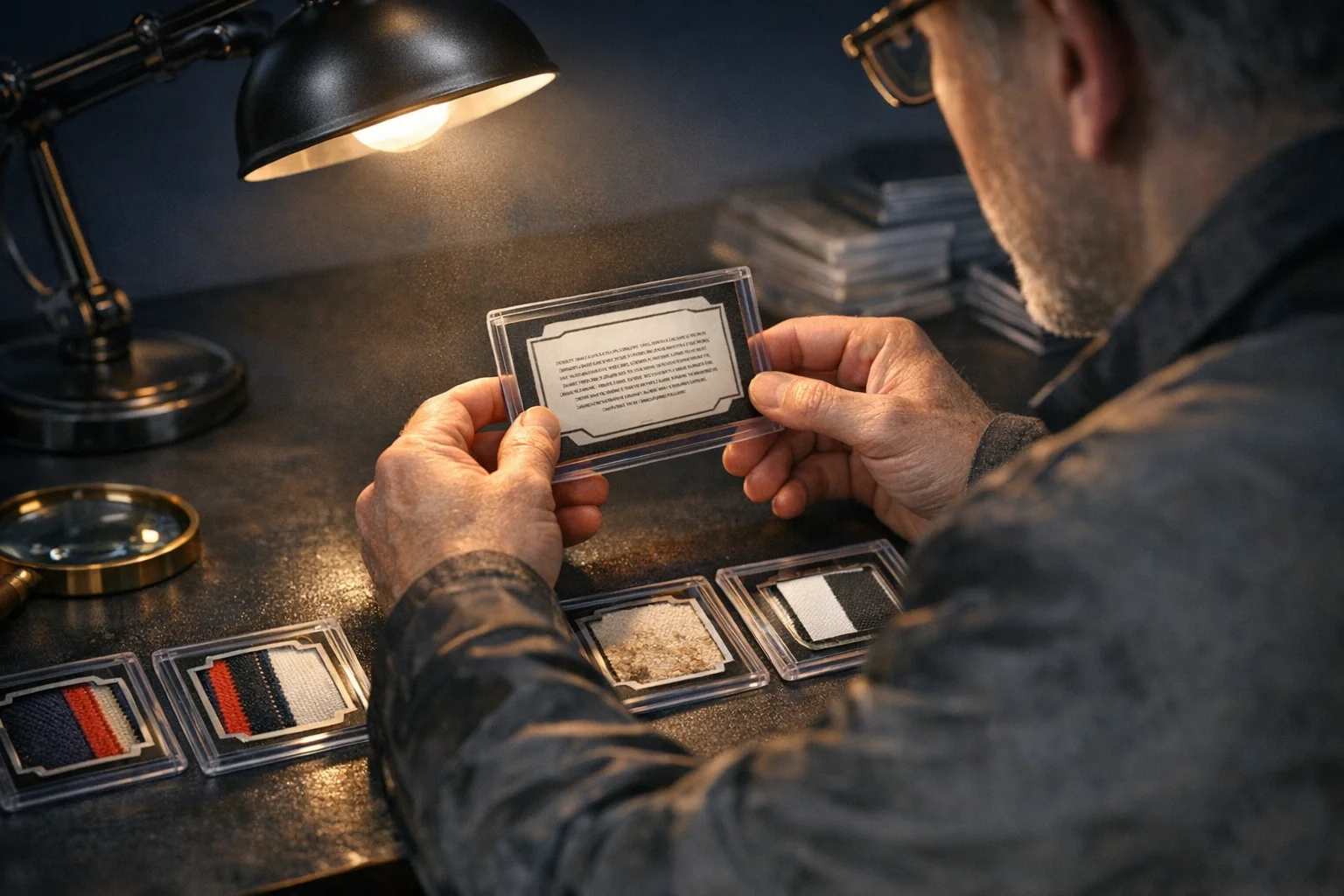
Illustration generated for this guide; not a photograph of an actual card, product or event.
Photo Gallery