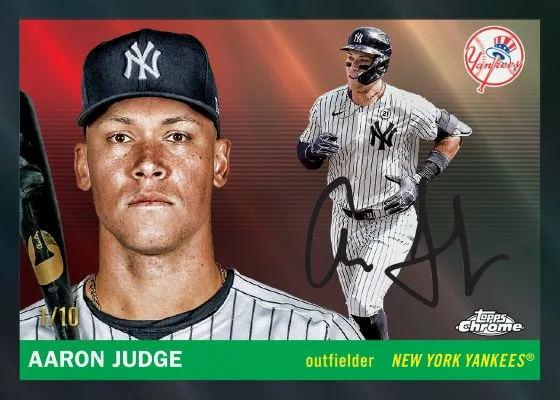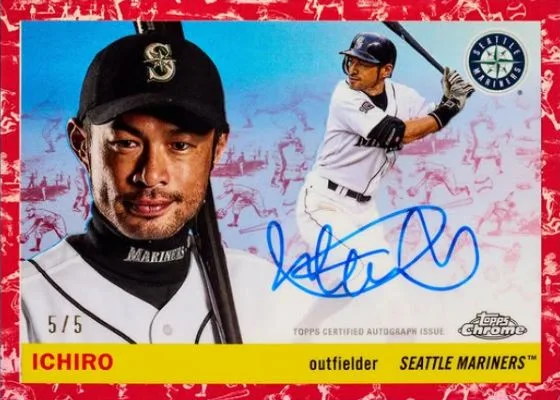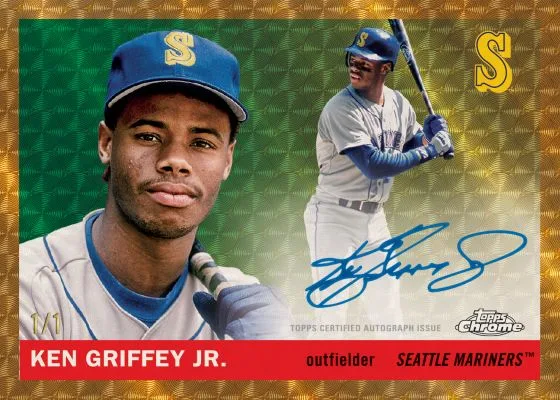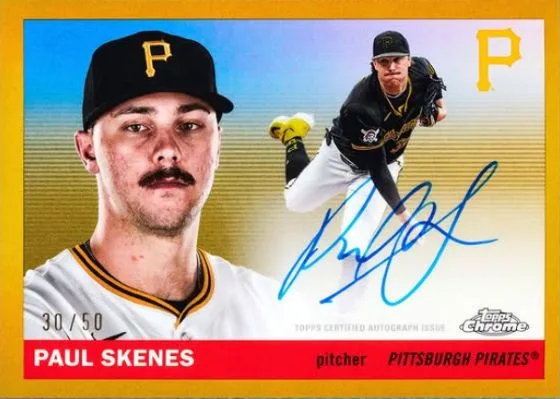
2025 Topps Chrome Platinum Anniversary Baseball returns after a one-year pause, and this time the concept lines up perfectly with the design it is celebrating. The release revives the 1955 Topps flagship look in chromium form, giving collectors a modern finish paired with one of the hobby’s most recognizable vintage layouts.
The timing matters here. Topps Chrome Platinum launched in 2021 with the 1952 design, then continued with 1953 and 1954 styles in the next two editions. By skipping a year, the brand now lands directly on the 70th anniversary of 1955 Topps, which gives this release a cleaner historical connection than the earlier installments.
For collectors who enjoy a mix of stars, rookies, Hall of Famers, and creative variations, this set has a lot working in its favor. Hobby boxes promise one autograph, the base set once again stretches to 500 cards, and the checklist leans heavily into both nostalgic themes and modern chase elements.
2025 Topps Chrome Platinum Anniversary Baseball at a glance
- Release date: June 5, 2026
- Set size: 500 cards
- Hobby packs per box: 20
- Cards per hobby pack: 4
- Value packs per box: 8
- Cards per value pack: 4
- Hobby box hit: 1 autograph
- Value box highlight: Prism Parallels
- Hobby cases: 12 boxes
The format stays familiar. Hobby remains the place to chase guaranteed ink, while value boxes are geared more toward parallel hunters. That split should make the product accessible to both breaker-driven buyers and collectors who prefer ripping at a lower entry point.
What stands out in the 2025 release
The biggest draw is the 1955 horizontal design. Unlike many retro-inspired products that simply borrow the border or color palette, Chrome Platinum tends to lean fully into the original layout. The result is a card style that feels distinct from flagship Chrome and works especially well for veterans and legends.
The 500-card base set mixes active stars, emerging rookies, retired greats, and deep-cut historical names. Mike Trout opens the checklist at card No. 1, while Buster Posey lands at No. 500. In between are major current names such as Shohei Ohtani, Aaron Judge, Bobby Witt Jr., Ronald Acuña Jr., Juan Soto, Elly De La Cruz, Gunnar Henderson, Paul Skenes, Jackson Chourio, and Yoshinobu Yamamoto.
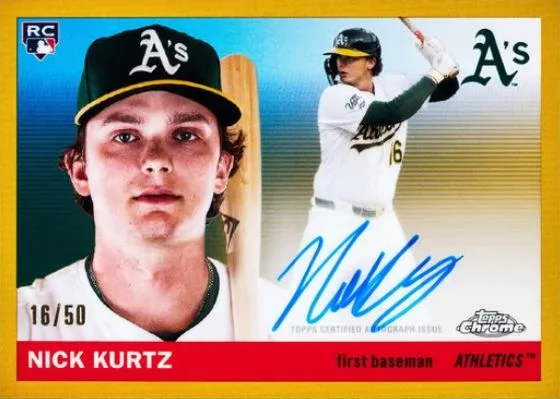
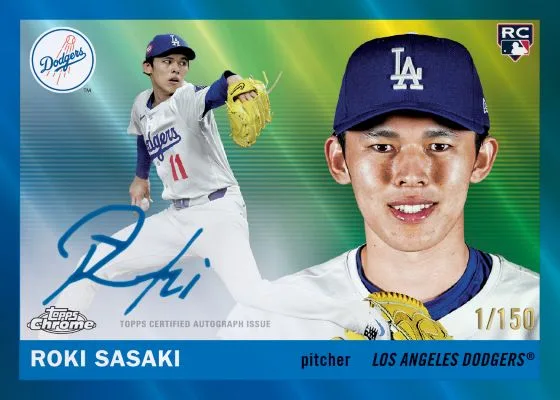
Rookies are also a central part of the release, with names like Roki Sasaki, Dylan Crews, James Wood, Jackson Jobe, Coby Mayo, Dalton Rushing, Marcelo Mayer, Matt Shaw, Kristian Campbell, Brooks Lee, Nick Kurtz, Jacob Wilson, and Hyeseong Kim appearing in the base set or variation mix.
Parallels and refractor chase
Topps has indicated that the product will again feature a broad menu of colored and patterned Refractor parallels. One specifically confirmed example is the Black Refractor, numbered to 10. As with past Chrome Platinum releases, collectors should expect a rainbow approach that gives set builders and player collectors plenty of targets.
Autograph parallels are a major part of that chase. Flagship-style signed cards are expected in Blue Refractors numbered to 150, Gold Refractors numbered to 50, Platinum Toile Cream/Red Refractors numbered to 5, plus Superfractors at 1-of-1. The Platinum Toile pattern remains one of the product’s signature finishes and helps separate Chrome Platinum from standard Topps Chrome releases.
Autographs: two main lanes for collectors
Autographs are one of the clearest selling points in this set. Every hobby box includes one signed card, and Topps is building that autograph lineup around two distinct themes.
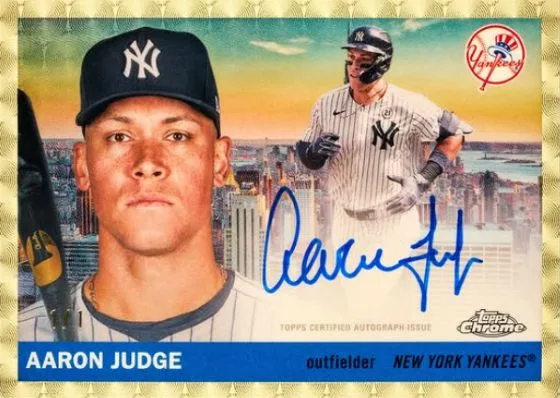
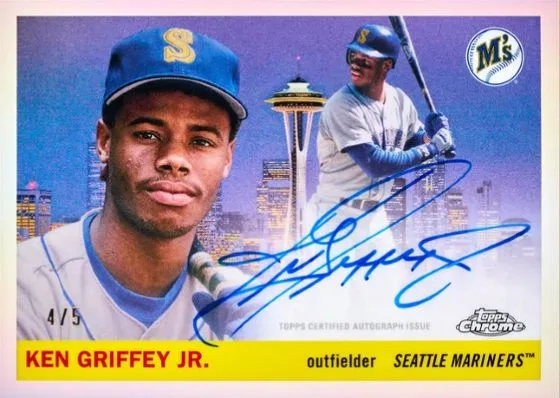
The first is the main Chrome Platinum Autographs set. It includes 178 signers and mixes active stars, rookies, and retired names. Among the notable names are Aaron Judge, Derek Jeter, Ichiro, Ken Griffey Jr., Bobby Witt Jr., Mike Trout, Ronald Acuña Jr., Jackson Holliday, Gunnar Henderson, Juan Soto, Paul Skenes, Roki Sasaki, Yoshinobu Yamamoto, Clayton Kershaw, Nolan Ryan, George Brett, Frank Thomas, and Mike Schmidt.
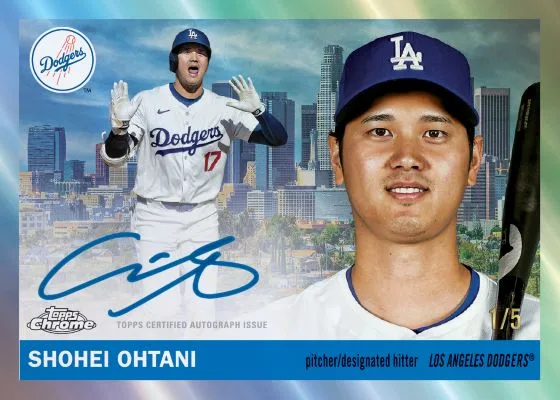
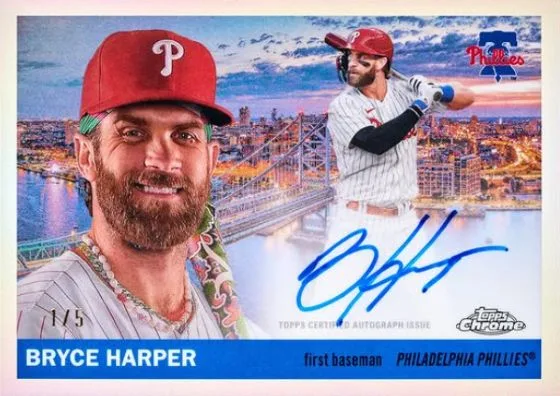
The second autograph lane expands on one of the strongest ideas from the 2023 edition: City Variations. Those skyline-backed cards now have signed versions, creating a 92-card autograph subset that should be one of the most visually appealing chases in the product. The horizontal 1955 layout gives those city backgrounds more room to breathe, which makes this concept work better here than it would on a vertical design.
Notable City Variations Autographs include Aaron Judge, Derek Jeter, Shohei Ohtani, Clayton Kershaw, Roki Sasaki, Yoshinobu Yamamoto, Ken Griffey Jr., Ichiro, Julio Rodríguez, Juan Soto, Francisco Lindor, Mike Trout, Bobby Witt Jr., George Brett, Cal Ripken Jr., Gunnar Henderson, Chipper Jones, David Ortiz, Bryce Harper, Mike Schmidt, Paul Skenes, Fernando Tatis Jr., and Vladimir Guerrero Jr.
City Variations and image variations
There are two primary short-print style variation groups in the product.
The first is a 40-card image variation lineup. This checklist focuses on premium names and hot rookies, including Mike Trout, Elly De La Cruz, Shohei Ohtani, Aaron Judge, Bryce Harper, Gunnar Henderson, Corey Seager, Paul Skenes, Roki Sasaki, Dylan Crews, Marcelo Mayer, Kristian Campbell, James Wood, Ken Griffey Jr., Babe Ruth, and Willie Mays.
The second is a much larger 80-card City Variations set. This group blends current stars with franchise legends, creating a strong team-collector angle. Some of the highlights include Mike Trout and Rod Carew for the Angels, Cal Ripken Jr. and Gunnar Henderson for the Orioles, David Ortiz and Carl Yastrzemski for Boston, Elly De La Cruz and Johnny Bench for Cincinnati, Shohei Ohtani and Mookie Betts for the Dodgers, Aaron Judge and Derek Jeter for the Yankees, Juan Soto and Francisco Lindor for the Mets, Paul Skenes for the Pirates, Manny Machado and Fernando Tatis Jr. for the Padres, Ichiro and Ken Griffey Jr. for Seattle, Albert Pujols and Nolan Arenado for St. Louis, and James Wood plus Dylan Crews for Washington.
Insert lineup built around 1955 themes
The insert program keeps the historical framing consistent throughout the release. Rather than drifting into unrelated modern concepts, Topps uses several 1955-era ideas as the backbone of the product.
1955 World Series
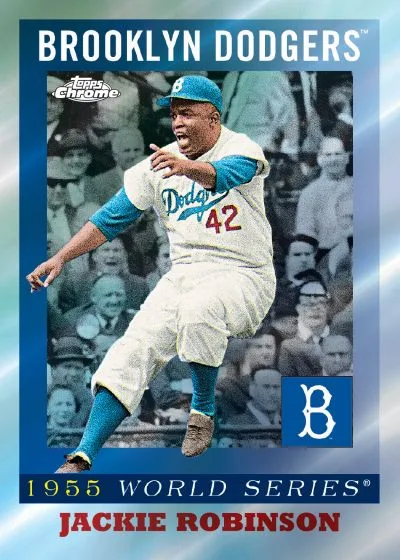
This 10-card insert revisits the 1955 Fall Classic between the Brooklyn Dodgers and New York Yankees. Brooklyn finally broke through in seven games, and the insert set reflects the key figures from both clubs. Dodgers cards include Roy Campanella, Pee Wee Reese, Jackie Robinson, Duke Snider, Gil Hodges, and Sandy Koufax. Yankees selections include Casey Stengel, Yogi Berra, Whitey Ford, and Mickey Mantle.
1955 Topps Rails and Sails
This 20-card insert borrows from the original non-sport concept and gives it a baseball treatment. The checklist features Juan Soto, Francisco Lindor, Albert Pujols, Roger Clemens, Alex Rodriguez, Rickey Henderson, Ken Griffey Jr., Iván Rodríguez, Giancarlo Stanton, Vladimir Guerrero, Manny Ramirez, Pedro Martinez, Randy Johnson, Nolan Ryan, Greg Maddux, Eddie Murray, Manny Machado, Shohei Ohtani, and Bryce Harper.
1955 Topps Doubleheaders
This 20-card insert pairs stars across eras and franchises. Some of the most interesting combinations include Sandy Koufax and Shohei Ohtani, Mickey Mantle and Aaron Judge, Jackie Robinson and Mookie Betts, Mike Schmidt and Bryce Harper, Mike Piazza and Francisco Lindor, Ken Griffey Jr. and Ichiro, Roki Sasaki and Yoshinobu Yamamoto, Bobby Witt Jr. and George Brett, Cal Ripken Jr. and Gunnar Henderson, Tony Gwynn and Fernando Tatis Jr., and Nolan Ryan with Mike Trout.
1955 Cards That Never Were
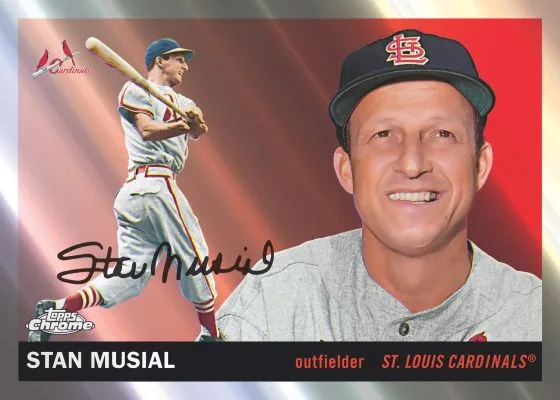
This 20-card insert imagines how major names from the era might have looked in the original 1955 Topps set. That includes Stan Musial, Whitey Ford, Bob Feller, Mickey Mantle, Roy Campanella, Pee Wee Reese, Richie Ashburn, Brooks Robinson, Larry Doby, Robin Roberts, Don Larsen, and Casey Stengel. For vintage-oriented collectors, this may be one of the most charming parts of the release.
Employee Super Short Prints
Topps also continues its employee SSP concept with 10 ultra-limited cards. Names in this group include Ariel Charnowitz, Hunter Stanley, Josh Ringler, Keith Andrews, Krystal Beisick, Keith Rothschild, Michelle Diller, Micah Layton, Nikki Rubin, and Pat O'Sullivan.
Key names in the base set
The full 500-card checklist is deep, but several sections of the base set should draw the most attention from collectors.
- Top current stars: Shohei Ohtani, Aaron Judge, Juan Soto, Bobby Witt Jr., Ronald Acuña Jr., Mookie Betts, Bryce Harper, Francisco Lindor, Julio Rodríguez, Vladimir Guerrero Jr., Fernando Tatis Jr., Manny Machado
- Breakout and young star names: Gunnar Henderson, Jackson Holliday, Jackson Merrill, Wyatt Langford, Junior Caminero, Pete Crow-Armstrong, Riley Greene, Jackson Chourio, Elly De La Cruz
- Rookie chase names: Roki Sasaki, Dylan Crews, James Wood, Jackson Jobe, Coby Mayo, Dalton Rushing, Marcelo Mayer, Matt Shaw, Kristian Campbell, Brooks Lee, Nick Kurtz, Jacob Wilson, Ben Rice, Cade Horton
- Legends and Hall of Famers: Hank Aaron, Cal Ripken Jr., Ichiro, Ted Williams, David Ortiz, Sandy Koufax, Ken Griffey Jr., Derek Jeter, Willie Mays, Jackie Robinson, Babe Ruth, Roberto Clemente, Nolan Ryan, Tony Gwynn, Albert Pujols
The base checklist also includes multiple historical franchise identities, such as Brooklyn Dodgers, Montréal Expos, California Angels, Oakland Athletics, Milwaukee Braves, Cleveland Indians, New York Giants, and Florida Marlins. That adds another layer of appeal for collectors who enjoy team history beyond the modern MLB structure.
Strong team and player collector angles
Several teams stand out as especially loaded within the product.
The Dodgers have one of the deepest checklists, with Shohei Ohtani, Yoshinobu Yamamoto, Mookie Betts, Freddie Freeman, Clayton Kershaw, Roki Sasaki, Hideo Nomo, Chan Ho Park, Dalton Rushing, and Brooklyn Dodgers legends including Sandy Koufax, Jackie Robinson, and Duke Snider. Their image variations, city variations, autograph lineup, and 1955 World Series presence make them one of the release’s biggest focal points.
The Yankees are similarly stacked. Aaron Judge, Derek Jeter, Babe Ruth, Lou Gehrig, Yogi Berra, Thurman Munson, Paul Goldschmidt, Jasson Domínguez, Ben Rice, and several high-end autograph subjects give New York collectors a lot to chase. The team also appears prominently in Doubleheaders, Rails and Sails, World Series inserts, and Cards That Never Were.
Seattle is another major draw because of the franchise’s blend of modern and historical star power. Julio Rodríguez, Ichiro, Ken Griffey Jr., Edgar Martinez, Félix Hernández, Cal Raleigh, and Alex Rodriguez all appear, with city variations and autograph content making the Mariners one of the most attractive team builds in the set.
Collectors focused on newer talent will likely gravitate toward Baltimore, Washington, Boston, Pittsburgh, and Los Angeles. Baltimore brings Gunnar Henderson, Jackson Holliday, Adley Rutschman, and Coby Mayo. Washington has Dylan Crews and James Wood. Boston includes Marcelo Mayer and Kristian Campbell alongside Ted Williams and David Ortiz. Pittsburgh features Paul Skenes as one of the biggest modern chase cards in the entire release.
Checklist notes collectors should know
The base set contains 500 cards, but the numbering is not presented in strict sequence in the published checklist. Hideki Matsui appears as card No. 228 and Hyeseong Kim appears as card No. 360, yet both are positioned out of order in the printed list. That is a formatting quirk in the checklist, not a separate parallel or unannounced subset.
Topps has also not announced print runs for non-serial-numbered cards. That means collectors can identify the numbered parallels and autograph tiers clearly, but some unnumbered short prints and base print quantities remain unknown at launch.
Most notable checklist groups
- Base set: 500 cards
- Image variations: 40 cards
- City variations: 80 cards
- Chrome Platinum Autographs: 178 cards
- 1955 Topps City Variations Autographs: 92 cards
- 1955 World Series inserts: 10 cards
- 1955 Topps Rails and Sails inserts: 20 cards
- 1955 Topps Doubleheaders inserts: 20 cards
- 1955 Cards That Never Were inserts: 20 cards
- 1955 Topps Employee Super Short Prints: 10 cards
Collector takeaway
2025 Topps Chrome Platinum Anniversary Baseball looks like one of the stronger retro-chrome releases Topps has put together in recent years. The 1955 design is a natural fit for the brand, the autograph structure gives hobby buyers a clear reason to rip boxes, and the checklist balances modern stars with vintage icons in a way that should appeal to several different corners of the market.
For player collectors, the chase is broad. For team collectors, the city variations create an extra layer of interest. For vintage fans, inserts like 1955 World Series and Cards That Never Were give the product a deeper identity than a standard chromium reprint concept. With a June 5, 2026 release date and one autograph per hobby box, this is positioned as a major baseball card release for collectors who want both nostalgia and variety in the same rip.
Photo Gallery